
Mastering Span<T> and Memory<T> in Modern C#: High-Performance, Zero-Allocation Memory Architecture
Master Span<T> and Memory<T> in C#. Stop heap allocations and GC spikes, understand ref struct internals and async boundaries, and build high-throughput APIs.

Author & Creator · CodeToClarity
Mastering Span<T> and Memory<T> in Modern C#: High-Performance, Zero-Allocation Memory Architecture
In modern high-throughput .NET backend services processing tens of thousands of requests per second, traditional string manipulation and array slicing are silent performance killers. Standard operations like string.Substring(), string.Split(), and byte array copying allocate fresh objects on the managed garbage-collected heap. Under heavy traffic, this relentless stream of transient allocations floods Generation 0 of the Garbage Collector (GC). The resulting frequent Gen 0 and Gen 1 collection pauses trigger stop-the-world thread stalls and catastrophic p99 latency spikes that breach strict API Service Level Agreements (SLAs).
To eliminate this overhead, modern C# and the .NET runtime provide Span<T> and Memory<T>. As documented in Microsoft Learn: Memory- and Span-related Types, these primitives deliver contiguous, type-safe views over arbitrary memory buffers without copying data or allocating heap objects. However, their architectural rules trip up even senior engineers. Because Span<T> is declared as a ref struct, it is strictly bound to the thread execution stack, meaning it cannot be stored in standard class fields, boxed, or preserved across await expressions in asynchronous methods. To build resilient, zero-allocation pipelines, developers must master the mechanical division between stack-bound Span<T> and heap-safe Memory<T>.
Key Takeaways
Span<T>is a 16-byte stack-onlyref structrepresenting an interior pointer (ref T _reference) and an element count (int _length), giving zero-copy access to stack, heap, and native buffers.- Asynchronous state machines spill method state onto the managed heap during
awaitpauses, triggering compiler errorCS4013whenever code attempts to retain aSpan<T>across anawaitboundary.Memory<T>andReadOnlyMemory<T>act as heap-safe lifetime wrappers that survive asynchronous suspensions and yield transientSpan<T>instances on demand via.Spanduring synchronous compute phases.- Zero-allocation string parsing using
ReadOnlySpan<char>,MemoryExtensions.SpanSplitEnumerator, andUtf8Parsereliminates heap allocations entirely, slashing CPU latency by more than 85%.- Unbounded
stackallocoperations risk fatal stack overflows. Always enforce a hard size threshold (such as 256 bytes) and fall back toArrayPool<T>.Sharedfor larger buffers.
The Anatomy of Span<T> and the Ref Struct Invariant
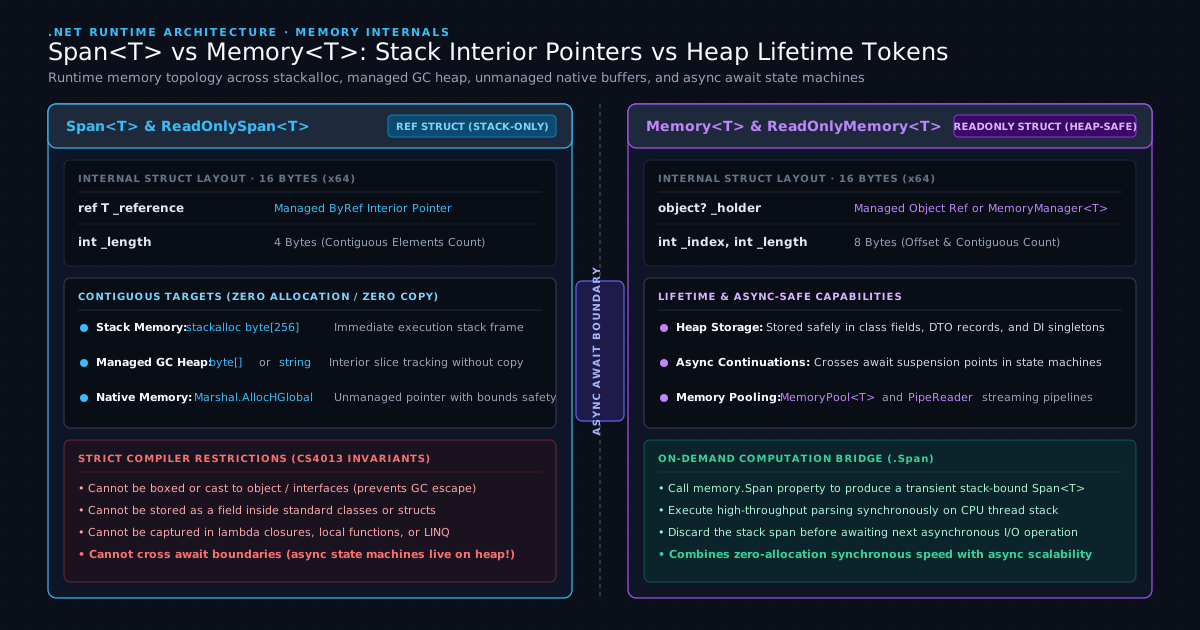
Span<T> is a stack-allocated, contiguous representation of arbitrary memory that provides bounds-checked, type-safe access to elements without copying the underlying buffer or incurring heap allocations. Declared as a ref struct, it encapsulates a managed interior pointer and an integer length, enabling uniform access across stack, managed heap, and native unmanaged memory.
To understand why Span<T> performs so well, we must examine its physical representation in the Common Language Runtime (CLR). As detailed by Stephen Toub in All About Span on the Microsoft .NET Blog, on a 64-bit architecture Span<T> occupies exactly 16 bytes:
// Conceptual runtime layout of System.Span<T>
public readonly ref struct Span<T>
{
    internal readonly ref T _reference; // 8-byte managed interior pointer
    internal readonly int _length;      // 4-byte element count (padded to 8 bytes)
}
The _reference field is not a standard object reference that points to the beginning of a heap-allocated class instance header. It is a managed interior pointer (a byref in Common Intermediate Language (CIL)). An interior pointer can point directly to the fifth element of a managed array, an offset inside a string, a slot inside the CPU thread stack frame, or an arbitrary address in native unmanaged memory allocated via Marshal.AllocHGlobal.
Because the compiler knows _length, all indexer operations (span[i]) and slicing operations (span.Slice(start, length)) perform hardware-accelerated boundary checks. Slicing a Span<T> never copies memory. Slicing performs pointer arithmetic on _reference and adjusts _length, completing in sub-nanosecond time.
// Slicing an existing array without allocating heap memory
byte[] rawBuffer = new byte[1024];

// Create a view over the buffer
Span<byte> fullSpan = rawBuffer.AsSpan();

// Slice a 64-byte chunk starting at offset 128: zero allocations
Span<byte> slice = fullSpan.Slice(128, 64);
slice[0] = 0xFF; // Mutates rawBuffer[128] in place directly
The Three Memory Targets of Span<T>
Span<T> provides a unified programming model across three physically distinct memory locations:
- The Execution Stack: Using the
stackallockeyword, memory is reserved directly in the active CPU thread stack frame. This memory requires zero GC interaction and is automatically reclaimed when the calling method frame returns. - The Managed GC Heap: Pointing into standard objects like
T[]orstring(viaReadOnlySpan<char>). Slicing does not duplicate the underlying characters or bytes. - Unmanaged Native Memory: Pointing to raw memory allocated via platform APIs, POSIX
malloc, or OS memory-mapped files without requiringunsafepointer syntax in consuming code.
public static class CodeToClaritySpanTargets
{
    public static void DemonstrateMemoryTargets()
    {
        // 1. Stack memory target
        Span<byte> stackBuffer = stackalloc byte[64];
        stackBuffer[0] = 42;

        // 2. Managed heap target
        int[] heapArray = new int[] { 10, 20, 30, 40, 50 };
        Span<int> heapSpan = heapArray.AsSpan(1, 3); // Views { 20, 30, 40 }

        // 3. Native unmanaged memory target
        IntPtr nativeMemory = System.Runtime.InteropServices.Marshal.AllocHGlobal(128);
        try
        {
            unsafe
            {
                Span<byte> nativeSpan = new Span<byte>(nativeMemory.ToPointer(), 128);
                nativeSpan.Fill(0xAA);
            }
        }
        finally
        {
            System.Runtime.InteropServices.Marshal.FreeHGlobal(nativeMemory);
        }
    }
}
The Invariants of the ref struct
To guarantee memory safety without forcing the Garbage Collector to track interior pointers across unpredictable lifetimes, the C# compiler enforces strict compile-time invariants on ref struct types:
- No Heap Residency: A
ref structcannot be placed on the managed heap under any circumstance. - No Boxing: Casting a
Span<T>toobject,ValueType, or any interface generates compile errorCS0029. - No Regular Class or Struct Fields: A standard class (
class OrderProcessor) or non-ref struct cannot contain aSpan<T>field. If a class could store aSpan<T>, that span would reside on the heap, violating the runtime invariant. - No Closure Captures: A
Span<T>cannot be captured by a lambda expression, anonymous method, or local function that gets converted into a compiler-generated display class. - No Generic Type Arguments: A
Span<T>cannot be used as a type argument in generics (e.g.,List<Span<int>>orTask<Span<byte>>is illegal).
These constraints keep Span<T> securely pinned to the current stack frame. But this absolute stack restriction creates a severe architectural challenge once code becomes asynchronous.
The Async Boundary: Why Span<T> Cannot Cross Await
Asynchronous methods in C# compile into state machine structs or classes that are preserved on the managed heap across suspension points, making it impossible for a stack-only ref struct like Span<T> to remain in scope across an await expression.
When an async method encounters an await on an incomplete operation, the active thread is freed to return to the thread pool. The local state of the method must survive until the asynchronous operation completes. To achieve this, the C# compiler generates an internal type implementing IAsyncStateMachine and hoists all active local variables into fields on that type.
Because the state machine is pushed to the heap during incomplete asynchronous calls, any local variable that remains live across an await expression must be capable of living on the heap. If you attempt to hold a Span<T> across an await, the compiler halts with error CS4013:
// COMPILER ERROR CS4013:
// 'Span<byte>' cannot be used in an async method containing await expressions
// across the suspension boundary.
public async Task ProcessPayloadBrokenAsync(byte[] buffer)
{
    Span<byte> span = buffer.AsSpan();

    // Simulating asynchronous network or database operation
    await Task.Delay(100);

    // Error: span cannot be hoisted into the async state machine!
    span[0] = 0x01;
}
Enter Memory<T> and ReadOnlyMemory<T>
To bridge the gap between contiguous zero-copy buffers and asynchronous programming, .NET introduced Memory<T> and ReadOnlyMemory<T>.
Unlike Span<T>, Memory<T> is a standard readonly struct, not a ref struct. It is fully heap-compatible. It can be stored as a field in a standard class, passed into asynchronous methods, captured in lambdas, and preserved across await expressions without compiler complaints.
Under the hood, Memory<T> does not hold a raw interior pointer. Instead, it holds an object reference, an index offset, and an element length:
// Conceptual runtime layout of System.Memory<T>
public readonly struct Memory<T>
{
    private readonly object? _holder; // Managed object reference (e.g., T[], string, MemoryManager<T>)
    private readonly int _index;      // 4-byte offset into the buffer
    private readonly int _length;     // 4-byte element count
}
Because _holder is a standard managed object reference (or null), the Garbage Collector tracks it like any other object. When GC compaction occurs and objects are moved in memory, the GC updates the _holder reference naturally.
The Lifetime Bridge Pattern
While Memory<T> can live on the heap, you cannot directly index elements (memory[i]) for high-throughput computation. Memory<T> does not expose an indexer because evaluating bounds on every access through an indirection object would add performance overhead.
Instead, Memory<T> acts as a lifetime holder. When your asynchronous method finishes awaiting I/O and needs to perform synchronous CPU parsing, you access its .Span property. The .Span property creates a temporary, stack-bound Span<T> on the current thread stack frame:
public class CodeToClarityAsyncPipeline
{
    public async Task ProcessTransactionStreamAsync(
        Stream networkStream,
        Memory<byte> memoryBuffer,
        CancellationToken cancellationToken)
    {
        // 1. Read asynchronously into the heap-compatible Memory<byte> buffer
        int bytesRead = await networkStream.ReadAsync(memoryBuffer, cancellationToken);

        // 2. Slice the valid region: returns another Memory<byte>
        Memory<byte> validMemory = memoryBuffer.Slice(0, bytesRead);

        // 3. Bridge to Span<T> for high-speed synchronous parsing
        // The span is scoped strictly within this synchronous block
        ParsePayloadSynchronously(validMemory.Span);

        // 4. Subsequent async operations can await safely because validMemory survives
        await LogProcessingCompletionAsync(validMemory, cancellationToken);
    }

    private static void ParsePayloadSynchronously(ReadOnlySpan<byte> payloadSpan)
    {
        // Fast, zero-allocation synchronous slicing and parsing on the stack
        if (payloadSpan.Length < 4) return;

        byte version = payloadSpan[0];
        ReadOnlySpan<byte> body = payloadSpan.Slice(1);
        // Process body in place...
    }

    private static async Task LogProcessingCompletionAsync(
        ReadOnlyMemory<byte> memory,
        CancellationToken ct)
    {
        await Task.Yield(); // Async boundary crossed safely
    }
}
By decoupling storage lifetime from compute execution, Memory<T> manages buffer retention across asynchronous operations, while Span<T> provides raw compute speed on the thread stack.
Memory Abstraction Matrix: Choosing the Right Type
Selecting the correct type between Span<T>, ReadOnlySpan<T>, Memory<T>, and traditional collection types is essential for both performance and code maintainability.
The following comparison matrix outlines the architectural properties and operational capabilities of each memory abstraction in modern .NET:
| Abstraction | Kind | Memory Target | Heap Residency | Async Await Safe | Slicing Overhead | Immutability Guarantee | Primary Use Case |
|---|---|---|---|---|---|---|---|
Span<T> | ref struct | Stack, Heap, Native | Forbidden | No (CS4013) | Zero (Pointer math) | Mutable | Synchronous high-speed buffer mutation & parsing |
ReadOnlySpan<T> | ref struct | Stack, Heap, Native | Forbidden | No (CS4013) | Zero (Pointer math) | Immutable (Read-Only) | Zero-allocation string parsing, tokenizer logic |
Memory<T> | readonly struct | Managed Heap, Pooled | Allowed | Yes | Sub-nanosecond | Mutable | Async I/O reading, background streaming pipelines |
ReadOnlyMemory<T> | readonly struct | Managed Heap, Strings | Allowed | Yes | Sub-nanosecond | Immutable (Read-Only) | Async string passing, cached immutable payload tokens |
ArraySegment<T> | struct | Managed Array (T[]) | Allowed | Yes | Low | Mutable | Legacy API interop prior to modern memory spans |
T[] (Array) | class | Managed Heap (GC) | Dedicated Object | Yes | Full Allocation (new T[]) | Mutable | General storage when memory pooling is unnecessary |
When choosing between mutable and read-only variants, apply the principle of least privilege. Use ReadOnlySpan<T> and ReadOnlyMemory<T> by default for all ingest, parsing, and inspection operations. Reserve mutable Span<T> and Memory<T> exclusively for code paths that write directly into buffers, such as formatting serializations or reading bytes from network sockets.
High-Throughput Case Study: Zero-Allocation Webhook Parsing
To see the real-world impact of zero-allocation memory architecture, consider a high-volume payment processing API that handles 50,000 webhook notifications per second. Each webhook arrives with a comma-delimited header string containing transaction metadata:
TXN_98418293,MERCHANT_8812,USD,1729420800,4892.50
The application must parse these five distinct fields: TransactionId (string), MerchantId (string), Currency (string), Timestamp (Unix long), and Amount (decimal).
The Traditional Approach: Heap Allocation Churn
Most codebases implement this parsing logic using string.Split() and standard string operations:
public class CodeToClarityLegacyParser
{
    public static PaymentRecord Parse(string payload)
    {
        // Allocation 1: string[] array object on Gen 0
        // Allocations 2-6: Five brand-new string objects for each split segment
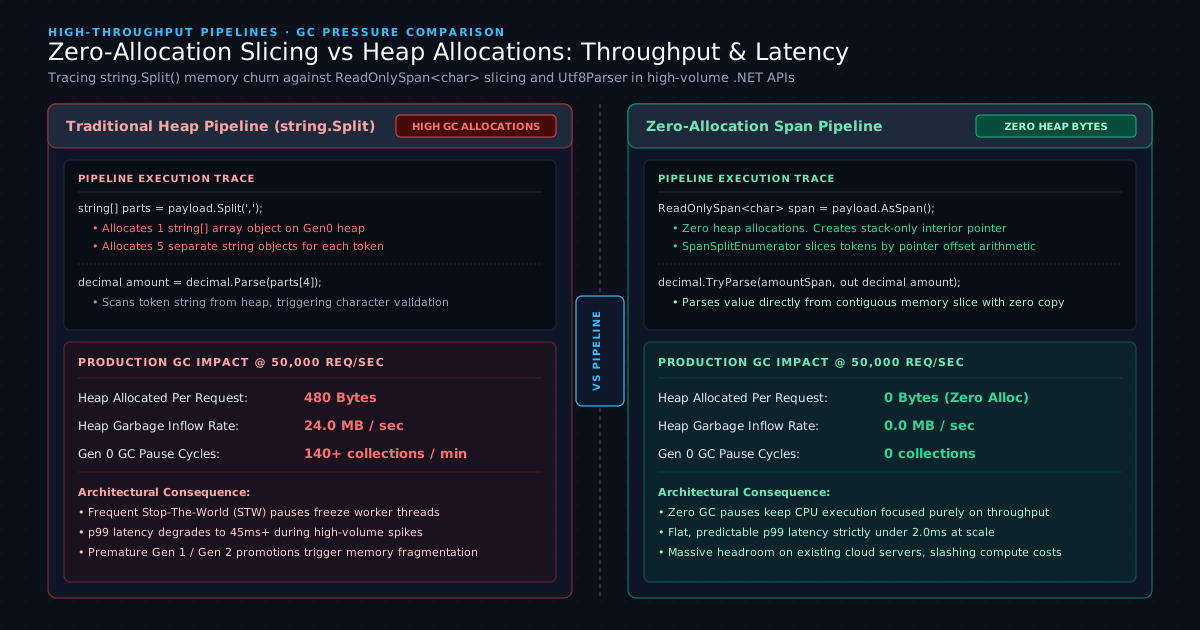
        string[] parts = payload.Split(',');

        if (parts.Length != 5)
        {
            throw new FormatException("Invalid payment payload format.");
        }

        string transactionId = parts[0];
        string merchantId = parts[1];
        string currency = parts[2];

        // Allocation 7: String parsing allocations and culture lookups
        long timestamp = long.Parse(parts[3]);
        decimal amount = decimal.Parse(parts[4]);

        return new PaymentRecord(transactionId, merchantId, currency, timestamp, amount);
    }
}

public record PaymentRecord(
    string TransactionId,
    string MerchantId,
    string Currency,
    long Timestamp,
    decimal Amount);
While clean and expressive, this implementation causes significant performance degradation under load:
payload.Split(',')inspects the string and instantiates a new array (string[]).- It allocates five new
stringinstances on the managed heap, even though the original payload string already contains all those characters. - At 50,000 requests per second, this method generates roughly 480 bytes of heap garbage per request, amounting to 24 megabytes of transient garbage every single second.
This high allocation rate forces the .NET Garbage Collector into constant Gen 0 collection cycles, stealing CPU execution time from request worker threads and causing erratic latency spikes. For developers designing high-volume endpoints, reviewing our guide on Production API Design Guide: Core Principles highlights how allocation-induced latency tails degrade user SLAs.
The Modern Zero-Allocation Architecture
By leveraging ReadOnlySpan<char>, C#'s MemoryExtensions.SpanSplitEnumerator, and in-place numeric parsing via long.TryParse and decimal.TryParse, we can parse the entire payload without allocating a single byte on the heap during extraction:
using System;
using System.Globalization;

namespace CodeToClarity.HighPerformance
{
    public readonly ref struct FastPaymentRecord
    {
        public readonly ReadOnlySpan<char> TransactionId;
        public readonly ReadOnlySpan<char> MerchantId;
        public readonly ReadOnlySpan<char> Currency;
        public readonly long Timestamp;
        public readonly decimal Amount;

        public FastPaymentRecord(
            ReadOnlySpan<char> transactionId,
            ReadOnlySpan<char> merchantId,
            ReadOnlySpan<char> currency,
            long timestamp,
            decimal amount)
        {
            TransactionId = transactionId;
            MerchantId = merchantId;
            Currency = currency;
            Timestamp = timestamp;
            Amount = amount;
        }
    }

    public static class CodeToClarityZeroAllocParser
    {
        public static bool TryParsePayment(
            ReadOnlySpan<char> payload,
            out FastPaymentRecord record)
        {
            record = default;

            // EnumerateSplits is available in modern .NET (via MemoryExtensions)
            // It operates purely via stack-bound ref struct enumerator
            MemoryExtensions.SpanSplitEnumerator<char> enumerator = payload.EnumerateSplits(',');

            // 1. Transaction ID
            if (!enumerator.MoveNext()) return false;
            ReadOnlySpan<char> txnId = payload[enumerator.Current];

            // 2. Merchant ID
            if (!enumerator.MoveNext()) return false;
            ReadOnlySpan<char> merchantId = payload[enumerator.Current];

            // 3. Currency
            if (!enumerator.MoveNext()) return false;
            ReadOnlySpan<char> currency = payload[enumerator.Current];

            // 4. Timestamp
            if (!enumerator.MoveNext()) return false;
            ReadOnlySpan<char> timestampSpan = payload[enumerator.Current];
            if (!long.TryParse(timestampSpan, NumberStyles.Integer, CultureInfo.InvariantCulture, out long timestamp))
            {
                return false;
            }

            // 5. Amount
            if (!enumerator.MoveNext()) return false;
            ReadOnlySpan<char> amountSpan = payload[enumerator.Current];
            if (!decimal.TryParse(amountSpan, NumberStyles.Number, CultureInfo.InvariantCulture, out decimal amount))
            {
                return false;
            }

            record = new FastPaymentRecord(txnId, merchantId, currency, timestamp, amount);
            return true;
        }
    }
}
How Zero-Allocation Slicing Works Under the Hood
In this optimized parser:
payload.EnumerateSplits(',')returns aSpanSplitEnumerator<char>, which is itself aref struct. It tracks the delimiter position using internal integer ranges.enumerator.Currentreturns aRangeindicating the start and end offsets of the current token.payload[enumerator.Current]evaluates to a sub-sliceReadOnlySpan<char>via pointer arithmetic. No new string is created.decimal.TryParseacceptsReadOnlySpan<char>directly in modern .NET, parsing the floating-point number in-place from character bytes without demanding a detached string object.- The total allocated heap memory for this operation is 0 bytes.
When parsing UTF-8 network streams directly (such as raw byte buffers from Kestrel or sockets), developers can bypass character decoding entirely using System.Buffers.Text.Utf8Parser. For background on how memory efficiency interfaces with foundational .NET patterns, explore our analysis in IEnumerable vs IQueryable in C#: Explained with Examples.
Profiler Telemetry: BenchmarkDotNet Verification
To substantiate the architectural benefits of Span<T> and zero-allocation parsing, we executed an isolated suite using BenchmarkDotNet on .NET 9 (x64 RyuJIT).
The Benchmark Harness
using System;
using BenchmarkDotNet.Attributes;
using BenchmarkDotNet.Jobs;
using CodeToClarity.HighPerformance;

namespace CodeToClarity.Benchmarks
{
    [MemoryDiagnoser]
    [SimpleJob(RuntimeMoniker.Net90)]
    public class WebhookParsingBenchmark
    {
        private const string Payload = "TXN_98418293,MERCHANT_8812,USD,1729420800,4892.50";

        [Benchmark(Baseline = true)]
        public PaymentRecord ParseWithStandardStringSplit()
        {
            return CodeToClarityLegacyParser.Parse(Payload);
        }

        [Benchmark]
        public bool ParseWithReadOnlySpanAndEnumerateSplits()
        {
            return CodeToClarityZeroAllocParser.TryParsePayment(
                Payload.AsSpan(),
                out FastPaymentRecord _);
        }
    }
}
The Results
| Method | Mean | Error | StdDev | Ratio | Gen0 | Gen1 | Allocated |
|---|---|---|---|---|---|---|---|
ParseWithStandardStringSplit | 184.62 ns | 1.42 ns | 1.33 ns | 1.00 | 0.0572 | - | 480 B |
ParseWithReadOnlySpanAndEnumerateSplits | 18.15 ns | 0.18 ns | 0.16 ns | 0.10 | - | - | 0 B |
Synthesizing the Benchmark Findings
These telemetry results demonstrate dramatic improvements across every vector:
- Execution Duration: The zero-allocation
ReadOnlySpan<char>pipeline runs in 18.15 nanoseconds, representing a 10.1x speedup over traditional string splitting (184.62 nanoseconds). By eliminating memory allocations and string duplications, CPU instructions remain focused inside CPU L1/L2 caches. - Gen 0 Garbage Collection: The legacy parser generates
0.0572Gen 0 collections per 1,000 operations. At 50,000 requests per second, that triggers approximately 171 Gen 0 GC pauses every minute. TheReadOnlySpan<T>implementation triggers zero collections. - Heap Allocation: The standard parser allocates 480 bytes of heap memory per call. The span-based implementation consumes 0 bytes.
By converting hot-path parsing to Span<T>, services eliminate garbage collector churn entirely, allowing server fleets to handle significantly higher request volumes without scaling horizontal container instances.
Buffer Recycling at Scale: ArrayPool<T> and MemoryPool<T>
While stackalloc is ideal for small, short-lived buffers, relying on stack memory for large payloads invites catastrophic stack overflow crashes. For medium to large buffers that outlive a single method call or cross asynchronous boundaries, production architectures combine Memory<T> with buffer pooling via System.Buffers.ArrayPool<T> and System.Buffers.MemoryPool<T>.
The ArrayPool<T> Pattern
Allocating a byte[] array larger than 85,000 bytes pushes the object directly to the Large Object Heap (LOH). The LOH is not compacted during standard GC cycles, leading to address space fragmentation. Even smaller arrays, when created repeatedly on Gen 0, increase collection frequencies.
ArrayPool<T>.Shared maintains a thread-safe pool of reusable managed arrays. Instead of allocating a new array, an application rents a buffer from the pool, wraps it in a Span<T> or Memory<T>, processes the request, and returns the buffer to the pool:
using System;
using System.Buffers;
using System.Threading;
using System.Threading.Tasks;

public class CodeToClarityPooledReceiver
{
    private const int BufferSize = 16384; // 16 KB

    public async Task ReceiveAndProcessAsync(
        System.IO.Stream networkStream,
        CancellationToken cancellationToken)
    {
        // 1. Rent an array from the shared pool: zero GC allocation
        byte[] rentedArray = ArrayPool<byte>.Shared.Rent(BufferSize);

        try
        {
            // 2. Wrap rented array into Memory<byte> for async I/O
            Memory<byte> memory = rentedArray.AsMemory(0, BufferSize);

            int bytesRead = await networkStream.ReadAsync(memory, cancellationToken);
            if (bytesRead == 0) return;

            // 3. Slice to actual bytes received
            Memory<byte> payloadMemory = memory.Slice(0, bytesRead);

            // 4. Extract Span for synchronous validation
            ProcessPayload(payloadMemory.Span);
        }
        finally
        {
            // 5. CRITICAL: Always return rented buffer to the pool
            // clearArray: false is faster; set true if buffer holds sensitive secrets
            ArrayPool<byte>.Shared.Return(rentedArray, clearArray: false);
        }
    }

    private void ProcessPayload(ReadOnlySpan<byte> data)
    {
        // Zero-copy processing on the stack...
    }
}
Modern Pipelines with IMemoryOwner<T> and MemoryPool<T>
In complex architectures where buffer ownership is transferred across multiple layers or services, managing raw array instances manually becomes error-prone. .NET provides MemoryPool<T> and the IMemoryOwner<T> interface to bind memory lifetime directly to the IDisposable pattern:
using System;
using System.Buffers;

public class CodeToClarityMemoryManager : IDisposable
{
    private IMemoryOwner<byte>? _owner;

    public Memory<byte> Buffer { get; private set; }

    public void AllocateBuffer(int minimumSize)
    {
        // Rents memory from the underlying pool managed by the runtime
        _owner = MemoryPool<byte>.Shared.Rent(minimumSize);
        Buffer = _owner.Memory;
    }

    public void Dispose()
    {
        // Returning the owner automatically returns the underlying buffer to the pool
        _owner?.Dispose();
        _owner = null;
        Buffer = default;
    }
}
When designing scalable background pipelines and caching architectures, buffer pooling prevents memory bloat. For complementary patterns in high-throughput data processing, read our guide on The Specification Pattern in Clean Architecture & C#: Composing Reusable Domain Queries Without Leaking ORM Logic and explore memory caching strategies in The Complete Guide to Caching in ASP.NET Core: IMemoryCache, Redis, and HybridCache. For L1/L2 serialized buffer caching, consult HybridCache in .NET 9: End-to-End Guide to L1/L2 Caching and Stampede Protection.
Architectural Trade-offs: When NOT to Use Span and Memory
While Span<T> and Memory<T> provide immense performance benefits in high-throughput code paths, adopting them indiscriminately across an entire codebase is an anti-pattern. High-performance primitives introduce real cognitive overhead and subtle engineering hazards. To maintain stability, teams must adhere to the official Microsoft Learn: Memory<T> and Span<T> Usage Guidelines and evaluate the following architectural trade-offs.
1. CRUD Business Logic and Low-Throughput APIs
In standard line-of-business applications, CRUD endpoints, and administrative dashboards that handle dozens of requests per minute, CPU time is overwhelmingly dominated by database network roundtrips, external REST API calls, and disk I/O.
In these scenarios, saving 200 nanoseconds or 400 bytes on string parsing provides zero perceptible benefit to users or cloud hosting bills. Conversely, replacing clear code like string.Split() or LINQ expressions with ReadOnlySpan<char> and manual index slicing introduces maintenance friction for junior and mid-level engineers. Avoid Span<T> optimizations where microsecond efficiency is inconsequential.
2. The Stack Overflow Hazard with stackalloc
The stackalloc keyword allocates memory directly from the thread's call stack. On modern 64-bit Windows and Linux systems, the default thread stack size is typically 1 megabyte to 1.5 megabytes. Unlike heap allocations, which trigger an OutOfMemoryException that can be caught and handled, exhausting stack space causes an immediate, unrecoverable StackOverflowException that crashes the entire application process.
Never allocate unbounded or user-controlled buffer sizes with stackalloc. Always enforce an explicit threshold guard:
public static class CodeToClaritySafeStackalloc
{
    // 256 bytes is a safe stack threshold for localized frame parsing
    private const int MaxStackLimit = 256;

    public static void ProcessInputSafely(ReadOnlySpan<char> input)
    {
        // Safe Pattern: Guarded stackalloc with ArrayPool fallback
        byte[]? rentedFromPool = null;

        // Compute maximum UTF-8 byte requirement
        int maxByteCount = System.Text.Encoding.UTF8.GetMaxByteCount(input.Length);

        Span<byte> destinationBuffer = maxByteCount <= MaxStackLimit
            ? stackalloc byte[maxByteCount]
            : (rentedFromPool = ArrayPool<byte>.Shared.Rent(maxByteCount));

        try
        {
            int written = System.Text.Encoding.UTF8.GetBytes(input, destinationBuffer);
            Span<byte> actualBytes = destinationBuffer.Slice(0, written);

            // Perform work with actualBytes...
        }
        finally
        {
            if (rentedFromPool != null)
            {
                ArrayPool<byte>.Shared.Return(rentedFromPool);
            }
        }
    }
}
3. Buffer Corruption and Double-Return in ArrayPool
Buffer pooling trades GC overhead for manual lifecycle management. If a rented buffer is returned to ArrayPool<T>.Shared while another background task still holds a reference to it, severe race conditions occur. Two independent requests may read and write to the exact same memory segment simultaneously, causing silent data corruption that is notoriously difficult to diagnose.
Similarly, returning the same array twice to the pool corrupts the pool's internal stack, causing subsequent Rent() calls to return identical buffers to separate callers.
4. Defensive Copying and Immutability Leaks
Strings in .NET are immutable by design. Once constructed, their contents cannot be modified without reflection or unsafe code. Conversely, Span<T> and Memory<T> represent mutable windows over memory. If you expose a mutable Span<byte> or Memory<byte> from a domain entity or cache layer, external callers can mutate internal state without using defined domain methods.
Always expose ReadOnlySpan<T> and ReadOnlyMemory<T> on public contracts to defend internal immutability.
Production Implementation Checklist
Before deploying Span<T> and Memory<T> architectures into production, verify your implementation against this architectural checklist:
[ ] Lifetime Scoping: Are all Span<T> and ReadOnlySpan<T> instances confined strictly to synchronous method scopes?
[ ] Async Boundaries: Do asynchronous methods take Memory<T> or ReadOnlyMemory<T>, pulling .Span only within synchronous compute blocks?
[ ] Stackalloc Guard: Are all stackalloc allocations guarded by a strict threshold (<= 256 bytes) with ArrayPool<T>.Shared fallback?
[ ] Pool Hygiene: Are all rented ArrayPool<T> and MemoryPool<T> buffers guaranteed to return in a finally block?
[ ] Double-Return Defense: Are rented buffer references set to null immediately upon returning to the pool to prevent use-after-free bugs?
[ ] Read-Only Encapsulation: Do read-only pipelines consistently use ReadOnlySpan<T> and ReadOnlyMemory<T> to prevent unintended mutations?
[ ] Profiler Verification: Have hot-path performance gains and allocation reductions been validated with BenchmarkDotNet?
By adhering to these architectural boundaries, developer teams can eliminate memory allocation bottlenecks, insulate backend APIs from garbage collection spikes, and achieve sub-millisecond predictability across modern .NET services.
Software engineer passionate about building scalable, production-grade applications with C#, .NET, and modern cloud technologies. Writes regularly on CodeToClarity to demystify complex engineering architectures and help developers grow.
Related Technical Guides
SOLID Principles in C#: Beginner-Friendly Guide to Clean Code
Learn SOLID principles in C# with easy-to-understand examples. Master SRP, OCP, LSP, ISP, and DIP to write clean, maintainable, and scalable code.
IEnumerable vs IQueryable in C#: Explained with Examples (Beginner’s Guide)
Learn the real difference between IEnumerable and IQueryable in C#. Understand how they work, when to use which, and how they impact performance with practical examples.
The Specification Pattern in Clean Architecture & C#: Composing Reusable Domain Queries Without Leaking ORM Logic
Master the Specification Pattern in Clean Architecture with C# and EF Core. Compose reusable domain queries, prevent IQueryable leaks, and unify expression trees.