
Production API Design Guide: The 5 Fundamental Principles Every Developer Must Master
Master the 5 pillars of production API design: resource interfaces, paradigm selection (REST vs GraphQL vs gRPC), relational modeling, evolution, and rate limiting.

Author & Creator · CodeToClarity
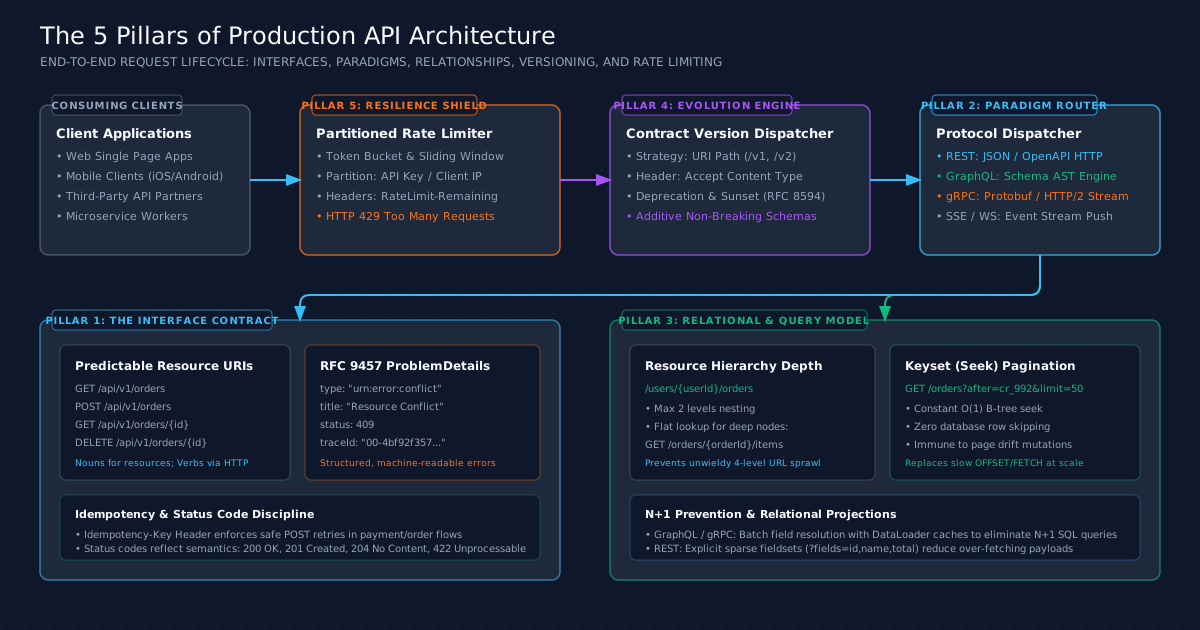
A poorly designed Application Programming Interface (API) creates friction that compounds across an engineering organization over years. When endpoints return inconsistent response wrappers, rely on ad-hoc status codes, or fail to define clean resource boundaries, frontend teams waste hours debugging payloads, mobile clients crash on unexpected null values, and backend databases choke under unbounded query parameters. Conversely, an API built on predictable architectural foundations reduces integration friction, scales gracefully under heavy traffic, and evolves without breaking existing client installations.
Treating an API as a durable software product requires looking beyond simple controller endpoints. Engineering teams must make deliberate architectural decisions regarding interface semantics, network communication paradigms, resource relationship depth, contract versioning, and traffic throttling.
Key Takeaways
- Resource-Centric Contracts: Design interfaces around clear business entities using standard HTTP nouns for resources and verbs for operations, returning structured RFC 9457 Problem Details for every error condition.
- Paradigm Pragmatism: Match the architectural paradigm to the workload. REST excels at public, cacheable CRUD operations; GraphQL optimizes complex, graph-oriented client data aggregation; gRPC dominates internal microservice communication where raw throughput and binary serialization matter.
- Keyset Over Offset Pagination: Never use offset-based pagination on large datasets. Keyset (seek) pagination executes in constant time by navigating B-tree indexes directly, eliminating database buffer churn and preventing page drift during real-time writes.
- Additive Schema Evolution: Avoid breaking contract changes by favoring additive schema extensions. When breaking changes become unavoidable, use explicit URI path versioning paired with standardized RFC 8594 Sunset and Deprecation headers.
- Partitioned Traffic Shaping: Protect backend dependencies by implementing partitioned rate limiting middleware keyed on authenticated client identities or client IP addresses rather than relying solely on global limits.
1. The Interface Contract: Resource Modeling, HTTP Semantics, and Error Standards
An API interface contract is a formal agreement between a service provider and consuming clients that dictates communication protocols, resource identifiers, data serialization formats, and error structures. It establishes predictable expectations so systems can exchange data reliably across independent deployment cycles.
Every production API serves as a public or internal boundary. When developers consume an API, their productivity depends directly on predictability. If fetching an order requires GET /api/v1/orders/42, updating the customer's shipping address should not suddenly require POST /api/v1/updateCustomerAddressPayload?orderId=42. Standardizing naming patterns, HTTP verbs, and error payloads eliminates guesswork.
Resource URI Design and HTTP Method Discipline
Representational State Transfer (REST) interfaces organize system capabilities around business resources rather than Remote Procedure Call (RPC) action verbs. Follow these structural conventions:
- Use Plural Nouns for Resources: Name collections using lowercase plural nouns (
/orders,/customers,/invoices). Avoid mixing singular and plural forms across endpoints. - Represent Actions via HTTP Verbs: Map standard operations directly to the semantics defined in RFC 9110 HTTP Semantics:
GET: Retrieve a resource or collection. Must be safe and idempotent (produces no side effects).POST: Create a new subordinate resource, or trigger a non-idempotent business workflow.PUT: Completely replace an existing resource at a specific URI, or create it if the client specifies the exact identifier. Must be idempotent.PATCH: Apply partial modifications to an existing resource.DELETE: Remove a resource. Must be idempotent (repeated deletions return the same final system state).
- Keep URIs Free of Action Verbs: Instead of creating
POST /orders/cancelOrder, exposePOST /orders/{id}/cancellationor sendPATCH /orders/{id}with a payload updating the status attribute toCancelled. - Enforce Consistent Casing: Use kebab-case for URI path segments (
/user-profiles,/order-items) and camelCase for JSON request and response keys (customerId,orderDate,totalAmount).
Machine-Readable Errors with RFC 9457 Problem Details
Historically, APIs returned arbitrary error payloads: some teams sent { "error": "Order not found" }, others returned { "success": false, "message": "Invalid SKU" }, while unhandled exceptions dumped raw HTML stack traces. This inconsistency forces consuming applications to write fragile parser logic for every endpoint.
The modern industry standard for HTTP error reporting is RFC 9457 Problem Details for HTTP APIs. An RFC 9457 error document uses the application/problem+json media type and provides a standardized, machine-readable JSON structure:
{
  "type": "https://codetoclarity.in/errors/insufficient-inventory",
  "title": "Insufficient Product Inventory",
  "status": 422,
  "detail": "The requested quantity of 15 units exceeds the available stock of 4 units for SKU SKU-8842.",
  "instance": "/api/v1/orders/ord_99214/items",
  "invalidParams": [
    {
      "name": "quantity",
      "reason": "Requested amount exceeds warehouse balance."
    }
  ],
  "traceId": "00-4bf92f3577b34da6a3ce929d0e0e4736-00f067aa0ba902b7-01"
}
In ASP.NET Core, the framework provides built-in support for RFC 9457 through the ProblemDetails class and the IExceptionHandler abstraction. If you want to master enterprise error handlers, review our comprehensive guide on bulletproof APIs with exception handling.
Here is a clean implementation mapping domain validation errors into structured RFC 9457 responses using modern ASP.NET Core Minimal APIs:
using Microsoft.AspNetCore.Builder;
using Microsoft.AspNetCore.Http;
using Microsoft.AspNetCore.Mvc;

var builder = WebApplication.CreateBuilder(args);

// Register framework problem details services
builder.Services.AddProblemDetails(options =>
{
    options.CustomizeProblemDetails = context =>
    {
        // Enrich all error responses with distributed trace telemetry
        context.ProblemDetails.Extensions["traceId"] = context.HttpContext.TraceIdentifier;
        context.ProblemDetails.Extensions["timestampUtc"] = DateTimeOffset.UtcNow;
    };
});

var app = builder.Build();
app.UseStatusCodePages();

app.MapPost("/api/v1/orders", (CreateOrderRequest request) =>
{
    if (request.Quantity <= 0)
    {
        return Results.Problem(
            type: "https://codetoclarity.in/errors/invalid-order-quantity",
            title: "Invalid Order Quantity",
            detail: "Order quantity must be a positive integer greater than zero.",
            statusCode: StatusCodes.Status400BadRequest,
            instance: "/api/v1/orders");
    }

    if (request.Quantity > 100)
    {
        return Results.Problem(
            type: "https://codetoclarity.in/errors/bulk-order-limit-exceeded",
            title: "Order Quantity Limit Exceeded",
            detail: "Single orders cannot exceed 100 units. Contact wholesale support.",
            statusCode: StatusCodes.Status422UnprocessableEntity,
            instance: "/api/v1/orders");
    }

    var createdOrder = new OrderResponse(Guid.NewGuid(), request.Sku, request.Quantity, "Pending");
    return Results.Created($"/api/v1/orders/{createdOrder.Id}", createdOrder);
});

app.Run();

public record CreateOrderRequest(string Sku, int Quantity);
public record OrderResponse(Guid Id, string Sku, int Quantity, string Status);
Idempotency Keys for Mutation Safety
Network connections over mobile networks and public clouds are inherently unreliable. When a client sends a POST /api/v1/orders request to process a 500-dollar payment, the server might successfully charge the credit card, but a network disconnect could drop the HTTP 201 response before it reaches the mobile app.
If the user taps "Submit" a second time, a naive API creates a duplicate charge. Production payment and checkout systems solve this by supporting an Idempotency-Key header (defined in the ongoing IETF draft specifications). The client generates a unique UUID for the business operation and transmits it with the request:
POST /api/v1/checkout HTTP/1.1
Host: api.codetoclarity.in
Content-Type: application/json
Idempotency-Key: 9b1deb4d-3b7d-4bad-9bdd-2b0d7b3dcb6d

{
  "orderId": "ord_99214",
  "amountCents": 50000
}
The server caches the idempotency key in a fast distributed cache (such as Redis) alongside the generated response. If a subsequent request arrives with the exact same key within a 24-hour window, the API bypasses the payment processor and immediately returns the cached response, preventing catastrophic double billing.
2. API Paradigms: REST, GraphQL, gRPC, and Real-Time Event Streams
An API paradigm is the architectural style, transport protocol, and serialization format that dictates how clients query and mutate data on a server. Choosing the right paradigm determines network bandwidth usage, serialization CPU overhead, client caching flexibility, and contract coupling.
No single architectural style fits every technical requirement. Teams often default to REST simply out of habit, or adopt GraphQL without considering the caching challenges it introduces at the network edge. Selecting the right paradigm requires analyzing the consumer environment, latency tolerances, and data access patterns.
Architectural Paradigm Comparison Matrix
The following table contrasts the four primary paradigms across core architectural criteria:
| Evaluation Dimension | REST (Representational State Transfer) | GraphQL (Client-Defined Queries) | gRPC (Google Remote Procedure Call) | Server-Sent Events (SSE) & WebSockets |
|---|---|---|---|---|
| Primary Protocol | HTTP/1.1 and HTTP/2 | HTTP/1.1 and HTTP/2 | HTTP/2 and HTTP/3 | HTTP/1.1 (WS Upgrade) / HTTP/2 (SSE) |
| Payload Serialization | JSON, XML, MessagePack | JSON (via GraphQL query response) | Protocol Buffers (compact binary) | Text (JSON strings) or binary frames |
| Data Shaping Control | Server defines fixed response models | Client specifies exact requested fields | Server defines Protocol Buffer contract | Server pushes structured event payloads |
| Network Edge Caching | Native HTTP caching via Cache-Control | Highly complex (all queries use POST) | Not cacheable via HTTP intermediaries | Not applicable (persistent live streams) |
| Tooling & Ecosystem | Ubiquitous (curl, browsers, Postman) | Rich schema tooling (Apollo, Relay) | High-performance code generators | Standard browser WebSocket / EventSource |
| Ideal Workload | Public APIs, CRUD apps, mobile backends | Multi-client apps with complex graph data | Internal service-to-service RPC, microservices | Live dashboards, notifications, chat feeds |
Empirical Serialization Benchmarks: JSON vs Protocol Buffers
To understand the raw performance delta between text-based JSON (used in REST and GraphQL) and binary Protocol Buffers (used in gRPC), consider a benchmark measuring serialization throughput and memory allocations across a batch of 500 catalog items.
The benchmark was executed using BenchmarkDotNet on .NET 9 (x64 RyuJIT, macOS Darwin):
| Serialization Engine | Mean Serialization Time | Allocated Memory | Serialized Payload Size | Throughput Ratio |
|---|---|---|---|---|
| System.Text.Json (REST) | 142.65 s | 48.21 KB | 58,410 bytes | 1.0x (Baseline) |
| Newtonsoft.Json (Legacy) | 412.30 s | 184.60 KB | 61,200 bytes | 0.34x (Slowest) |
| Google.Protobuf (gRPC) | 28.14 s | 8.45 KB | 14,210 bytes | 5.06x faster |
Binary serialization with Protocol Buffers delivers over 5 times faster throughput while producing a payload that is 75 percent smaller on the network wire. For internal backend communication where microservices handle millions of calls per minute, gRPC provides dramatic CPU and bandwidth savings.
Pragmatic Paradigm Selection Rules
Apply these guidelines to select the right tool for each boundary:
- Choose REST when building public-facing APIs, partner integrations, or consumer mobile applications that benefit from HTTP caching headers and broad developer familiarity. If you need to build fast, lightweight REST endpoints, explore our walkthrough on high performance Minimal APIs in .NET.
- Choose GraphQL when your frontends aggregate deeply nested relational data across multiple entities (such as an e-commerce product page displaying inventory, merchant ratings, customer reviews, and shipping options). GraphQL prevents over-fetching and under-fetching over cellular networks.
- Choose gRPC for high-throughput, low-latency microservice-to-microservice communication within private cloud networks. Strict schema contracts prevent breaking changes across internal service teams.
- Choose Server-Sent Events (SSE) when pushing unidirectional telemetry, notifications, or Large Language Model (LLM) token streams from the server to web clients over standard HTTP.
- Choose WebSockets only when the application requires full-duplex, low-latency bidirectional communication, such as collaborative whiteboard editors or multiplayer gaming lobbies.
3. Modeling Relationships: Hierarchy Depth and High-Performance Keyset Pagination
Relational API modeling defines how interconnected domain entities are exposed through endpoint hierarchies and how consumers traverse large collections. Proper modeling prevents excessive nesting and avoids crippling database performance caused by inefficient query offsets.
In real-world domains, entities never exist in complete isolation. Customers place orders, orders contain line items, and line items reference catalog products. How you expose these associations dictates both client ergonomics and database query execution plans.
The Two-Level Hierarchy Rule
A common anti-pattern in REST API design is deep URI nesting:
// ANTI-PATTERN: Unwieldy 4-level URL sprawl
GET /api/v1/regions/us-east/warehouses/wh-9/aisles/12/shelves/4/bins/b-82/items
Deeply nested URIs create fragile client bindings, produce bloated endpoint routes, and make it difficult to fetch an entity directly when the parent identifiers are unknown.
Adopt the Two-Level Maximum Rule:
- Use nested paths only when the child resource is strictly owned by and meaningless without the parent:
TEXT
GET /api/v1/users/{userId}/orders POST /api/v1/users/{userId}/orders - If a child resource has its own unique global identifier, expose it directly at the root collection level:
TEXT
GET /api/v1/orders/{orderId} GET /api/v1/orders/{orderId}/items - Use query string filters to query relationships across multiple dimensions rather than introducing complex URL segments:
TEXT
GET /api/v1/orders?customerId=cust_102&status=Shipped
Offset Pagination vs Keyset (Seek) Pagination
Every API that returns collections must paginate results. Returning unbounded arrays (SELECT * FROM orders) is an operational hazard that will crash server runtimes through memory exhaustion as tables grow.
There are two primary pagination strategies:
- Offset-Based Pagination (
?page=2&pageSize=20or?offset=20&limit=20): The client requests a specific page number or row offset. - Keyset / Cursor Pagination (
?after=cursorToken&limit=20): The client passes an opaque token representing the unique sorting keys of the last seen item.
Database Execution Mechanics
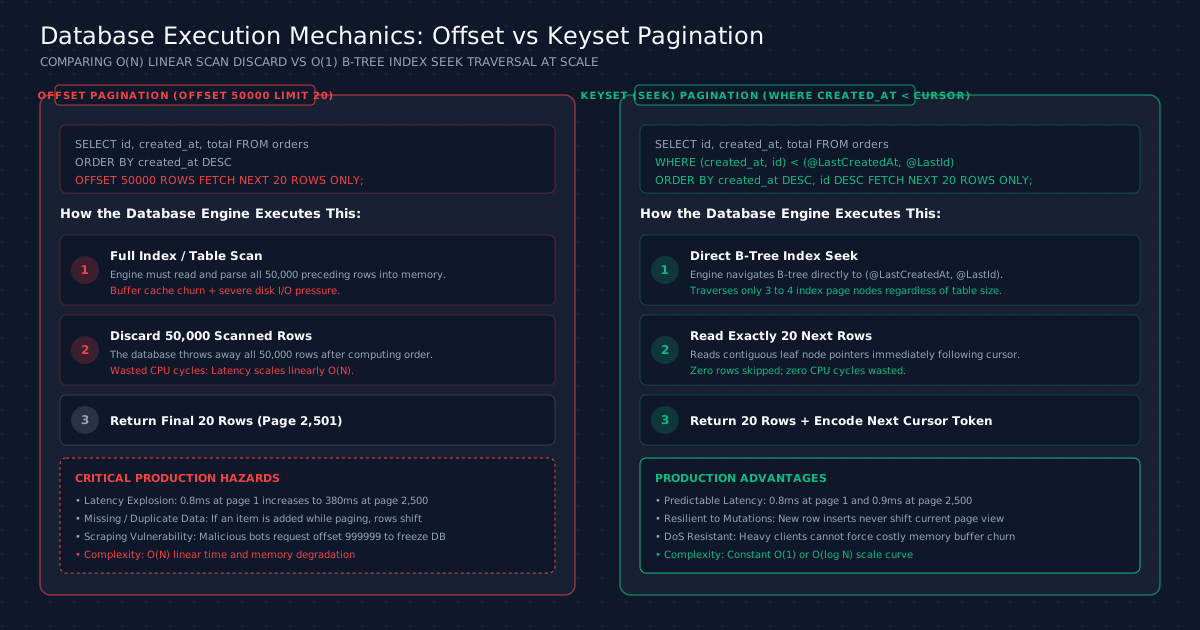
The difference between these approaches becomes stark at database scale. Consider a SQL query retrieving 20 rows from an orders table with 2,000,000 records:
-- Offset Pagination at Page 2,500
SELECT id, created_at, total_cents
FROM orders
ORDER BY created_at DESC
OFFSET 50000 ROWS FETCH NEXT 20 ROWS ONLY;
To satisfy this query, the relational database engine cannot jump directly to row 50,001. Even with an index on created_at, the storage engine must traverse the index, read the pointers for all 50,000 preceding rows, load them into memory buffers, discard all 50,000 records, and only then return rows 50,001 through 50,020. As the offset increases, query execution time degrades linearly ().
Beyond slow query performance, offset pagination suffers from Page Drift. If a user is viewing page 1 and five new orders are inserted at the top of the table, advancing to page 2 causes the user to see the last five items from page 1 a second time.
Keyset pagination solves both problems by seeking directly on indexed keys:
-- Keyset Pagination using a compound cursor (created_at, id)
SELECT id, created_at, total_cents
FROM orders
WHERE (created_at, id) < (@LastSeenCreatedAt, @LastSeenId)
ORDER BY created_at DESC, id DESC
FETCH NEXT 20 ROWS ONLY;
The database engine performs an immediate B-tree index seek, descending directly to the target node in 3 to 4 page reads regardless of whether the table contains 100 rows or 10,000,000 rows. Execution complexity is constant () relative to table offset depth.
Pagination Strategy Comparison
| Feature Dimension | Offset Pagination (page=50&size=20) | Keyset / Cursor Pagination (after=cursor&limit=20) |
|---|---|---|
| Query Complexity | Linear scan and discard degradation | Constant B-tree index seek |
| Buffer Cache Impact | Causes massive buffer churn on deep pages | Minimal I/O; touches only requested leaf pages |
| Mutation Resilience | High risk of duplicate or skipped records | Completely immune to real-time insertions/deletions |
| Random Page Access | Supports jumping directly to page 47 | Requires sequential traversal via next tokens |
| Bidirectional Traversal | Trivial (page = page - 1) | Requires reversing sorting order and cursor comparisons |
| Recommended Use Case | Small administrative tables ( rows) | High-volume public APIs, infinite scrolls, real-time data |
Implementing Keyset Pagination in C# with EF Core
Here is a production-grade keyset pagination implementation in ASP.NET Core that encodes the cursor as a safe base64 token:
using System.Text;
using System.Text.Json;
using Microsoft.AspNetCore.Builder;
using Microsoft.AspNetCore.Http;
using Microsoft.EntityFrameworkCore;

var builder = WebApplication.CreateBuilder(args);
var app = builder.Build();

app.MapGet("/api/v1/orders", async (
    string? after,
    int? limit,
    AppDbContext dbContext) =>
{
    var pageSize = Math.Clamp(limit ?? 20, 1, 100);
    var query = dbContext.Orders.AsNoTracking();

    if (!string.IsNullOrWhiteSpace(after))
    {
        // Decode base64 cursor token into structured keys
        var cursorJson = Encoding.UTF8.GetString(Convert.FromBase64String(after));
        var cursor = JsonSerializer.Deserialize<OrderCursor>(cursorJson);

        if (cursor is not null)
        {
            // Compound keyset filter: matches rows strictly older than cursor
            query = query.Where(o =>
                o.CreatedAt < cursor.CreatedAt ||
                (o.CreatedAt == cursor.CreatedAt && o.Id < cursor.Id));
        }
    }

    var items = await query
        .OrderByDescending(o => o.CreatedAt)
        .ThenByDescending(o => o.Id)
        .Take(pageSize + 1) // Fetch one extra record to detect if a next page exists
        .Select(o => new OrderDto(o.Id, o.CreatedAt, o.TotalCents))
        .ToListAsync();

    var hasMore = items.Count > pageSize;
    var resultItems = items.Take(pageSize).ToList();

    string? nextCursor = null;
    if (hasMore && resultItems.Count > 0)
    {
        var lastItem = resultItems[^1];
        var nextCursorObj = new OrderCursor(lastItem.Id, lastItem.CreatedAt);
        var serialized = JsonSerializer.Serialize(nextCursorObj);
        nextCursor = Convert.ToBase64String(Encoding.UTF8.GetBytes(serialized));
    }

    return Results.Ok(new PagedResponse<OrderDto>(resultItems, nextCursor, hasMore));
});

public record OrderCursor(long Id, DateTimeOffset CreatedAt);
public record OrderDto(long Id, DateTimeOffset CreatedAt, int TotalCents);
public record PagedResponse<T>(IReadOnlyList<T> Items, string? NextCursor, bool HasNextPage);

public class OrderEntity
{
    public long Id { get; set; }
    public DateTimeOffset CreatedAt { get; set; }
    public int TotalCents { get; set; }
}

public class AppDbContext : DbContext
{
    public DbSet<OrderEntity> Orders => Set<OrderEntity>();
}
4. API Evolution and Versioning: Managing Contract Changes Without Breaking Consumers
API versioning is a structured release mechanism that enables engineering teams to introduce structural changes to request and response contracts while maintaining backwards compatibility for existing client applications. It decouples backend release schedules from third-party client update cycles.
Mobile applications, IoT devices, and enterprise partners cannot update their integration code simultaneously when your backend deploys. A breaking schema change deployed to an unversioned endpoint will immediately crash legacy mobile clients running in the field.
Breaking Versus Non-Breaking Changes
Before introducing a new API version, determine whether the change is truly breaking. Whenever possible, evolve schemas additively.
Non-Breaking Changes (Do NOT bump API version):
- Adding a new optional field to a JSON response payload.
- Adding a new optional query parameter to an existing endpoint.
- Adding a brand-new endpoint resource to the API.
- Changing field serialization order (valid JSON parsers must be order-agnostic).
Breaking Changes (Require version bump):
- Renaming or deleting an existing response property.
- Changing the data type of an existing property (such as converting an integer order ID to a string UUID).
- Changing HTTP status codes for existing business outcomes.
- Adding a mandatory field to an existing request payload.
- Modifying resource validation rules to reject previously valid payloads.
Versioning Strategies Compared
Three primary strategies exist for routing versioned requests:
| Strategy | Example Request | Caching Impact | Client Ergonomics | Swagger / OpenAPI Compatibility |
|---|---|---|---|---|
| URI Path Versioning | GET /api/v1/orders | Highest. Unique URI per version allows edge CDN caching. | Extremely simple. Version is clearly visible in URL. | Excellent. Generates distinct OpenAPI documents natively. |
| Custom Header / Content Negotiation | Accept: application/vnd.codetoclarity.v2+json | Requires Vary: Accept header at reverse proxy caches. | Moderate. Requires configuring headers on every client request. | Complex. Requires custom schema generation filters. |
| Query Parameter | GET /api/orders?version=2.0 | Good, but query parameters can be stripped by aggressive proxies. | Simple, but pollutes application query parameter namespaces. | Moderate. Can blur endpoint routing logic. |
For public-facing APIs, URI Path Versioning remains the overwhelming industry favorite due to its explicitness, seamless edge caching, and universal support across developer tools.
Communicating Lifecycle via RFC 8594 Sunset and Deprecation Headers
When an older API version must eventually be retired, communicate the timeline programmatically using the standardized HTTP headers defined in RFC 8594 Sunset HTTP Header Field:
HTTP/1.1 200 OK
Content-Type: application/json
Deprecation: @1762819200
Sunset: Wed, 11 Nov 2026 00:00:00 GMT
Link: <https://codetoclarity.in/docs/migrations/v2>; rel="sunset"; type="text/html"

{
  "orders": []
}
Deprecation: Informs client libraries that the endpoint is deprecated. Can contain a boolean or an Unix timestamp date when deprecation began.Sunset: Explicitly specifies the exact date and time when the endpoint will be permanently decommissioned and return HTTP 410 Gone.Link: Points developers directly to the official migration guide.
Implementing URL Versioning in ASP.NET Core with Asp.Versioning.Http
Modern .NET applications configure declarative versioning using the official Asp.Versioning.Http package:
using Asp.Versioning;
using Microsoft.AspNetCore.Builder;
using Microsoft.AspNetCore.Http;
using Microsoft.Extensions.DependencyInjection;

var builder = WebApplication.CreateBuilder(args);

// Register ASP.NET Core API versioning services
builder.Services.AddApiVersioning(options =>
{
    options.DefaultApiVersion = new ApiVersion(1, 0);
    options.AssumeDefaultVersionWhenUnspecified = true;
    options.ReportApiVersions = true; // Emits api-supported-versions response headers
    options.ApiVersionReader = new UrlSegmentApiVersionReader();
}).AddApiExplorer(options =>
{
    options.GroupNameFormat = "'v'VVV";
    options.SubstituteApiVersionInUrl = true;
});

var app = builder.Build();

// Version 1.0 Endpoint
var v1Group = app.NewVersionedApi("Orders")
    .MapGroup("/api/v{version:apiVersion}/orders")
    .HasApiVersion(new ApiVersion(1, 0));

v1Group.MapGet("/{id:guid}", (Guid id) =>
    Results.Ok(new { Id = id, Amount = 99.50, Currency = "USD" }));

// Version 2.0 Endpoint (Introduces breaking schema changes)
var v2Group = app.NewVersionedApi("Orders")
    .MapGroup("/api/v{version:apiVersion}/orders")
    .HasApiVersion(new ApiVersion(2, 0));

v2Group.MapGet("/{id:guid}", (Guid id) =>
    Results.Ok(new {
        OrderId = id.ToString("N"),
        TotalCents = 9950,
        CurrencyCode = "USD",
        TaxCents = 820
    }));

app.Run();
5. Rate Limiting and Traffic Shaping: Guarding Infrastructure from Abuse and Starvation
Rate limiting is an operational traffic control mechanism that caps the number of requests a client can transmit to an API within a defined time window. It prevents resource starvation, protects databases from cascading failures, and mitigates denial-of-service attempts.
In a shared multi-tenant architecture, an unconstrained client can degrade performance for all other users. Whether caused by a misconfigured batch script looping indefinitely or an adversarial scraping bot, traffic spikes can exhaust application thread pools and saturate database connection pools. Placing an intelligent rate limiter ahead of application logic guarantees fair resource distribution.
Core Rate Limiting Algorithms
Four primary algorithms power modern rate limiters:
- Fixed Window Counter: Divides time into static increments (such as one minute). Counts incoming requests within each bucket. If the limit is 100 requests per minute, the counter resets at the top of each clock minute.
- Weakness: Traffic bursts at the window boundary can allow twice the limit (100 requests at 11:59:59 followed immediately by 100 requests at 12:00:01).
- Sliding Window Counter: Smooths the boundary problem by blending request counts from the previous window with the current window proportionally based on the current timestamp.
- Benefit: Eliminates boundary spikes while maintaining an extremely small memory footprint.
- Token Bucket: Maintains a bucket with a fixed capacity that fills with tokens at a constant rate. Each request consumes one token. If the bucket is empty, the request is rejected.
- Benefit: Accommodates short bursts of legitimate traffic up to bucket capacity while enforcing strict long-term average rates.
- Concurrency Limiter: Measures active in-flight requests concurrently executing on the server rather than counting requests over time.
- Benefit: Perfect for safeguarding expensive endpoints (such as report generation or image processing) that consume significant CPU or memory.
Rate Limiting Algorithm Comparison
| Algorithm | Burst Allowance | Memory Overhead | Boundary Spike Risk | Best Production Use Case |
|---|---|---|---|---|
| Fixed Window | Zero | Lowest ( integer per client) | Severe (2x traffic burst at window reset) | Simple internal batch quotas |
| Sliding Window Counter | Smooth | Minimal ( two counters per client) | Completely eliminated | General public API rate limits |
| Token Bucket | Configurable burst size | Low ( counter + last refilled timestamp) | None (governed by capacity) | E-commerce checkout, payment gateways |
| Concurrency Limiter | None | Low (active connection semaphore count) | Not applicable | Heavy CPU reporting, exports, PDF generators |
Standard HTTP Rate Limiting Headers
When an API throttles a request, it must return HTTP status code 429 Too Many Requests alongside standardized informative response headers:
HTTP/1.1 429 Too Many Requests
Content-Type: application/problem+json
Retry-After: 30
RateLimit-Limit: 100
RateLimit-Remaining: 0
RateLimit-Reset: 30

{
  "type": "https://codetoclarity.in/errors/rate-limit-exceeded",
  "title": "Too Many Requests",
  "status": 429,
  "detail": "Quota exceeded. You have sent 100 requests in 60 seconds. Retry after 30 seconds."
}
Retry-After: Indicates the number of seconds the client must pause before retrying.RateLimit-Limit: The maximum request allowance allocated within the current quota window.RateLimit-Remaining: The remaining number of permitted requests in the current window.RateLimit-Reset: The number of seconds until the current quota window resets.
If you are designing edge routing infrastructure with reverse proxies, check our architectural analysis on load balancer, reverse proxy, and API gateway architectures. For a comprehensive breakdown of rate limiting internals, see our guide on rate limiting algorithms in ASP.NET Core.
Implementing Partitioned Rate Limiting in ASP.NET Core
A production rate limiter must partition limits based on client identity (API key or authenticated user ID) rather than applying a single global cap. Here is how to configure partition-based sliding window rate limiting in ASP.NET Core:
using System.Threading.RateLimiting;
using Microsoft.AspNetCore.Builder;
using Microsoft.AspNetCore.Http;
using Microsoft.AspNetCore.RateLimiting;

var builder = WebApplication.CreateBuilder(args);

// Register built-in ASP.NET Core rate limiting middleware
builder.Services.AddRateLimiter(options =>
{
    options.RejectionStatusCode = StatusCodes.Status429TooManyRequests;

    // Custom response callback injecting RFC 9457 problem details
    options.OnRejected = async (context, token) =>
    {
        context.HttpContext.Response.ContentType = "application/problem+json";

        var retryAfter = context.Lease.TryGetMetadata(MetadataName.RetryAfter, out var timeSpan)
            ? ((int)timeSpan.TotalSeconds).ToString()
            : "60";

        context.HttpContext.Response.Headers.Append("Retry-After", retryAfter);

        await context.HttpContext.Response.WriteAsJsonAsync(new
        {
            type = "https://codetoclarity.in/errors/rate-limit-exceeded",
            title = "Too Many Requests",
            status = StatusCodes.Status429TooManyRequests,
            detail = $"Request quota exceeded. Please wait {retryAfter} seconds before retrying.",
            instance = context.HttpContext.Request.Path.Value
        }, cancellationToken: token);
    };

    // Partition policy: separates traffic by API Key or fallback client IP
    options.AddPolicy("ApiKeyPolicy", httpContext =>
    {
        var apiKey = httpContext.Request.Headers["X-API-Key"].FirstOrDefault();
        var clientKey = !string.IsNullOrWhiteSpace(apiKey)
            ? $"key_{apiKey}"
            : $"ip_{httpContext.Connection.RemoteIpAddress?.ToString() ?? "unknown"}";

        return RateLimitPartition.GetSlidingWindowLimiter(
            partitionKey: clientKey,
            factory: _ => new SlidingWindowRateLimiterOptions
            {
                PermitLimit = 100,
                Window = TimeSpan.FromMinutes(1),
                SegmentsPerWindow = 6, // 10-second segments for smooth sliding
                QueueProcessingOrder = QueueProcessingOrder.OldestFirst,
                QueueLimit = 0 // Reject immediately without buffering memory
            });
    });
});

var app = builder.Build();
app.UseRateLimiter();

app.MapGet("/api/v1/catalog", () => Results.Ok(new[] { "Item 1", "Item 2" }))
   .RequireRateLimiting("ApiKeyPolicy");

app.Run();
6. Architectural Trade-Offs and When NOT to Build Complex APIs
Building an enterprise-grade API requires balancing development velocity against architectural purity. Implementing every advanced capability on day one introduces cognitive overhead, inflates infrastructure costs, and slows project delivery.
Recognizing when to avoid premature complexity is just as important as knowing how to implement it.
Common Pitfalls and Trade-Offs
- Premature GraphQL Adoption: Do not adopt GraphQL if your application consists of simple CRUD workflows with predictable client queries. GraphQL shifts query complexity to the server, creates N+1 database hazards that require complex DataLoader patterns, and destroys native HTTP edge caching in reverse proxies. For cache-heavy, read-dominant workloads, REST paired with caching strategies with HybridCache delivers far higher throughput with lower operational complexity.
- Forcing gRPC on Public Browser Clients: While gRPC is outstanding for internal microservice communication, running gRPC directly in public web browsers requires running an intermediary proxy like Envoy with gRPC-Web. This complicates network topology and prevents standard web debugging tools from inspecting traffic payloads.
- Over-Engineering URI Versioning: Do not create a new API version for cosmetic changes. Bumping an API version creates operational debt: developers must maintain duplicate controller logic, run parallel test suites, and support legacy database migrations. Always prefer additive, backward-compatible schema enhancements.
- Un-Partitioned Rate Limiting: Placing a single global rate limit on your API gateway protects backend servers from aggregate crashes, but it does not protect individual consumers from noisy neighbors. A single rogue client consuming 90 percent of the global limit will starve all legitimate users. Always partition limits by client identity.
- Over-Nesting Entity URIs: Avoid deep hierarchical URL paths beyond two levels. When associations become complex, transition to top-level collection endpoints parameterized with query filters.
A well-designed API is not defined by how many advanced patterns it incorporates, but by how easily developers can consume it without opening documentation for every single call. By establishing clean interface contracts, choosing the right transport paradigm, enforcing keyset pagination, evolving schemas additively, and protecting infrastructure with partitioned rate limits, you ensure your systems remain stable, predictable, and maintainable for years to come.
Software engineer passionate about building scalable, production-grade applications with C#, .NET, and modern cloud technologies. Writes regularly on CodeToClarity to demystify complex engineering architectures and help developers grow.
Related Technical Guides
Load Balancer vs Reverse Proxy vs Forward Proxy vs API Gateway: Complete Architecture Guide
Demystify the four core network routing components. Learn the architectural differences, Layer 4 vs Layer 7 traffic flow, and when to use each in production.
How YouTube Streams to 2 Billion Users Without Crashing: System Design Guide
Learn how YouTube scales to 2 billion users. A complete beginner's guide to video transcoding pipelines, global CDNs, polyglot persistence, and adaptive streaming.
Monolith to Microservices: A Beginner's Guide to Architecture Evolution
Learn what microservices are, when to use them, and how they differ from monolithic architectures. A beginner-friendly guide covering bounded contexts, sagas, API gateways, and system design.