
How YouTube Streams to 2 Billion Users Without Crashing: System Design Guide
Learn how YouTube scales to 2 billion users. A complete beginner's guide to video transcoding pipelines, global CDNs, polyglot persistence, and adaptive streaming.
Have you ever stopped to think about what happens when you click on a YouTube video? Within milliseconds, high-definition video starts playing, seemingly by magic. It doesn't matter if you are on a fiber-optic connection in Tokyo, a 5G network in New York, or a patchy 4G mobile network in rural Brazil. The video just plays, almost instantly.
For most of us, this is just a normal Tuesday. But for software engineers, backend developers, and system architects, YouTube is a modern marvel of distributed systems and a masterclass in planetary-scale engineering.
To put things in perspective, YouTube handles over 2 billion monthly active users. Users upload more than 500 hours of new video every single minute. That equates to over 82 years of new content uploaded every single day. The platform serves petabytes of data daily and stores exabytes of data in total. Traditional monolithic architectures and standard web servers would melt under a fraction of this load.
If you are preparing for a system design interview, or if you simply want to become a better software engineer, studying YouTube's architecture is essential. The platform didn't just scale by adding more servers. It practically invented new paradigms for handling massive file sizes, global content delivery, and real-time data processing.
In this comprehensive guide, we will deconstruct YouTube's system design. We will walk through the entire lifecycle of a video from the moment a creator hits "upload" to the moment it streams perfectly on your smartphone. We will explore the video processing pipeline, the database architecture, the global Content Delivery Network (CDN), the adaptive streaming technology, and the massive observability infrastructure required to keep it all running.
Let's dive in and uncover the engineering secrets behind the world's largest video platform.
1. The Video Processing Pipeline: Taming Massive Files
When you build a simple CRUD (Create, Read, Update, Delete) application, handling a user upload usually means saving a small profile image or a JSON payload to a server. Video is a completely different beast.
The Raw Video Problem
Imagine a creator uploads a 10-minute 4K video. In its raw, uncompressed form, or even lightly compressed from a high-end camera, this file can easily exceed 10 to 20 gigabytes. If YouTube simply stored this massive file on a hard drive and tried to serve it directly to users, two catastrophic things would happen.
First, serving 20 gigabytes of data for a single view would cost a fortune in server egress fees and quickly saturate the global internet backbone. Second, device incompatibility would be rampant. An iPhone, a smart TV, and an old Android tablet all require different video formats, resolutions, and codecs. A massive video file encoded in a proprietary format simply will not play on half of these devices.
To solve this problem, YouTube relies on a massive, distributed, and highly resilient video processing pipeline.
Transcoding and Smart Encoding
When a video is successfully uploaded, it is placed into a highly durable message queue. This queue triggers a fleet of background worker servers dedicated to a task called transcoding.
Transcoding is the computational process of converting a video file from one digital format to another. YouTube doesn't just keep one single copy of your video. It generates dozens of different versions. The system creates multiple resolutions ranging from 144p to 4K and uses multiple codecs. These include H.264 for universal hardware compatibility, VP9, and the highly efficient AV1 codec.
By leveraging modern codecs like AV1, YouTube can drastically reduce the file size of a video without sacrificing visual quality. This smart encoding saves Google millions of dollars in bandwidth costs and ensures that users with slower internet connections can still watch videos without interruption.
The Power of Parallel Processing
Encoding high-definition video is extremely CPU-intensive. If a single server tried to process a 2-hour podcast into 10 different formats sequentially, it could take days. By the time the video finished processing, the trend would be over.
Instead, YouTube uses chunking and parallel processing. The original uploaded video is split into small, independent chunks like 5-second segments. Thousands of servers process these chunks simultaneously across the data center. These servers often utilize custom Google ASICs designed specifically for video encoding. Once all the chunks are transcoded, they are seamlessly stitched back together.
This means a 2-hour video can be processed in a fraction of the time, getting breaking news and trending content to viewers faster.
Metadata Extraction and Thumbnail Generation
During this pipeline, it isn't just the video being processed. Sub-systems run in parallel to extract audio for automatic closed captioning using Speech-to-Text AI. Other systems analyze the video frames using computer vision to automatically generate the best possible thumbnail options for the creator.
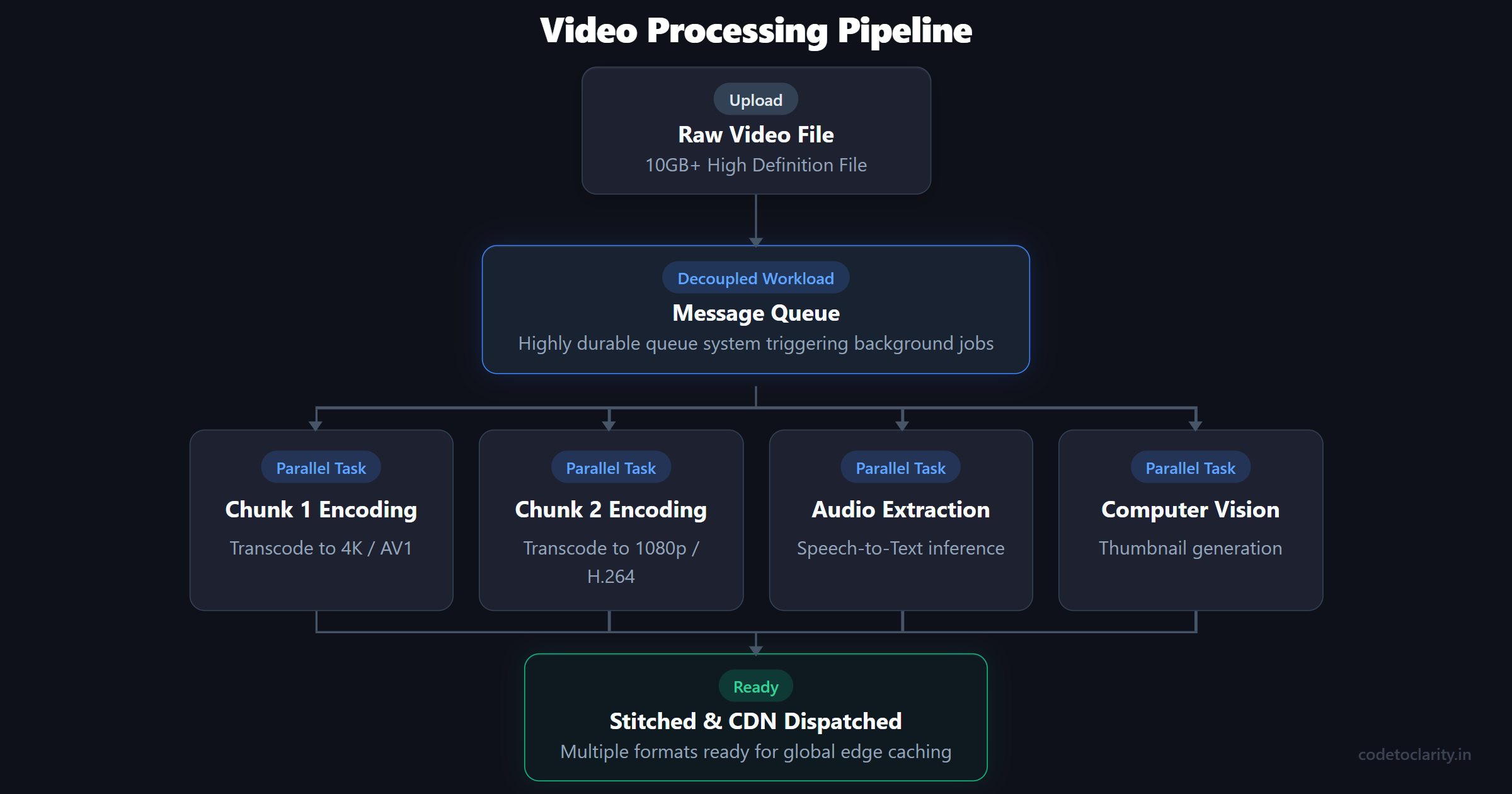
If you are building a system that handles heavy processing tasks, always decouple the heavy lifting from the main web server using asynchronous message queues and background workers. You can learn more about this architectural pattern in our guide on scaling a system from zero to 10 million users.
2. Polyglot Persistence: The Database Architecture
With billions of videos, comments, likes, and user profiles, how does YouTube actually store all this data? The secret to planetary scale is that they don't use just one massive database. They embrace a concept called polyglot persistence. This means using different database technologies for different types of data based on their specific access patterns and consistency requirements.
User Data and Relational Consistency
When it comes to your user account, your billing information for YouTube Premium, or your channel subscription list, strict data integrity and strong consistency are critical. You wouldn't want to subscribe to a channel on your phone and then not see it on your smart TV because the database hasn't synced yet.
For this type of relational data, YouTube historically relied heavily on MySQL. To handle their massive scale, they pioneered Vitess. This is an incredible database clustering system that allows for horizontal scaling of MySQL. Today, within Google's ecosystem, systems like Google Cloud Spanner provide globally distributed, strongly consistent SQL databases. Spanner guarantees ACID transactions across continents. This is an engineering feat that defies traditional database constraints.
Video Metadata and High-Volume Reads
What about video metadata? The title, description, tags, view count, and the millions of comments on a viral music video all need to be stored. This data is read billions of times a day. While strong consistency is nice, it is not strictly required here. If your view count is off by a few hundred for a couple of seconds, it doesn't break the user experience.
For this highly scalable, schema-less data, YouTube leans on NoSQL databases like Bigtable. Bigtable is optimized for massive scale, low latency, and astronomically high-throughput reads and writes. It can handle petabytes of data, making it perfect for storing engagement metrics and timeseries data without breaking a sweat.
Search and Discovery
When you type a query into the YouTube search bar, you expect instant, highly relevant results. Traditional relational databases are notoriously slow at full-text search across billions of rows. Instead, YouTube uses distributed search engines. These are conceptually similar to Elasticsearch and index video titles, descriptions, and auto-generated transcripts. This allows for sub-second search responses, intelligent typo tolerance, and personalized ranking algorithms.
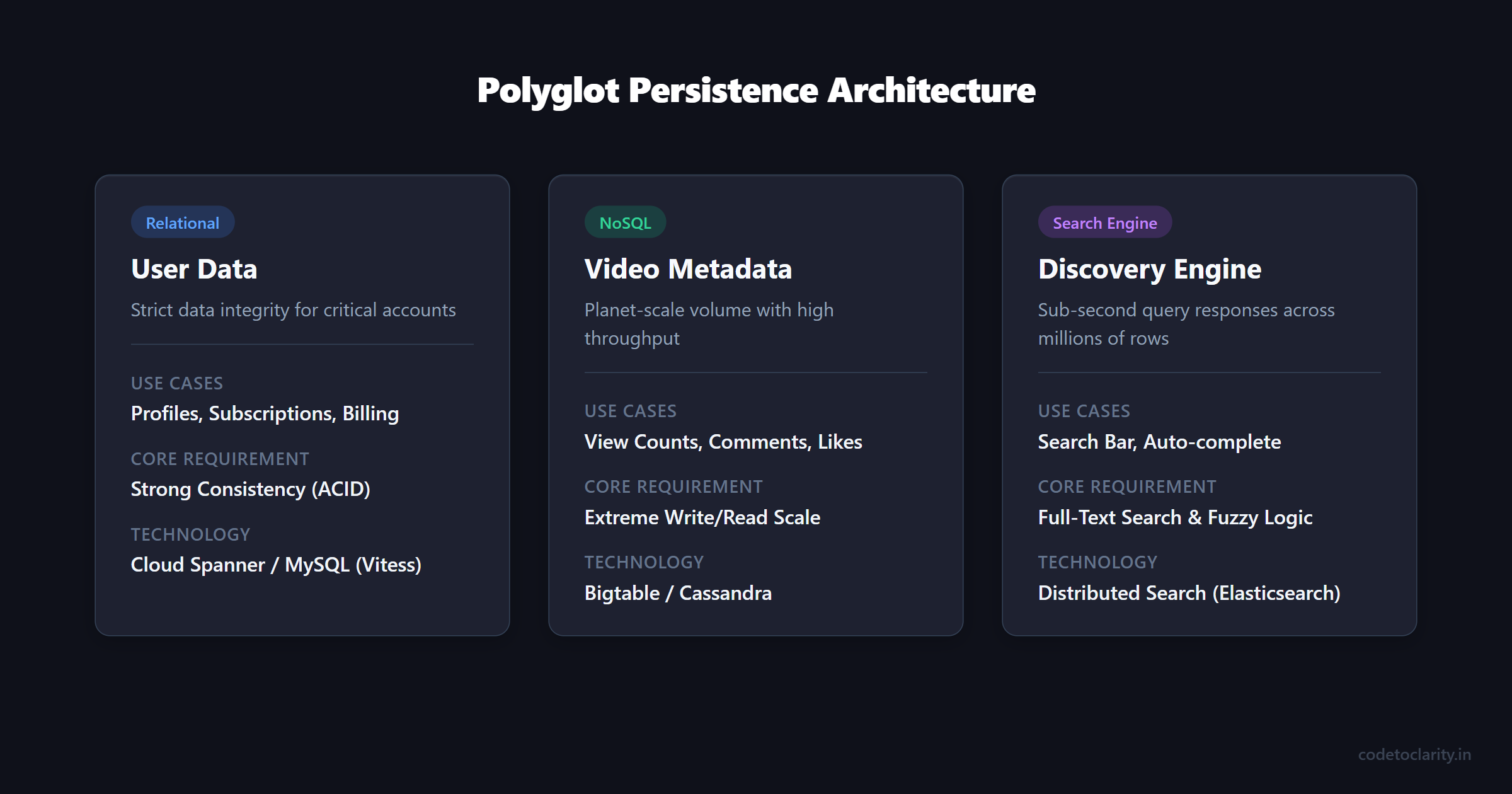
Takeaway: Never try to force all your application's data into a single database. Choose the right tool for the job based on your read to write ratios and consistency needs. To dive deeper into how database choices impact system performance, check out our article on why database performance fails at schema design or explore the PACELC theorem to understand these distributed trade-offs.
3. The Global CDN: Defeating the Speed of Light
Let's talk about the laws of physics. Data traveling through fiber-optic cables is fast, but it cannot exceed the speed of light. If a video is stored in a primary data center in California, and a user in Mumbai tries to watch it, the data packets have to travel halfway across the globe. This physical distance introduces latency.
In the world of video streaming, high latency means buffering, and buffering means frustrated users who close the app and go elsewhere.
What is a Content Delivery Network?
To solve the latency problem, YouTube relies on an enormous Content Delivery Network (CDN). A CDN is a globally distributed network of proxy servers deployed in multiple data centers around the world. The goal of a CDN is to serve content to end-users with high availability and high performance by storing cached copies of the data physically closer to the user.
Google operates one of the largest private networks in the world, with hundreds of Edge locations spread across every continent.
Intelligent and Predictive Caching
YouTube doesn't just blindly cache every video on every server globally. That would require an impossible amount of storage space. Instead, they use sophisticated machine learning models to perform predictive caching and intelligent cache warming.
When a video starts gaining traction and going viral in the United Kingdom, the CDN intelligence layer notices the rapid spike in traffic. Before users in neighboring European countries even search for the video, the system proactively pushes cached copies of that video to Edge servers in France, Germany, and Spain.
By the time a user in Paris requests the video, it is served from a server that might be just a few miles away from their house, rather than an ocean away. This drops the network latency from hundreds of milliseconds down to tens of milliseconds.
Furthermore, internet service providers (ISPs) often partner with Google to place dedicated cache servers directly inside the ISP's own local network. This means the video traffic might not even have to traverse the public internet to reach your screen!
4. Adaptive Bitrate Streaming (ABS): The End of Buffering
We have all experienced the frustration of a patchy, unreliable internet connection. You are watching a video on your daily train commute, the cellular signal suddenly drops as you enter a tunnel, and you are left staring at a spinning loading wheel. To combat this poor user experience, YouTube utilizes a brilliant technology called Adaptive Bitrate Streaming (ABS).
Chunk-Based Delivery
Remember how we mentioned earlier that videos are transcoded into different resolutions and chopped into small chunks during the processing pipeline? That chunking process is the absolute secret to smooth streaming.
When you watch a YouTube video, your browser or mobile app isn't downloading one massive, continuous file. Instead, the player is downloading small, independent 2-to-10 second segments of the video. The server provides a manifest file using standard protocols like MPEG-DASH or HLS. This file lists all the available resolutions, bitrates, and the specific URLs for each video chunk.
Dynamic Quality Switching in Real-Time
As you watch the video, the YouTube player on your device is incredibly smart. It is constantly monitoring your internet connection in the background. It checks metrics like available bandwidth, network latency, and exactly how much video is currently stored in your local playback buffer.
If your connection is strong and stable, the player will confidently request the next video chunk in high definition, such as 1080p or 4K. But if your train enters a tunnel and your signal plummets to 3G speeds, the player instantly detects the drop in bandwidth. Instead of pausing the video to stubbornly wait for the heavy 1080p file to download, it dynamically requests the next chunk in a much lower resolution like 480p or 240p.
Because the video is delivered in independent chunks, this transition is entirely seamless. The video quality might get a little blurry or pixelated for a few seconds, but the playback never stops. Once your train exits the tunnel and your fast 5G connection returns, the player seamlessly switches back to requesting the high-definition chunks.
This continuous, real-time optimization ensures that viewers have a buffer-free experience. It maximizes watch time and user retention even on the most unstable mobile networks.
5. The Recommendation Engine: The Core of Engagement
You can build the most robust, highly scalable, and blazing-fast video delivery system in the world. However, if users cannot find content they actually want to watch, the platform will ultimately fail. The recommendation engine is the absolute lifeblood of YouTube. It is estimated that recommendations drive over 70% of the total watch time on the platform.
Collaborative Filtering and The Two-Tower Model
Historically, YouTube's recommendation system relied heavily on traditional collaborative filtering. The fundamental idea is simple. Users who watched Video A also watched Video B. Since you just watched Video A, you will probably like Video B.
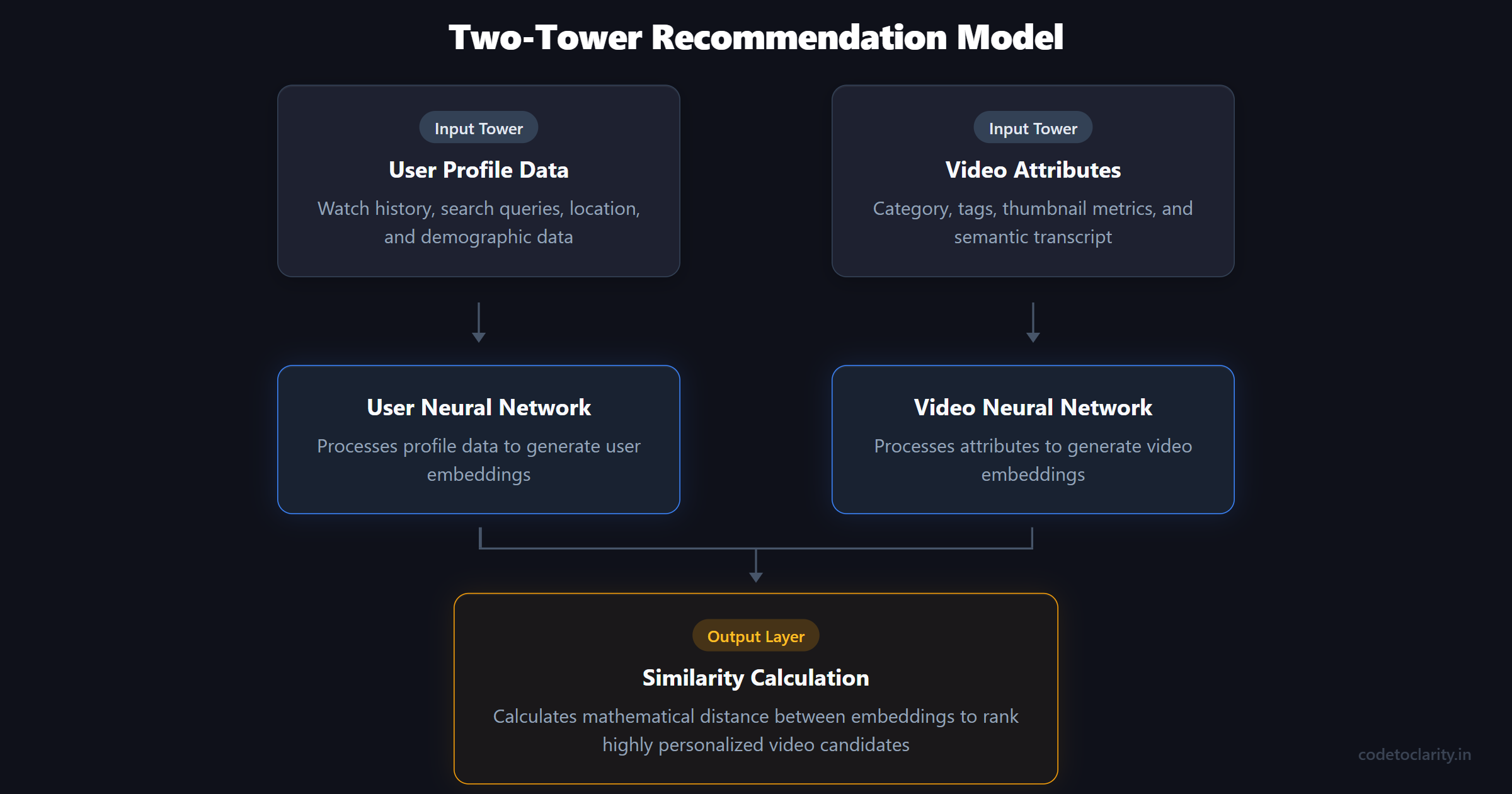
However, modern recommendation systems are vastly more complex, often utilizing deep neural networks in what is called a Two-Tower architecture. The first tower processes your user profile, including your watch history, search queries, geographic location, time of day, and demographic data. The second tower processes the video's attributes, such as its category, tags, thumbnail engagement rate, and semantic meaning derived from the transcript.
The system calculates the mathematical similarity between the user profile embeddings and the video embeddings to generate a highly personalized list of candidates.
Real-Time Event Processing
To make these recommendations hyper-relevant and addictive, the system must learn and adapt in real-time. When you skip a video after 5 seconds, explicitly click the Not Interested button, or suddenly binge-watch three 40-minute documentaries about space exploration, the system immediately updates your user profile.
This requires massive real-time stream processing frameworks like Apache Flink or Google Cloud Dataflow. Billions of individual events like clicks, pauses, watch times, and likes are streamed into the processing engine every single day. This continuously fine-tunes the machine learning models.
Balancing Exploration vs. Exploitation
A truly great recommendation engine doesn't just show you what it mathematically knows you already like. This is a concept called exploitation. It also helps you discover entirely new interests, which is called exploration. If YouTube only ever recommended programming tutorials to a software developer, that user would eventually get bored and leave.
The algorithm actively tests the waters by occasionally sprinkling in out-of-category videos. This might include a video about astrophysics, woodworking, or a cooking tutorial. By analyzing your reaction to these exploration videos, the system broadens its understanding of your interests. This keeps the content feed fresh and engaging over years of usage. It also helps solve the cold start problem for new creators by testing their fresh content against a small subset of relevant users.
6. Observability and Monitoring: Keeping the Lights On
When you are operating at the scale of 500,000+ servers globally, things break every single minute of every single day. Hard drives fail, network switches drop packets, and memory leaks bring down microservices. How does YouTube maintain 99.9% uptime despite constant hardware and software failures?
The answer is world-class observability.
Distributed Tracing and Metrics
At this scale, a single user request like loading the homepage might touch 50 different microservices before returning an HTML response. If the homepage is loading slowly, how do you know which of the 50 microservices is the bottleneck?
Engineers use distributed tracing to tag every request with a unique ID. As the request flows through the architecture, each service logs exactly how many milliseconds it spent processing its portion of the work. This trace data is aggregated into massive dashboards.
Coupled with granular metrics and centralized logging, Site Reliability Engineers can set up automated alerts. If the error rate for the transcoding service spikes by 2%, automated systems can instantly roll back the latest code deployment or route traffic away from a failing data center before users even notice a glitch.
Observability is not just for tech giants. If you want to stop guessing why your own applications are failing in production, check out our ultimate guide to .NET observability with traces, logs, and metrics.
Conclusion: System Design Lessons for Every Developer
You do not need to be building the next YouTube to benefit from understanding its architecture. The core principles that power this massive platform apply to almost any modern web application or enterprise system you will build in your career.
Here are the key takeaways for your own system designs:
- Decouple Heavy Workloads: Never tie up your main API servers with CPU-intensive tasks. Use message queues and background workers for processing images, generating PDF reports, or sending batch emails. Let your web servers focus purely on serving HTTP requests quickly.
- Embrace Polyglot Persistence: Stop trying to make a single database do everything. Use a relational database for transactional integrity, NoSQL for high-volume reads and writes, and a dedicated search engine for complex queries.
- Cache Everywhere, Strategically: Caching is the ultimate performance cheat code in software engineering. Use CDNs for your static frontend assets and implement robust distributed caching layers in your backend. For more on this, read our complete guide to caching in ASP.NET Core.
- Design for Failure: Distributed systems will fail. It is an absolute certainty. Design your systems with graceful degradation in mind. This is much like how YouTube dynamically lowers video quality rather than halting playback entirely when a network connection degrades.
Understanding planetary-scale architecture transforms the way you approach everyday coding challenges. When you start thinking in terms of bottlenecks, caching strategies, and distributed workloads, you elevate yourself from a simple coder to a true system architect.
Now, the next time you click on a YouTube video and it plays instantly, you will know exactly how much incredible, orchestrated engineering is happening behind the scenes to make that magic possible.

Kishan Kumar
Software Engineer / Tech Blogger
A passionate software engineer with experience in building scalable web applications and sharing knowledge through technical writing. Dedicated to continuous learning and community contribution.