
Hashing vs Encryption vs Tokenization: A Developer's Guide to Picking the Right Tool
Learn the crucial differences between Hashing, Encryption, and Tokenization. A beginner-friendly guide to choosing the right cryptographic tool to protect your data.

Author & Creator · CodeToClarity
Imagine spending thousands of dollars on a state-of-the-art titanium vault, only to leave the combination written on a sticky note attached to the door.
In the software world, we do something similar every day. We reach for advanced cryptographic algorithms to protect our users' data, but we often pick the wrong tool for the job. You wouldn't use a hammer to drive a screw. Yet, many developers use hashing when they should be encrypting, or encryption when they should be tokenizing.
The scary part? Unlike a compiler error that screams at you in bright red text, using the wrong security mechanism doesn’t trigger an alarm. It quietly compiles, passes your unit tests, and gives you a false sense of security right up until the day of a massive data breach.
In this guide, we are going to break down Hashing, Encryption, and Tokenization. By the end, you won't just know what they are. You will understand exactly when and why to use each one in your applications.
The Golden Rule: What Are You Trying to Protect?
Before we dive into the deep end of cryptography, we need to establish a framework for making decisions. When you are handed a sensitive piece of data (like a password, a credit card number, or a private medical record), you need to ask yourself one fundamental question:
Do I ever need to get the original value back?
Your answer to this question acts as a fork in the road:
- If the answer is NO: You almost certainly want Hashing. You don't need the data itself. You just need to be able to verify that future data matches this original data.
- If the answer is YES, and your goal is to hide it from prying eyes: You want Encryption. You are trying to maintain confidentiality.
- If the answer is YES, but your goal is to stop the sensitive data from spreading across your microservices: You want Tokenization. You want to limit exposure.
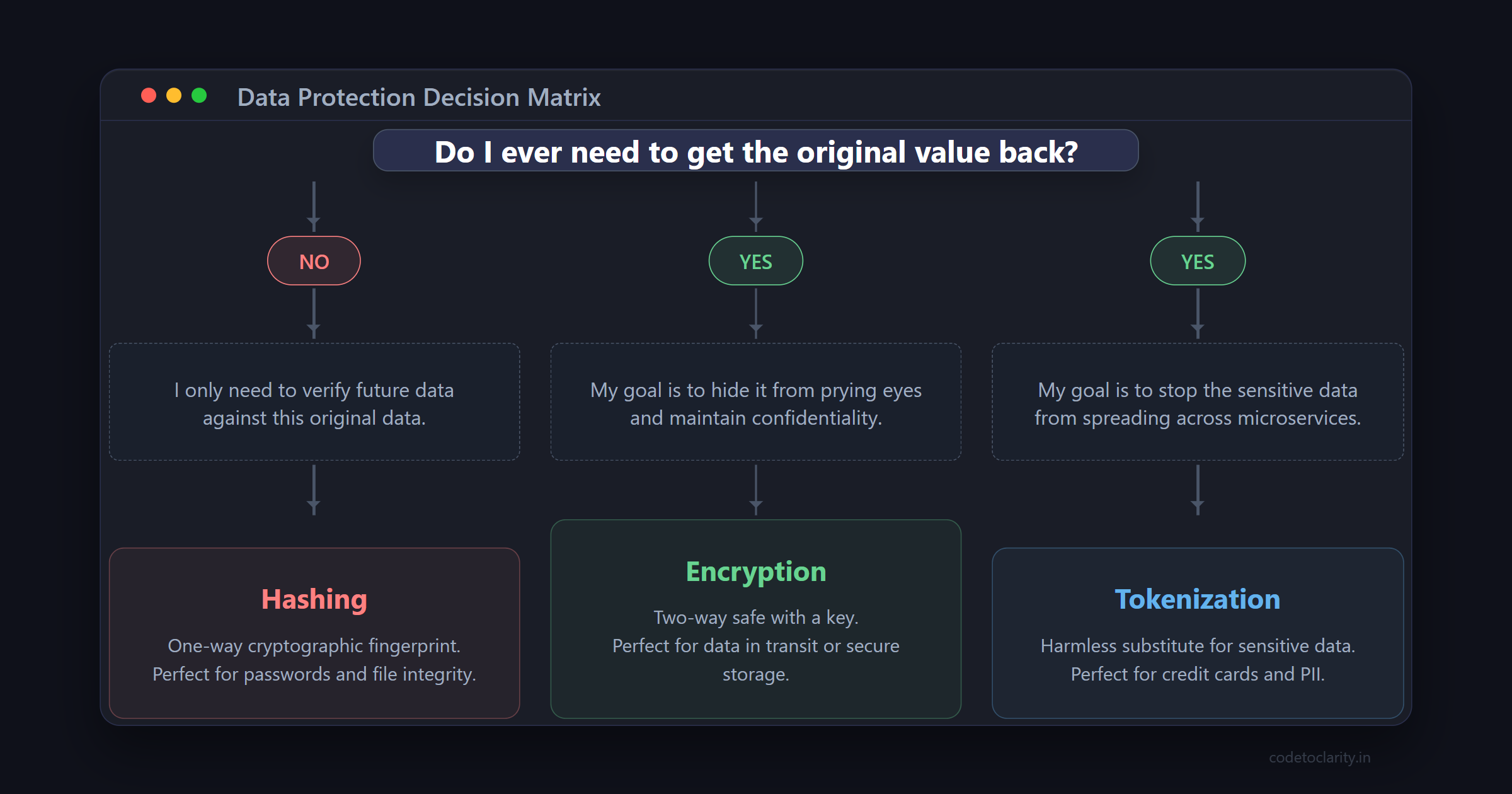
While all three techniques transform data into unreadable strings of characters, they serve completely different architectural goals. Let's explore each one in detail.
Hashing: The One-Way Street
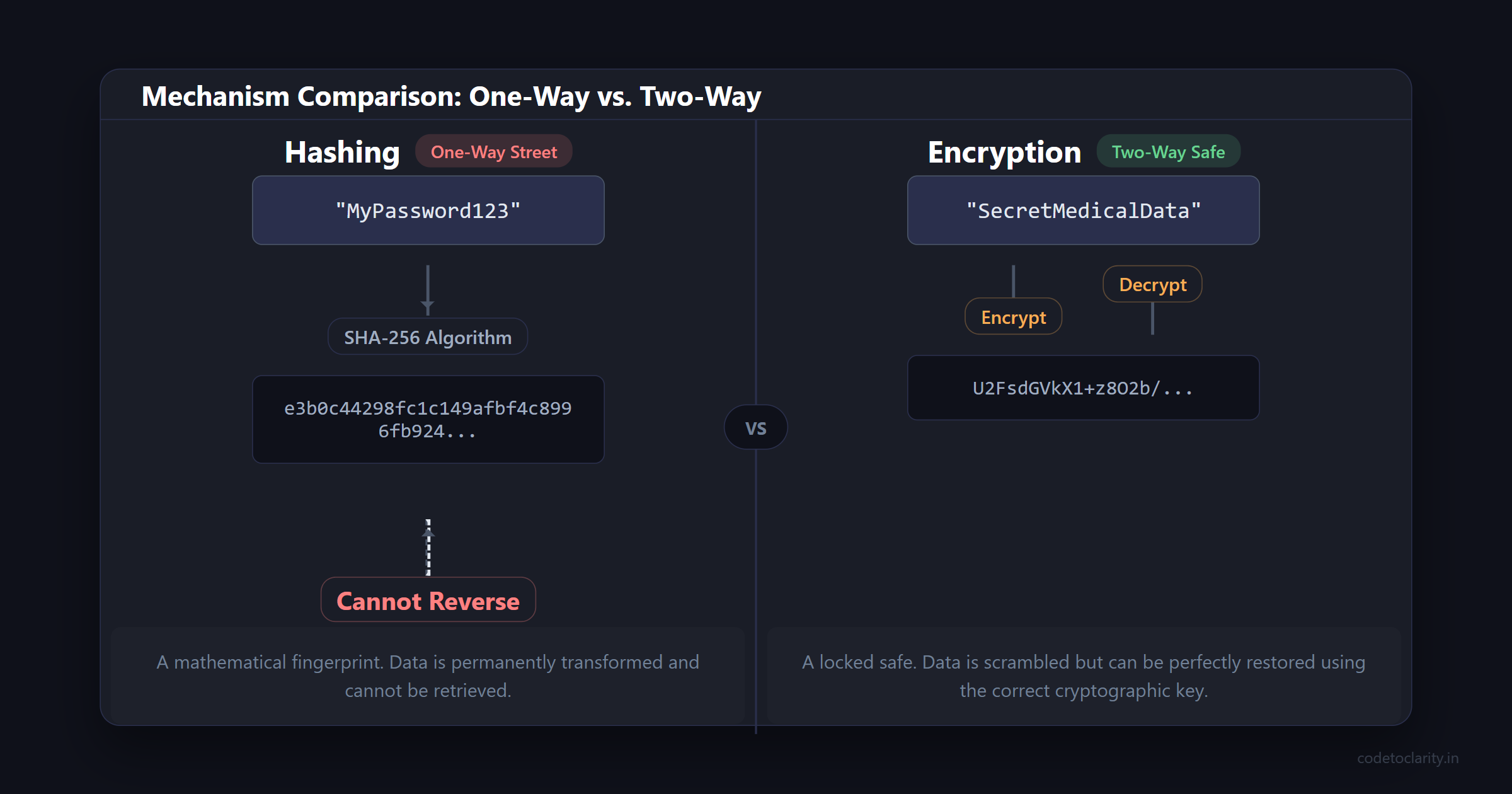
Hashing is a cryptographic process that takes an input of any size (whether it is a single word or a 10-gigabyte video file) and mathematically transforms it into a fixed-length string of characters. This output is called a hash or a digest.
The defining characteristic of a hash is that it is strictly one-way. Once you turn a string of text into a hash, there is no mathematical way to reverse the process and get the original text back.
Think of hashing like a human fingerprint. If you have a suspect in custody, you can take their fingerprint and compare it to one found at a crime scene. If they match, you know you have the right person. However, you cannot use a fingerprint found at a crime scene to reconstruct the physical appearance of the criminal.
Key Characteristics of Hashing
- Deterministic: The same input will always produce the exact same output hash. If you hash the word
CodeToClarity, you will get the exact same digest today, tomorrow, and ten years from now. - Avalanche Effect: A tiny change in the input should drastically change the output. If you hash
CodeToClarityand then hashcodeToClarity(with a lowercase 'c'), the resulting hashes will look completely different. There is no overlapping pattern. - Fast (Usually): Standard hash algorithms like SHA-256 are designed to be extremely fast so they can process large files quickly.
What is Hashing Good For?
Because hashing provides a unique, non-reversible fingerprint of data, it is the perfect tool for Integrity and Verification.
- File Integrity: When you download a large software package, the provider often publishes the SHA-256 hash. After downloading, you can hash the file on your machine. If your hash matches their published hash, you know the file wasn't corrupted or tampered with during transit.
- Digital Signatures: In modern authentication systems, such as those relying on JSON Web Tokens (JWTs), the payload is hashed and cryptographically signed. This ensures that nobody has altered the claims inside the token.
- Data Structure Lookups: Hash tables use non-cryptographic hashes to quickly locate data in memory.
The Password Hashing Trap
We need to take a detour here. Storing passwords is where most developers make a critical mistake.
Since we never need to know a user's actual password, we only need to verify if the password they type during login matches the one they signed up with. Hashing is clearly the correct tool.
However, standard hashing algorithms like SHA-256 are terrible for passwords.
Why? Because they are too fast. A modern graphics card can calculate billions of SHA-256 hashes per second. If an attacker steals your database, they can use pre-computed tables (called rainbow tables) or brute-force dictionaries to guess your users' passwords in a matter of hours.
To store passwords securely, you must use slow, memory-hard hashing algorithms. Algorithms like Bcrypt, Scrypt, or Argon2 are intentionally designed to be computationally expensive. They incorporate a "work factor" that you can dial up as hardware gets faster. This ensures that even if an attacker steals your database, guessing passwords remains mathematically unfeasible.
For the definitive guide on securely storing passwords, always consult authoritative resources like the OWASP Password Storage Cheat Sheet.
When NOT to Use Hashing
- When you need the data back: A hash is a one-way door. If you hash a user's credit card to process a refund later, you are entirely out of luck.
- For confidentiality: Hashing does not hide data. It destroys it.
Encryption: The Safe with a Key
If hashing is a fingerprint, encryption is a heavy steel safe. You can put your valuables inside, lock the door, and as long as you have the key, you can open it up and retrieve your items later.
Encryption transforms readable plaintext into scrambled ciphertext using an algorithm and a cryptographic key. The defining characteristic of encryption is that it is two-way (reversible) by design.
This makes encryption the undisputed king of Confidentiality.
Symmetric vs. Asymmetric Encryption
Encryption comes in two primary flavors:
-
Symmetric Encryption (The Single Key): Imagine a padlock where the exact same physical key is used to both lock and unlock it. In symmetric encryption (like AES, or Advanced Encryption Standard), the sender and the receiver share a single secret key. It is incredibly fast and highly efficient for encrypting large volumes of data.
- The Catch: How do you safely get the key to the receiver without someone intercepting it?
-
Asymmetric Encryption (The Public/Private Key Pair): Imagine a mailbox. Anyone can drop a letter into the slot (the public key), but only the owner with the physical key (the private key) can open the box and read the mail. Algorithms like RSA or ECC use a mathematically linked pair of keys. You share your public key with the world, but fiercely guard your private key.
- The Catch: It is computationally heavy and very slow. This makes it unsuitable for encrypting large chunks of data (like streaming a movie).
The Real World: Hybrid Encryption
In practice, modern systems use a clever combination of both. When you connect to a secure website using HTTPS, your browser and the server use asymmetric encryption briefly. They only use it to securely agree on a shared secret key over the network. Once that secret key is established, they switch to symmetric encryption to rapidly send data back and forth.
This hybrid approach gives you the secure key exchange of asymmetric cryptography with the blinding speed of symmetric cryptography.
The Evolution: Authenticated Encryption (AEAD)
Historically, encryption only provided confidentiality. It scrambled the data, but it didn't guarantee that the data had not been tampered with. A clever attacker could intercept the ciphertext, flip a few bits, and cause the decryption process to output modified, corrupt data.
Today, modern encryption relies on Authenticated Encryption with Associated Data (AEAD), such as AES-GCM. AEAD is revolutionary because it solves two problems at once:
- Confidentiality: It encrypts the data so no one can read it.
- Integrity: It attaches an authentication tag (similar to a hash) that guarantees the ciphertext hasn't been altered in transit.
If you are building .NET applications and need to implement cryptography, always rely on the built-in, vetted libraries described in the official Microsoft Cryptography documentation rather than trying to roll your own security.
The Hidden Cost of Encryption
Encryption seems perfect, but it carries a massive architectural burden: Key Management.
Keys have a lifecycle. They need to be generated securely, stored in Hardware Security Modules (HSMs) or cloud services like Azure Key Vault, rotated periodically, and revoked if compromised. If you lose the key, you lose the data permanently. If a hacker steals the key, your encryption is completely worthless.
When NOT to Use Encryption
- When you don't need the data back: Do not encrypt passwords. If the key is stolen, every single user password is compromised in plaintext.
- When you are trying to stop data from spreading: Encrypting a credit card number and passing it through fifteen different microservices means fifteen microservices now handle encrypted sensitive data. You haven't solved the exposure problem. You have just shifted the risk around your network.
Tokenization: The Exposure Reducer
If encryption asks, "How do we hide this data?", Tokenization asks an entirely different question. It asks, "How do we stop this data from spreading in the first place?"
Tokenization replaces a highly sensitive piece of data (like a Social Security Number or a Primary Account Number) with a non-sensitive substitute called a "token." This token has no intrinsic value and no mathematical relationship to the original data.
Think of a casino. Instead of walking around with stacks of hundred-dollar bills (which are valuable everywhere), you exchange your cash for plastic casino chips (which are only valuable inside the casino for specific games). You have tokenized your money.
How Tokenization Works in Practice
Imagine a sprawling e-commerce architecture. A user submits their credit card to buy a product.
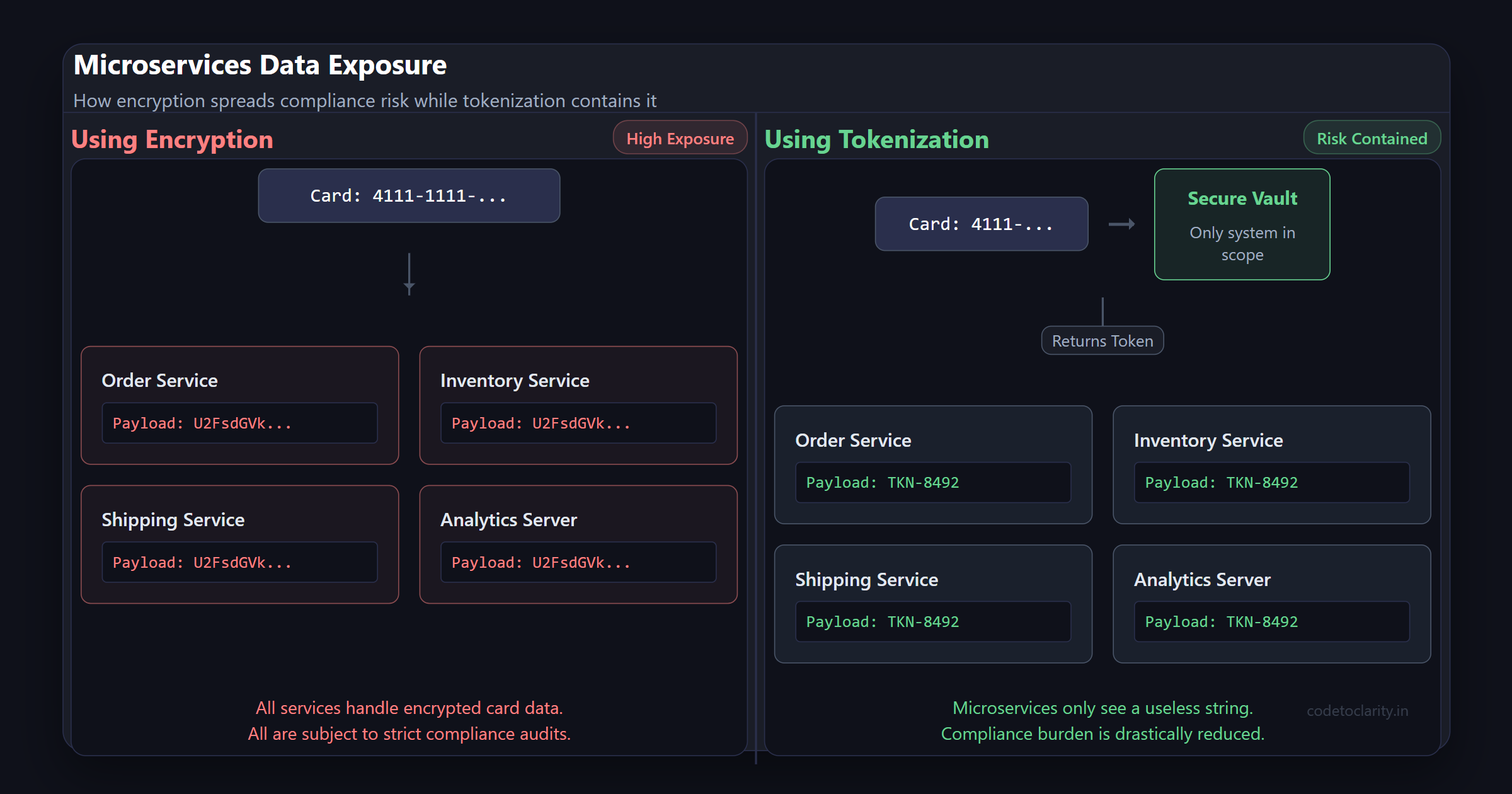
If you use encryption, the card is encrypted, and that ciphertext is passed to the order service, the inventory service, the shipping service, and the analytics database. All of these systems are now "in scope" for security audits like PCI DSS, because they touch sensitive data. It doesn't matter that the data is encrypted.
If you use Tokenization, the credit card goes straight to an isolated, highly secure Tokenization Vault. The vault stores the real card, generates a random string (like TKN-8492-4921), and hands that token back to your application.
Your order service, shipping service, and analytics database only ever see TKN-8492-4921.
- If a hacker breaches the shipping service, they steal a useless token.
- If a developer accidentally logs the payload, they log a useless token.
- Your compliance burden drops drastically because only the central Vault system actually handles the real credit card data.
Types of Tokenization
- Vault-Based Tokenization: The classic approach. A highly secure database maps the real value to the generated token. It is conceptually simple, but the vault becomes a high-value target and a potential network bottleneck.
- Vaultless (Cryptographic) Tokenization: This approach uses complex format-preserving encryption to generate a token without needing a massive lookup database. This removes the database bottleneck, but it heavily relies on strict key management policies.
When NOT to Use Tokenization
- Small, monolithic applications: If your app is simple and self-contained, the architectural overhead of deploying and maintaining a dedicated tokenization vault is likely overkill.
- When you need analytical querying: If you need to perform range scans or complex joins on the data (for example, "Find all users aged 25-30"), tokenization destroys the underlying formatting and makes these database operations impossible.
Side-by-Side Comparison
To crystalize these concepts, let's look at how they stack up against each other. Understanding this table will save you hours of architectural headaches.
| Feature | Hashing | Encryption | Tokenization |
|---|---|---|---|
| Primary Goal | Integrity & Verification | Confidentiality | Exposure Reduction |
| Is it Reversible? | No (Strictly one-way) | Yes (Requires a key) | Yes (Requires vault access) |
| Output Format | Fixed length string | Varies by input size | Often preserves original format |
| Key Dependency | No (Unless keyed) | Yes (Required for decryption) | Sometimes (For vaultless setups) |
| Best Use Case | Passwords, File integrity | Data in transit, Secure storage | Credit cards, PII in microservices |
Making the Decision: Real-World Scenarios
Let's put this knowledge to the test against common developer scenarios you will encounter in the wild.
Scenario 1: You are building a user login system and need to store user passwords in your SQL database.
- The Right Tool: Hashing (Specifically Bcrypt, Scrypt, or Argon2).
- Why: You never need to know the plaintext password. You only need to verify that what the user types during login matches what you have stored. You never need to retrieve the original value. The same irreversible hashing principle applies to machine credentials: see our deep dive on API Key Authentication & Management in ASP.NET Core to learn how high-entropy API keys are stored exclusively as SHA-256 digests.
Scenario 2: You are building a healthcare app that stores medical diagnoses. Doctors need to retrieve this data when viewing a patient profile.
- The Right Tool: Encryption (such as AES-256).
- Why: You need to retrieve the original data (a two-way operation). Your primary concern is keeping the data confidential from anyone who is not explicitly authorized to view it.
Scenario 3: You are building a sprawling microservices architecture for a retail platform. Customers save their credit cards for future purchases, and a dozen different services need to reference the user's payment method.
- The Right Tool: Tokenization.
- Why: You do not want twelve different services handling encrypted credit card data and dealing with massive PCI compliance audits. You want one secure vault to hold the card, while the rest of the ecosystem passes around a harmless, non-sensitive token.
Scenario 4: You are implementing a Single Sign-On flow where you need to securely pass user claims from your authentication server to a client application.
- The Right Tool: A mix of techniques!
- Why: As discussed in our OAuth 2.0 Guide and our Single Sign-On (SSO) Guide, modern identity systems rely heavily on structured tokens. While the token itself acts as a credential, the contents are typically protected using hashing and digital signatures to guarantee integrity. Occasionally, they use encryption to keep the claims entirely confidential.
Conclusion: Security is About Intent
The biggest takeaway here is that security vulnerabilities rarely come from a failure in the underlying math. The cryptographic algorithms behind AES, SHA-256, and Bcrypt are incredibly robust. They are tested continuously by the brightest cryptographers in the world.
The failures happen at the architectural level. They happen when we as developers do not clearly define what we are actually trying to achieve.
Hash when you need to verify. Encrypt when you need to retrieve. Tokenize when you need to contain.
Take a hard look at the systems you are building right now. Are you using the right tool, or are you just using the tool you are most familiar with? Understanding the difference between these three core concepts is exactly what separates a developer who knows how to write code from an engineer who knows how to design secure systems.
Software engineer passionate about building scalable, production-grade applications with C#, .NET, and modern cloud technologies. Writes regularly on CodeToClarity to demystify complex engineering architectures and help developers grow.
Related Technical Guides
OWASP API Security Top 10 in ASP.NET Core: Preventing BOLA, BOPLA, and SSRF with Resource-Based Authorization
Master OWASP API Security in ASP.NET Core 9. Prevent BOLA (IDOR) with resource-based authorization, stop BOPLA mass assignment, and neutralize webhook SSRF attacks.
API Key Authentication & Management in ASP.NET Core: Constant-Time Hashing, Scoping, and Secure Storage
Master API key authentication in ASP.NET Core 9. Learn Stripe-style prefixed keys, CRC32 checksums, SHA-256 hashing, FixedTimeEquals, and Redis caching.
Secure Refresh Token Rotation & Revocation: Preventing Token Theft and Replay Attacks in Distributed APIs
Prevent token theft and replay attacks in distributed APIs. Master Refresh Token Rotation, Token Family tracking, HttpOnly cookies, and ASP.NET Core 9 with Redis.