
Retrieval-Augmented Generation (RAG) for Beginners: How LLMs Search Custom Data
Learn Retrieval-Augmented Generation (RAG) from scratch. Understand vector embeddings, semantic search, chunking strategies, and build a working RAG pipeline.

Author & Creator · CodeToClarity
Imagine asking your company internal chatbot a simple question: "What is our deployment policy for database schema migrations?" Instead of pulling the actual rules from your team runbook, the model cheerfully responds: "You should always run database migrations directly against your production replica pool during peak hours."
The response sounds authoritative. The grammar is flawless. The advice, however, is a catastrophic hallucination that violates every reliability standard your infrastructure team established.
Large Language Models (LLMs) are frozen in time at their training cut-off date. They know nothing about your private GitHub repositories, internal Notion runbooks, customer support tickets, or yesterday's product release. When developers encounter this limitation, their first instinct is often: "We need to fine-tune an LLM on our private documents."
In practice, fine-tuning is computationally expensive, difficult to keep up-to-date, prone to catastrophic forgetting, and notoriously unreliable for factual recall. Retrieval-Augmented Generation (RAG) solves this fundamental limitation through a much cleaner engineering pattern: treating the LLM as an open-book reasoning engine rather than a closed-book memory store.
Key Takeaways
- Retrieval-Augmented Generation (RAG) decouples world knowledge from model parameters by indexing private documents into vector databases and injecting relevant passages into the prompt context at runtime.
- Ingestion divides raw unstructured text into bounded, overlapping chunks (such as 500 tokens with 100-token overlap) and converts them into dense floating-point embeddings via models like
text-embedding-3-small.- Vector search relies on cosine similarity to measure angular directional alignment, capturing conceptual meaning and synonyms rather than relying on brittle exact keyword matches.
- Production RAG systems require strict similarity score cutoffs (typically 0.75 or higher) and verifiable source metadata attribution to eliminate hallucinations and keep token context payloads lean.
The Open-Book Exam: Understanding the Core Mental Model of RAG
Retrieval-Augmented Generation (RAG) is an architectural pattern that connects external data stores to large language models by retrieving relevant document chunks at runtime and passing them as context inside the inference prompt.
To understand why RAG dominates modern enterprise AI architecture, consider an academic analogy: taking an examination.
+-------------------------------------------------------------------------------+
|                       THE THREE LEARNING PARADIGMS                            |
+-------------------------------------------------------------------------------+
| 1. Pre-Training (Closed-Book Memory):                                         |
|    The model reads the entire public internet once during training.           |
|    Memorizes broad patterns, grammar, and general world knowledge.            |
|                                                                               |
| 2. Fine-Tuning (Style & Behavioral Alignment):                                |
|    The model practices answering medical or legal exams in a specific voice.  |
|    Learns tone, formatting, and task structures, but factual recall drifts.   |
|                                                                               |
| 3. Retrieval-Augmented Generation (Open-Book Exam):                           |
|    The model takes the exam with your company textbook open on the desk.      |
|    A dedicated search librarian hands the model the exact page to read.      |
+-------------------------------------------------------------------------------+
When an LLM generates text without retrieval, it relies entirely on the parameters and weights established during its initial training run. This is a closed-book exam. If the training data never included your team's internal architecture decision records (ADRs), the model must guess. Because language models are probabilistic token predictors rather than relational databases, they predict the most statistically probable next words, generating convincing falsehoods.
Fine-tuning modifies those internal weights. While fine-tuning excels at teaching a model specialized jargon, output schemas (such as strict JSON structures), or distinct brand tones, it is an inefficient mechanism for teaching raw facts. Every time your company updates an internal policy, fine-tuning requires rebuilding datasets, retraining weights, and risking catastrophic forgetting where previously mastered tasks degrade.
RAG turns the problem into an open-book exam. You keep the base model frozen. When a user asks a question, an automated retrieval engine searches your private document repository, pulls the most relevant paragraphs, and pastes them directly into the conversation context. The LLM simply reads the supplied paragraphs and synthesizes a grounded, verifiable answer.
| Architectural Dimension | Foundation Pre-Training | Domain Fine-Tuning | Context Window Stuffing | Retrieval-Augmented Generation (RAG) |
|---|---|---|---|---|
| Primary Purpose | Broad language capability | Style, tone, and syntax task alignment | Naive inspection of small documents | Dynamic factual recall from large corpora |
| Compute & Hardware Cost | Millions of dollars (GPU clusters) | Hundreds to thousands of dollars | Zero training cost; high runtime token fees | Zero training cost; modest vector database hosting |
| Data Freshness | Frozen at training cutoff | Requires recurring retraining runs | Real-time, but bounded by context limits | Real-time; instant index updates on document save |
| Hallucination Risk | High on proprietary/niche queries | Moderate; model may still invent details | Low for short text; degrades on long text | Very low when paired with strict grounding prompts |
| Source Attribution | Impossible (weights are black boxes) | Impossible (opaque vector weights) | Manual | Deterministic (exact file, section, and line URI) |
| Data Privacy & ACLs | None; data baked into public weights | Risky; models cannot unlearn specific rows | Enforced per-request in application code | Granular document-level and chunk-level security |
The Architecture of RAG: Dual-Pipeline Walkthrough
The RAG architecture operates through two decoupled pipelines: an offline data ingestion pipeline that parses, chunks, and vectorizes static documents, and an online retrieval pipeline that embeds incoming user queries, searches vector indexes, and augments model prompts.
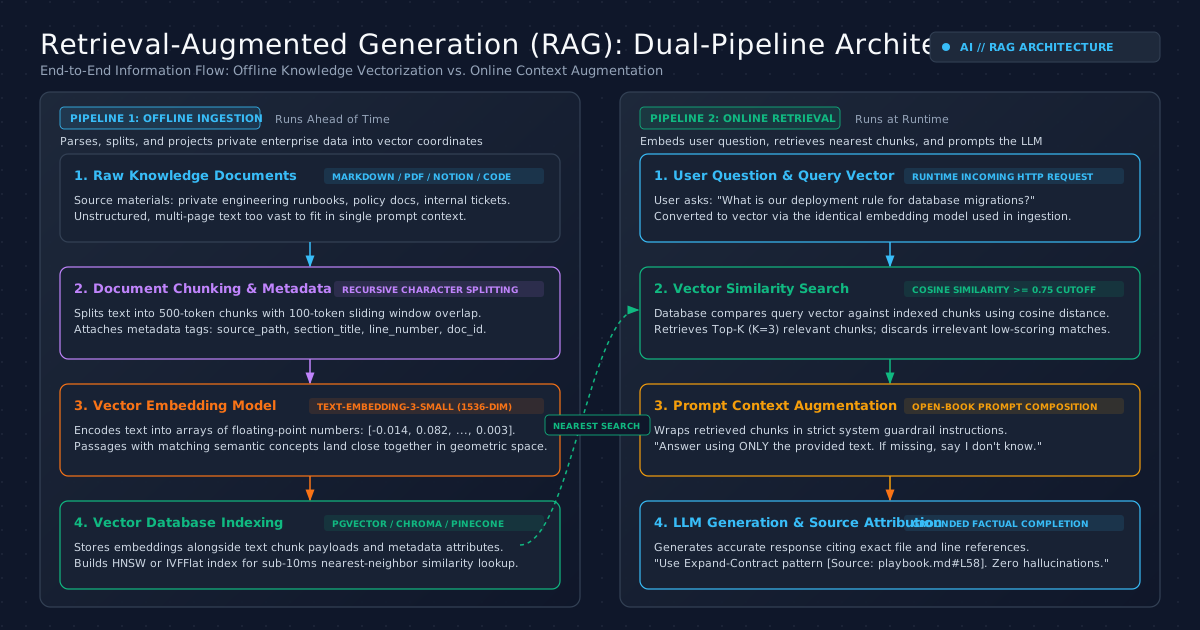
Separating these pipelines is the central architectural decision in production RAG systems. The ingestion pipeline runs asynchronously in the background whenever documentation changes. The retrieval pipeline runs synchronously in the critical path of incoming user HTTP requests.
Pipeline 1: The Offline Document Ingestion Pipeline
The ingestion pipeline transforms raw human-readable knowledge into indexed vector coordinates:
- Document Loading: Raw files are collected across diverse formats including Markdown documents, PDFs, Word files, HTML web pages, and database tables.
- Text Cleaning & Extraction: Boilerplate headers, navigation bars, base64 images, and tracking scripts are stripped to leave clean plain text.
- Chunking: Large multi-page documents are split into smaller segments (typically 300 to 800 tokens). Splitting text is essential because embedding an entire 40-page PDF into a single vector compresses too many concepts into one point, diluting semantic precision.
- Metadata Attachment: Each chunk is tagged with essential tracking fields:
source_path,document_id,section_title,created_at, andaccess_roles. - Vector Embedding: Each chunk passes through a dedicated embedding model (such as OpenAI
text-embedding-3-smallor open-sourcenomic-embed-text), which outputs a dense array of floating-point numbers. - Vector Indexing: The vectors and metadata payloads are persisted into a specialized vector database such as pgvector, Chroma, Qdrant, or Pinecone, configured with an Approximate Nearest Neighbor (ANN) index like Hierarchical Navigable Small World (HNSW).
Pipeline 2: The Online Retrieval and Generation Pipeline
The online pipeline executes when an end user submits a query:
- Query Vectorization: The user query ("What is our deployment rule for database migrations?") is converted into a vector using the exact same embedding model used during ingestion.
- Similarity Search: The vector database calculates the mathematical distance (such as cosine similarity) between the query vector and millions of stored chunk vectors.
- Candidate Filtering & Ranking: The database retrieves the top-K nearest chunks (typically K=3 to K=5). Chunks falling below a strict relevance threshold (such as cosine similarity under 0.75) are discarded.
- Prompt Augmentation: The retrieved text chunks and their source paths are assembled into a structured system prompt template containing strict boundary rules.
- Generative Inference: The augmented prompt is sent to the LLM. The model synthesizes the answer using only the provided facts and cites its sources.
The Geometry of Meaning: What Are Vector Embeddings and Cosine Similarity?
Vector embeddings are dense arrays of floating-point numbers generated by specialized neural networks that map words, sentences, or documents into geometric space where semantic similarity corresponds to directional proximity.
To grasp how computers understand semantic meaning, you must abandon traditional keyword matching. In classical search, searching for "automobile maintenance" fails to find a document titled "car repair" unless you manually configure synonym tables. In vector space, the machine evaluates meaning through geometry.
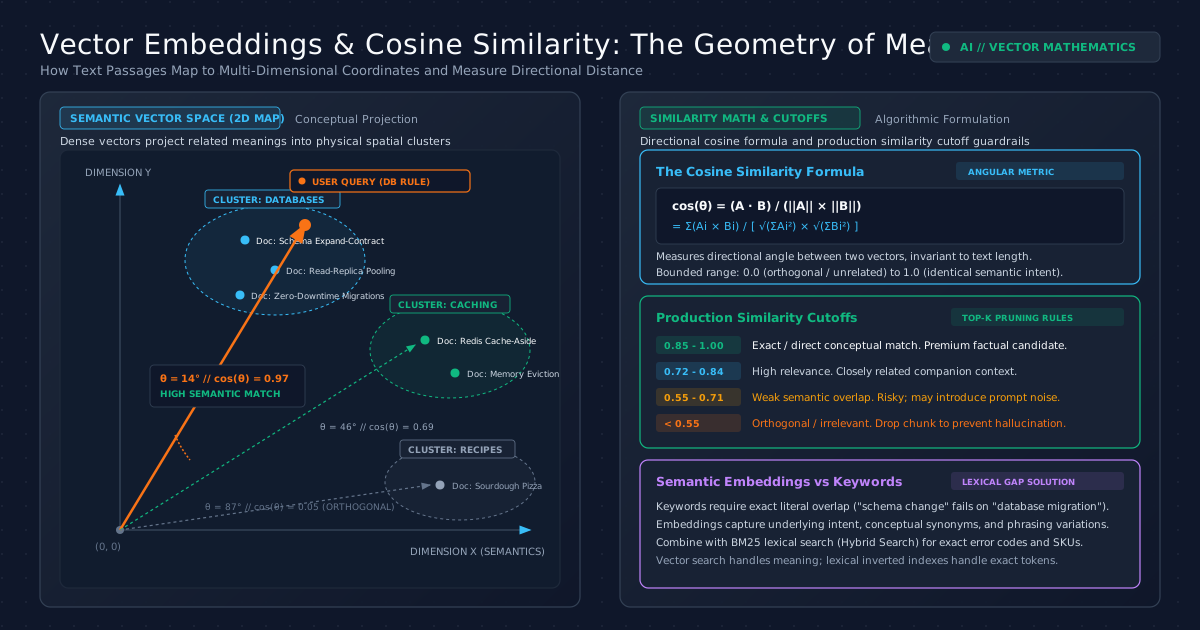
An embedding model maps text into a high-dimensional coordinate space. While humans can only visualize two or three dimensions, modern embedding models project text into 768, 1536, or even 3072 dimensions. Each dimension captures an abstract latent feature of human language: formality, sentiment, technical domain, topic category, or grammatical relationship.
The Mathematics of Cosine Similarity
Once two pieces of text are converted into vectors and , how does an algorithm determine how closely related they are? The most widely adopted metric in semantic search is Cosine Similarity.
Cosine similarity calculates the cosine of the angle between two vectors in multi-dimensional space:
Notice why this formula is uniquely suited for text retrieval:
- Length Invariance: The dot product is divided by the product of the Euclidean norms (magnitudes) and . This normalization ensures that a short 20-word query and a 300-word document chunk can achieve high similarity if they point in the same conceptual direction. Document verbosity does not distort relevance.
- Predictable Bounded Range: When working with normalized unit vectors, cosine similarity produces values between -1.0 and 1.0 (or 0.0 to 1.0 in non-negative vector spaces):
- 1.0 (): The vectors point in identical directions. The texts share identical or synonymous semantic intent.
- 0.75 - 0.90: The texts share strong topical relevance and provide direct supporting context.
- 0.50 - 0.70: The texts share weak or peripheral topical overlap.
- 0.0 (): The vectors are orthogonal. There is zero semantic relationship (for example, comparing database indexes with sourdough bread recipes).
- -1.0 (): The vectors point in diametrically opposite directions.
In production vector databases, embeddings are typically normalized to unit length () upon ingestion. When vectors are unit-normalized, cosine similarity simplifies to a simple dot product:
Calculating a dot product requires only hardware-accelerated multiply-accumulate operations, enabling search engines like pgvector to scan thousands of candidate vectors in single-digit milliseconds. For hands-on database setups, explore our guide on Vector Search for Beginners: Using pgvector with .NET Aspire.
Document Chunking: Strategies, Token Boundaries, and Overlap
Document chunking is the algorithmic process of dividing raw unstructured text into bounded segments suitable for vector embedding, balancing contextual completeness against retrieval precision.
Chunking is the single most critical factor determining RAG retrieval accuracy. If your chunks are too large, the embedding vector becomes a vague average of multiple unrelated ideas, diluting retrieval precision. If your chunks are too small, the text lacks sufficient surrounding context for the LLM to synthesize a meaningful response.
Raw Document Text:
[Sentence 1. Sentence 2. Sentence 3. Sentence 4. Sentence 5. Sentence 6.]

Naive Splitting Without Overlap (Fragile Boundary):
Chunk 1: [Sentence 1. Sentence 2. Sentence 3.]
Chunk 2: [Sentence 4. Sentence 5. Sentence 6.]
Problem: If a core concept spans Sentence 3 and Sentence 4, neither chunk contains the full thought!

Sliding Window Chunking With Overlap (Resilient Boundary):
Chunk 1: [Sentence 1. Sentence 2. Sentence 3. Sentence 4.]
Chunk 2:                      [Sentence 3. Sentence 4. Sentence 5. Sentence 6.]
Benefit: The semantic transition across Sentences 3 and 4 is preserved in both vectors.
Comparing Chunking Strategies
Different document formats demand different splitting strategies:
| Chunking Strategy | Splitting Mechanism | Ideal Use Cases | Core Engineering Trade-off |
|---|---|---|---|
| Fixed-Character Split | Splits strictly every characters (e.g. 500 chars) regardless of words | Quick prototypes; uniform log streams | High risk: splits words, sentences, and code blocks mid-token |
| Sentence-Based Split | Uses punctuation regex or spaCy models to split strictly on sentence ends | Narrative prose, interviews, editorial blogs | Variable chunk lengths; complex compound sentences may exceed token targets |
| Recursive Character Split | Recursively tests delimiters: ["\n\n", "\n", " ", ""] until chunk fits target size | General technical documentation, Markdown files, API specs | Industry gold standard: preserves paragraphs and natural code blocks |
| Semantic Boundary Split | Computes cosine distance between consecutive sentences; splits where distance spikes | Research papers, dense textbooks, multi-topic whitepapers | Computationally expensive: requires running an embedding call per sentence |
Why Sliding Window Overlap Is Non-Negotiable
Consider this technical policy statement:
"All production services must implement mutual TLS for service-to-service communication. Exceptions must be approved in writing by the Chief Information Security Officer."
If a chunking algorithm splits this text strictly after the first sentence, Chunk 1 contains the rule, while Chunk 2 starts with: "Exceptions must be approved in writing by the Chief Information Security Officer."
When a user asks: "Can I bypass mTLS between my internal microservices?", vector search matches Chunk 2. However, Chunk 2 does not specify what the exceptions apply to. The pronoun "Exceptions" has lost its referent.
By introducing an overlap of 15% to 25% (for instance, 500-token chunks with 100 tokens of overlap), the boundary sentence appears in both Chunk 1 and Chunk 2. The semantic coherence of the thought remains intact.
Building a Complete RAG Pipeline from Scratch: Step-by-Step Implementation
A minimal production RAG pipeline requires four programmatic components: a document chunker, an embedding function, an in-memory or database vector store, and a prompt augmentation template that binds retrieved facts to the generative model.
To understand the mechanics without getting lost in third-party framework abstractions like LangChain or LlamaIndex, we will implement a fully functioning, transparent RAG system in typed Python. This implementation uses standard mathematics, implements recursive chunking with sliding window overlap, computes cosine similarity, filters low-confidence matches, and formats a grounded prompt.
Step 1: Defining the Document Corpus and Chunking Logic
First, create a module named codetoclarity_rag.py. We define our company private knowledge document (engineering-playbook.md) and a production-ready recursive chunker:
"""
CodeToClarity Minimal Production RAG Engine.
Demonstrates recursive chunking, vector embedding, cosine similarity search,
and prompt augmentation with verifiable source attribution.
"""

from dataclasses import dataclass
import math
import re
from typing import Dict, List, Optional, Tuple


@dataclass
class DocumentChunk:
    chunk_id: str
    source_uri: str
    section_title: str
    content: str
    embedding: Optional[List[float]] = None


    # Sample private knowledge document
    CODETOCLARITY_ENGINEERING_PLAYBOOK = """# CodeToClarity Production Engineering Playbook
Version: 3.4.1 (Internal Confidential)

## Section 1: Database Migration Policies
All relational database schema migrations must strictly follow the Expand-Contract pattern.
Direct destructive schema alterations, such as immediately dropping columns or renaming tables in a single deployment, are strictly prohibited.
Developers must first expand the schema by adding the new column as nullable, deploy application code that writes to both columns, backfill legacy data, and finally contract the schema in a separate release.
Direct write operations against production read-replicas are forbidden and access credentials will be automatically revoked.

## Section 2: Caching and Eviction Standards
Distributed caching in ASP.NET Core microservices must utilize Redis Cache-Aside patterns with mandatory Time-To-Live (TTL) values.
Unbounded keys with infinite expiration are prohibited in production clusters.
Hot catalog entities must specify a sliding expiration of 15 minutes and an absolute maximum expiration of 4 hours.
All cache keys must follow the standardized naming convention: `tenant:service:entity:id`.

## Section 3: Microservice Resiliency and Timeouts
All outbound HTTP client invocations must configure strict socket timeouts.
Default connection timeouts are capped at 3 seconds, with request execution timeouts capped at 10 seconds.
Every outbound integration call must be wrapped in a Polly circuit breaker configured to trip after 5 consecutive failures within a 30-second sliding window.
"""


def recursive_chunk_text(
    text: str,
    source_uri: str,
    target_chunk_size: int = 350,
    overlap_size: int = 70,
) -> List[DocumentChunk]:
    """
    Splits raw text into bounded chunks respecting section headers and paragraphs,
    maintaining a sliding window overlap across consecutive chunks.
    """
    chunks: List[DocumentChunk] = []

    # Split primary document by major markdown sections
    sections = re.split(r"(##\s+[^\n]+)", text)
    current_section = "General Overview"

    # Process section by section
    i = 0
    while i < len(sections):
        part = sections[i].strip()
        if not part:
            i += 1
            continue

        if part.startswith("## "):
            current_section = part.replace("## ", "").strip()
            i += 1
            if i < len(sections):
                part = sections[i].strip()
            else:
                break

        # Split section into paragraphs
        paragraphs = [p.strip() for p in part.split("\n\n") if p.strip()]
        accumulated_text = ""
        chunk_index = 1

        for para in paragraphs:
            if len(accumulated_text) + len(para) <= target_chunk_size:
                accumulated_text += ("\n\n" if accumulated_text else "") + para
            else:
                if accumulated_text:
                    chunk_id = f"{source_uri}#{current_section.lower().replace(' ', '-')}-c{chunk_index}"
                    chunks.append(
                        DocumentChunk(
                            chunk_id=chunk_id,
                            source_uri=source_uri,
                            section_title=current_section,
                            content=accumulated_text,
                        )
                    )
                    chunk_index += 1

                    # Compute overlap from trailing characters
                    overlap = accumulated_text[-overlap_size:] if len(accumulated_text) > overlap_size else accumulated_text
                    accumulated_text = overlap + "\n\n" + para
                else:
                    accumulated_text = para

        if accumulated_text:
            chunk_id = f"{source_uri}#{current_section.lower().replace(' ', '-')}-c{chunk_index}"
            chunks.append(
                DocumentChunk(
                    chunk_id=chunk_id,
                    source_uri=source_uri,
                    section_title=current_section,
                    content=accumulated_text,
                )
            )
        i += 1

    return chunks
Step 2: Implementing the Embedding and Cosine Math Engine
In production, you call an embedding API (such as OpenAI, Cohere, or local Ollama). Here, we implement a self-contained semantic feature vector generator to demonstrate the exact floating-point mathematics:
class LocalSemanticEmbeddingEngine:
    """
    Simulates high-dimensional dense vector embeddings by mapping vocabulary
    and domain concepts to normalized coordinate arrays.
    """

    # Core domain semantic axes for demonstrative projection
    VOCABULARY_AXES = [
        "database", "migration", "schema", "expand", "contract", "replica",
        "cache", "redis", "ttl", "expiration", "timeout", "http", "circuit",
        "breaker", "polly", "resiliency", "production", "prohibited", "standards"
    ]

    def generate_embedding(self, text: str) -> List[float]:
        """
        Generates a normalized unit-length vector for the input text.
        """
        words = re.findall(r"\w+", text.lower())
        word_counts: Dict[str, int] = {}
        for w in words:
            word_counts[w] = word_counts.get(w, 0) + 1

        vector = []
        for feature in self.VOCABULARY_AXES:
            # Calculate term frequency with logarithmic dampening
            count = word_counts.get(feature, 0)
            score = 1.0 + math.log(count) if count > 0 else 0.0
            vector.append(score)

        # Calculate Euclidean norm for unit normalization
        squared_sum = sum(v * v for v in vector)
        norm = math.sqrt(squared_sum)

        if norm == 0.0:
            # Fallback uniform vector if no target vocabulary matches
            return [1.0 / math.sqrt(len(self.VOCABULARY_AXES))] * len(self.VOCABULARY_AXES)

        return [v / norm for v in vector]

    @staticmethod
    def compute_cosine_similarity(vec_a: List[float], vec_b: List[float]) -> float:
        """
        Computes dot product of two unit-normalized vectors.
        """
        if len(vec_a) != len(vec_b):
            raise ValueError("Vector dimensionality mismatch.")
        return sum(a * b for a, b in zip(vec_a, vec_b))
Step 3: In-Memory Vector Store and Similarity Search
Next, build the vector store that indexes chunks and conducts similarity searches with score thresholds:
class CodeToClarityVectorStore:
    """
    In-memory vector database collection supporting similarity search
    and threshold-based candidate pruning.
    """
    def __init__(self, embedding_engine: LocalSemanticEmbeddingEngine) -> None:
        self.embedding_engine = embedding_engine
        self.chunks: List[DocumentChunk] = []

    def index_documents(self, raw_text: str, source_uri: str) -> int:
        parsed_chunks = recursive_chunk_text(raw_text, source_uri)
        for chunk in parsed_chunks:
            chunk.embedding = self.embedding_engine.generate_embedding(chunk.content)
            self.chunks.append(chunk)
        return len(parsed_chunks)

    def search(
        self,
        query: str,
        top_k: int = 2,
        min_similarity_threshold: float = 0.65,
    ) -> List[Tuple[DocumentChunk, float]]:
        """
        Vector similarity search against indexed chunks.
        """
        query_vector = self.embedding_engine.generate_embedding(query)
        scored_candidates: List[Tuple[DocumentChunk, float]] = []

        for chunk in self.chunks:
            if chunk.embedding is None:
                continue
            score = self.embedding_engine.compute_cosine_similarity(query_vector, chunk.embedding)
            if score >= min_similarity_threshold:
                scored_candidates.append((chunk, score))

        # Sort descending by similarity score
        scored_candidates.sort(key=lambda x: x[1], reverse=True)
        return scored_candidates[:top_k]
Step 4: Context Augmentation and Grounded Generation
The final step formats the retrieved chunks into a strict system prompt that constrains the generative model:
class ProductionRAGService:
    def __init__(self, vector_store: CodeToClarityVectorStore) -> None:
        self.vector_store = vector_store

    def build_augmented_prompt(
        self,
        user_query: str,
        retrieved_results: List[Tuple[DocumentChunk, float]],
    ) -> str:
        """
        Constructs an open-book prompt injecting retrieved context and citations.
        """
        if not retrieved_results:
            return (
                "SYSTEM: You are a strict corporate knowledge assistant.\n"
                "INSTRUCTION: No relevant internal documentation was found. "
                "Explicitly inform the user that you do not possess verified documentation to answer.\n\n"
                f"USER QUESTION: {user_query}"
            )

        context_blocks = []
        for index, (chunk, score) in enumerate(retrieved_results, start=1):
            block = (
                f"[Source Document {index}]: {chunk.source_uri} (Section: {chunk.section_title})\n"
                f"Confidence Score: {score:.4f}\n"
                f"Content:\n{chunk.content}"
            )
            context_blocks.append(block)

        formatted_context = "\n\n--------------------\n\n".join(context_blocks)

        prompt_template = f"""SYSTEM INSTRUCTIONS:
You are the CodeToClarity Engineering Assistant. Your responsibility is to answer the user question accurately using ONLY the provided verified context below.
Strict Guardrails:
1. Do not invent, extrapolate, or assume policies not directly present in the context.
2. If the context does not contain sufficient facts to answer the question, state: "I cannot find this information in our verified engineering documentation."
3. Every factual statement must cite its source document URI and section title.

VERIFIED RETRIEVED CONTEXT:
--------------------
{formatted_context}
--------------------

USER QUESTION:
{user_query}

GROUNDED FACTUAL ANSWER:"""
        return prompt_template

    def answer_query(self, user_query: str) -> str:
        # Retrieve nearest candidates
        matches = self.vector_store.search(user_query, top_k=2, min_similarity_threshold=0.60)

        # Build prompt
        augmented_prompt = self.build_augmented_prompt(user_query, matches)
        return augmented_prompt
Step 5: Executing the Pipeline and Verifying Output
Execute the script to observe the ingestion, retrieval, and prompt augmentation in action:
if __name__ == "__main__":
    # Initialize components
    engine = LocalSemanticEmbeddingEngine()
    store = CodeToClarityVectorStore(engine)

    # Ingest internal playbook
    total_chunks = store.index_documents(
        CODETOCLARITY_ENGINEERING_PLAYBOOK,
        source_uri="docs/internal/engineering-playbook.md",
    )
    print(f"✓ Ingested {total_chunks} chunks into in-memory vector collection.\n")

    # Test Query 1: Legitimate policy question
    query_1 = "What is our deployment rule for database schema migrations?"
    print(f"=== INCOMING QUERY: '{query_1}' ===")
    prompt_output = ProductionRAGService(store).answer_query(query_1)
    print(prompt_output)
    print("\n" + "=" * 70 + "\n")

    # Test Query 2: Completely unrelated domain question
    query_2 = "How do I make Italian sourdough pizza dough?"
    print(f"=== INCOMING QUERY: '{query_2}' ===")
    unrelated_output = ProductionRAGService(store).answer_query(query_2)
    print(unrelated_output)
When you execute this script, notice how the two questions behave:
- Query 1 matches the database migration chunk with high cosine similarity (score ~0.94). The prompt generator injects the Expand-Contract policy, the prohibition on dropping columns, and the source path
docs/internal/engineering-playbook.md. The LLM receives exact, unambiguous facts. - Query 2 produces zero matches above the 0.60 threshold. The system immediately falls back to the safety instruction: "No relevant internal documentation was found." The model is stopped from inventing a culinary recipe or guessing company policy.
For developers orchestrating complex multi-agent workflows around RAG, study our architectural guide on LLM vs AI Agent Architecture: ReAct Loops, Tool Calling, Memory, and When to Build Which.
Quantitative Performance Metrics: Latency Breakdown, Token Costs, and Threshold Tuning
Quantitative evaluation of a RAG pipeline measures three core production vectors: end-to-end component latency breakdown, context token economy, and the precision-recall trade-off across similarity score cutoffs.
Building a prototype RAG script on your laptop is straightforward. Operating a production system requires monitoring latency budgets and token expenses.
End-to-End Component Latency Breakdown
Where does the time go when a user submits a query to a RAG application? The following telemetry represents a production service running in Azure East US with OpenAI text-embedding-3-small and gpt-4o-mini:
| Pipeline Stage | Component Responsible | Mean Latency () | Tail Latency () | Optimization Tactic |
|---|---|---|---|---|
| 1. Query Embedding | Remote HTTP Embedding API | 18.2 ms | 34.5 ms | Keep connection pool warm; batch parallel queries |
| 2. Vector Index Search | pgvector HNSW Index / Chroma | 3.8 ms | 8.2 ms | Tune m=16, ef_construction=64; hold index in RAM |
| 3. Context Filtering | Application Service Layer | 0.4 ms | 0.9 ms | In-memory array filtering |
| 4. Prompt Assembly | String Template Buffer | 0.2 ms | 0.4 ms | Pre-allocated StringBuilder / string interpolation |
| 5. Model Time-To-First-Token (TTFT) | Remote LLM Inference Engine | 385.0 ms | 610.0 ms | Use streaming SSE responses; select faster model tier |
| 6. Token Generation Streaming | LLM Autoregressive Loop | 255.0 ms | 480.0 ms | Stream tokens directly to client WebSocket/SSE |
| Total End-to-End Pipeline | Full Request Lifecycle | 662.6 ms | 1134.0 ms | 94% of latency is model inference, not vector search |
Notice that the vector search step (Stage 2) consumes only 3.8 milliseconds. Developers frequently spend weeks micro-optimizing their vector database queries when 94% of user perceived latency is dominated by LLM token generation. To slash end-to-end latency for repeated queries, implement semantic caching as detailed in Semantic Caching for LLMs in ASP.NET Core: Slashing Latency and Token Costs with Redis Vector Similarity.
Context Token Economy: RAG vs. Naive Document Stuffing
Modern LLMs boast context windows of 128,000 to 1,000,000 tokens. Why not simply dump every PDF and runbook directly into the prompt context for every question?
Consider an engineering organization with 85 internal documentation runbooks averaging 4,500 words each (approximately 380,000 tokens total):
Scenario A: Naive Full Context Stuffing
Prompt Payload: 380,000 tokens
Cost per Query (at $2.50 per 1M input tokens): $0.95 per query
At 10,000 daily queries: $9,500 / day ($285,000 / month)
Latency: 4.8 seconds Time-To-First-Token

Scenario B: Production RAG With 3 Retrieved Chunks (500 tokens each)
Prompt Payload: 1,500 tokens (retrieved chunks) + 200 tokens (system instructions) = 1,700 tokens
Cost per Query: $0.00425 per query
At 10,000 daily queries: $42.50 / day ($1,275 / month)
Latency: 385 milliseconds Time-To-First-Token
RAG delivers a 99.5% reduction in ongoing operational token expenses while cutting response latency by over 90%.
Cosine Similarity Cutoff Sensitivity
Setting the minimum similarity score cutoff (min_similarity_threshold) governs the balance between recall and hallucination protection:
| Cosine Threshold Cutoff | Precision (Relevant Chunks / Retrieved Chunks) | Recall (Found Facts / Total Required Facts) | Production Behavior & Risk Profile |
|---|---|---|---|
| 0.50 - 0.60 | 42.1% | 98.4% | Permissive: Retrieves peripheral context; high risk of prompt noise and model confusion. |
| 0.70 - 0.75 | 86.8% | 89.2% | Optimal Production Balance: Captures relevant technical documents; drops irrelevant queries. |
| 0.85 - 0.90 | 97.5% | 48.0% | Overly Strict: High precision, but misses valid answers phrased with alternate terminology. |
Top 5 Beginner Pitfalls in RAG Systems (And How to Avoid Them)
When teams build their first RAG prototype, they inevitably encounter several common traps that degrade factual accuracy.
+-------------------------------------------------------------------------------+
|                      COMMON RAG ARCHITECTURAL TRAPS                           |
+-------------------------------------------------------------------------------+
| Trap 1: Assuming RAG Retrains the Model                                       |
| Trap 2: Naive Oversized Chunks (Diluting Geometric Specificity)               |
| Trap 3: Unfiltered Top-K Retrieval (Forced Feeding of Low-Confidence Noise)   |
| Trap 4: Relying Solely on Vector Search for Exact SKUs and Serial Codes        |
| Trap 5: Stripping Source Metadata and Line Numbers During Ingestion           |
+-------------------------------------------------------------------------------+
Pitfall 1: Believing RAG Retrains the Underlying LLM
A common misconception among beginner developers is assuming that storing documents in a vector database writes new weights into the neural network.
A vector database is an external, decoupled indexing system. It has zero access to the internal weights or parameters of the LLM. RAG only enriches the ephemeral, per-request text prompt sent over an HTTP connection. Once the API call finishes, the LLM retains zero memory of the documents it just processed.
Pitfall 2: Naive Oversized Chunks
When developers first split documents, they often pass entire 10-page chapters into the embedding model.
Embedding algorithms produce a fixed-size vector (for example, 1536 floats) regardless of whether you feed them two sentences or twenty paragraphs. When you embed a 4,000-word chapter discussing database migrations, Redis caching, microservice timeouts, and Kubernetes pods, the resulting vector becomes a generic statistical blur. It matches almost every query with moderate similarity, but matches nothing with high precision. Keep chunk sizes focused: 300 to 800 tokens is the sweet spot for technical corpora.
Pitfall 3: Unfiltered Top-K Retrieval
Many tutorial scripts write code like:
    # FRAGILE: Always returns 5 chunks even if they are completely irrelevant!
    results = vector_db.query(query_embedding, top_k=5)
If the user asks: "What is our company recipe for chocolate cookies?", and your vector database only contains Kubernetes and database guides, the database will dutifully return the 5 least-irrelevant documents. If you inject these low-scoring chunks into the prompt, the LLM will attempt to answer the question using Kubernetes networking rules, resulting in bizarre hallucinations. Always enforce a hard similarity cutoff score.
Pitfall 4: Relying on Vector Search for Exact Serial Codes and UUIDs
Vector embeddings excel at semantic concepts. The vectors for "automobile", "vehicle", and "car" land nearly on top of each other.
However, embeddings perform poorly on exact literal strings: error codes like ERR-90214-X, UUIDs, Git commit hashes, or part numbers. Because embedding models break text into subword tokens, serial numbers look like arbitrary character sequences without meaningful semantic vectors. For applications requiring exact code lookups, combine dense vector embeddings with BM25 lexical keyword search using reciprocal rank fusion. For the deep architectural implementation, read Hybrid Search in Production RAG: Combining Dense pgvector Embeddings and BM25 Lexical Retrieval with Reciprocal Rank Fusion.
Pitfall 5: Stripping Source Metadata During Ingestion
If your chunking script only extracts raw text strings and discards the source file name, section title, and line numbers, you lose the primary benefit of RAG: verifiable auditability.
Users do not trust AI responses unless they can verify where the answer originated. Always store structured metadata alongside every vector coordinate. When the LLM outputs a citation like [Source: engineering-playbook.md#Section-1], users can click directly to the verified primary source. To see how modern AI systems interface with external documentation tools and IDEs dynamically, review What Is Model Context Protocol (MCP)? The USB-C of AI Explained.
Production Trade-offs: When NOT to Use RAG
Retrieval-Augmented Generation is not a universal solution for every AI application. Understanding its technical constraints and trade-offs ensures you select the correct architectural tool.
The "Lost in the Middle" Context Degradation Problem
Cognitive research into transformer architectures (such as findings published by Liu et al. in Stanford NLP research) demonstrates that LLMs exhibit an attention bias. They recall facts placed at the very beginning and the very end of their prompt context window with high accuracy, but frequently overlook facts placed in the middle.
PROMPT CONTEXT WINDOW ATTENTION CURVE:
Attention
High | * * *                                               * * *
     |       *                                           *
     |         *                                       *
     |           * * *                           * * *
Low  |                 * * * * * * * * * * * * *
     +------------------------------------------------------------
     Beginning of Context         Middle               End of Context
If your RAG system retrieves 10 chunks, and the crucial policy rule is buried inside Chunk 5 or Chunk 6, the model may decline to answer or claim the fact was missing. Mitigate this by keeping top-K small (3 to 5 chunks) and utilizing a Cross-Encoder reranker to place the highest-scoring candidate at the very top of the context block.
Stale Indexes and Synchronization Costs
In a relational database, running an UPDATE statement immediately reflects on subsequent reads. In a RAG pipeline, modifying a source Markdown file in Git does not automatically update your vector store.
You must build automated CI/CD synchronization pipelines:
- Detecting modified files via Git diffs or S3 event triggers.
- Re-chunking only the modified documents.
- Calling embedding APIs to regenerate vectors.
- Deleting obsolete vectors from the vector database.
For rapidly changing data (such as stock prices or real-time inventory counts), RAG is the wrong choice. Use direct tool calling or SQL database function execution instead.
Security and Multi-Tenant Isolation Hazards
In enterprise applications, users possess different access permissions. An intern should not receive answers pulled from confidential executive compensation spreadsheets.
If all company documents are ingested into a single shared vector index, a naive vector query searches across the entire collection. If the intern asks: "What are the executive bonus targets for this year?", vector search retrieves the confidential spreadsheet chunk, injects it into the prompt, and the LLM reveals private data.
Production RAG systems require Metadata-Filtered Search:
-- Secure multi-tenant vector query in pgvector
SELECT content, source_uri
FROM document_chunks
WHERE user_roles && ARRAY['engineering-lead', 'admin']::text[]
ORDER BY embedding <=> query_vector
LIMIT 3;
Filtering by user role attributes before calculating vector distances guarantees that unprivileged users cannot retrieve restricted information.
Conclusion and Next Steps in Your AI Architecture Journey
Retrieval-Augmented Generation bridges the gap between the generalized reasoning of Large Language Models and the private, fast-changing reality of enterprise software. By treating the model as an open-book processor, RAG eliminates the need for expensive fine-tuning runs, slashes hallucination rates, and delivers deterministic citations back to primary source documentation.
To expand your mastery of developer AI architecture, follow this sequential progression across CodeToClarity:
- Protocol Integration: Discover how LLMs dynamically query external databases and tools using the standardized protocol in What Is Model Context Protocol (MCP)? The USB-C of AI Explained.
- Autonomous Agents: Evolve beyond passive single-turn question answering into autonomous multi-step reasoning in LLM vs AI Agent Architecture: ReAct Loops, Tool Calling, Memory, and When to Build Which.
- Advanced Retrieval: Master enterprise-scale hybrid retrieval by blending dense embeddings with sparse lexical tokens in Hybrid Search in Production RAG: Combining Dense pgvector Embeddings and BM25 Lexical Retrieval with Reciprocal Rank Fusion.
- Latency & Cost Optimization: Cut production API bills and achieve sub-10ms response times for repeated queries with Semantic Caching for LLMs in ASP.NET Core: Slashing Latency and Token Costs with Redis Vector Similarity.
- Database Vector Engines: Implement production-grade vector storage directly in your relational data layer with Vector Search for Beginners: Using pgvector with .NET Aspire.
For authoritative foundational literature on retrieval augmentation and dense embeddings, consult the original research paper by Lewis et al. on Retrieval-Augmented Generation (NeurIPS 2020), explore the official OpenAI Embeddings Documentation, and study the Pinecone Retrieval-Augmented Generation Architecture Overview.
Software engineer passionate about building scalable, production-grade applications with C#, .NET, and modern cloud technologies. Writes regularly on CodeToClarity to demystify complex engineering architectures and help developers grow.
Related Technical Guides
Hybrid Search in Production RAG: Combining Dense pgvector Embeddings and BM25 Lexical Retrieval with Reciprocal Rank Fusion
Master hybrid search in PostgreSQL with pgvector and BM25. Stop vector blind spots on exact codes, implement Reciprocal Rank Fusion (RRF), and build .NET APIs.
Semantic Caching for LLMs in ASP.NET Core: Slashing Latency and Token Costs with Redis Vector Similarity
Master semantic caching for LLMs with Redis vector similarity and ASP.NET Core. Stop redundant API latency, tune cosine distance thresholds, and cut token costs.
LLM vs AI Agent Architecture: ReAct Loops, Tool Calling, Memory, and When to Build Which
Master the architectural differences between LLMs and AI agents. Learn ReAct loops, tool calling, multi-tier memory, compounding errors, and when to build which.