
How Instagram Scales to 500M Daily Active Users: System Design, Sharding, and Feed Architecture
Learn how Instagram serves billions of feeds daily. A complete system design guide to database sharding, fan-out vs fan-in, media pipelines, and global CDNs.

Author & Creator · CodeToClarity
When you open Instagram on your smartphone and pull down to refresh, dozens of high-resolution photos, Reels, and stories appear within 150 milliseconds. It does not matter whether you follow fifty close friends or five hundred accounts scattered across three continents. The feed loads almost instantly, complete with accurate like counts, comments, and personalized rankings.
For the average user, this smooth experience is taken for granted. For software engineers, backend developers, and system architects, Instagram represents one of the most demanding distributed systems ever built.
To understand the scale, consider the numbers. Instagram serves over 500 million Daily Active Users (DAUs) and more than 2 billion monthly active users. Every day, those users upload hundreds of millions of photos and videos, generate 10 billion likes, publish over 1 billion comments, and execute more than 5 billion feed queries. During peak evening hours, the platform must absorb over 20,000 post uploads per second, 350,000 like interactions per second, and 175,000 feed requests per second globally.
Building an architecture that handles this workload without crashing, lagging, or accumulating millions of dollars in unnecessary cloud egress fees requires rethinking traditional database design. You cannot rely on a single database, and you cannot compute a user's feed on the fly using standard SQL joins across millions of rows.
Key Takeaways
- Hybrid Feed Generation: Standard users with under 25,000 followers use Fan-Out on Write, pushing post references into follower timelines ahead of time. High-follower and celebrity accounts bypass this push write to prevent massive write storms, using dynamic Fan-In on Read during request assembly.
- Polyglot Persistence Layer: Core entities (users, relationships, and post metadata) reside in sharded relational databases partitioned by consistent hashing on user ID, while precomputed timelines live in wide-column storage (Apache Cassandra) and in-memory caches (Redis).
- Decoupled Asynchronous Pipelines: Time-consuming workloads such as media transcoding, notification dispatching, and fan-out updates are offloaded through Apache Kafka message queues, preserving sub-150-millisecond API response times for end users.
- Media Optimization at the Edge: Binary uploads bypass API application servers completely via pre-signed storage URLs, while global Content Delivery Networks (CDNs) absorb more than 95 percent of all image and video read traffic.
1. Capacity Estimations and Planetary-Scale Constraints
Capacity planning in high-scale distributed systems is the quantitative estimation of compute, memory, storage, and network throughput required to satisfy business traffic patterns. It translates high-level user metrics like Daily Active Users into concrete engineering bounds such as peak queries per second and daily raw byte ingress.
Before writing a single line of backend code or provisioning database servers, you must calculate the system limits. Designing for 500 million Daily Active Users requires understanding the read-to-write ratios, persistent storage demands, and peak throughput spikes.
User Traffic and Throughput Assumptions
Let us establish concrete parameters based on real-world mobile social graph usage:
- Daily Active Users (DAU): 500 million active individuals per day.
- Post Creation Frequency: On average, users publish 1 photo or video post per day across the global population, yielding 500 million posts per day.
- Feed Read Frequency: Each user opens the app and refreshes their feed approximately 10 times daily, resulting in 5 billion total feed reads every 24 hours.
- Interaction Volume: Users generate roughly 20 likes and 2 comments per day on average, translating to 10 billion likes and 1 billion comments daily.
From these daily totals, we can derive the steady-state and peak queries per second (QPS) using standard day-to-second conversions (86,400 seconds per day):
- Average Post Ingestion Throughput: 500,000,000 posts / 86,400 seconds = ~5,787 writes per second (rounded to 6,000 writes/sec).
- Average Feed Read Throughput: 5,000,000,000 reads / 86,400 seconds = ~57,870 reads per second (rounded to 58,000 reads/sec).
- Average Interaction Throughput: 11,000,000,000 interactions / 86,400 seconds = ~127,314 writes per second.
In production software systems, traffic is never evenly distributed. Major global events, holidays, and evening usage peaks typically generate traffic surges of 3x to 3.5x over the daily average. Therefore, our backend infrastructure must comfortably sustain:
- Peak Post Ingestion: ~20,000 writes per second.
- Peak Interaction Throughput: ~350,000 writes per second.
- Peak Feed Queries: ~175,000 reads per second.
Storage Capacity Calculations
Social networks are write-heavy, but media assets dwarf metadata in byte volume. Let us analyze both tiers:
- Media Composition: Assume 70 percent of uploads are compressed still images (averaging 500 Kilobytes) and 30 percent are short video clips or Reels (averaging 5 Megabytes across mobile resolutions).
- Blended Media Size: (0.70 * 0.5 MB) + (0.30 * 5.0 MB) = 0.35 MB + 1.50 MB = 1.85 Megabytes per upload.
- Daily Media Ingress: 500,000,000 posts * 1.85 MB = 925 Terabytes per day.
- Annual Media Ingress: ~337 Petabytes per year of raw media assets before multi-codec transcoding and thumbnail generation.
| Infrastructure Resource | Daily Ingress Volume | Peak Production Load | Architectural Target |
|---|---|---|---|
| Post Ingestion Pipeline | 500M posts / day | 20,000 writes / sec | Asynchronous Kafka queue with pre-signed blob uploads |
| Feed Timeline Delivery | 5.0B queries / day | 175,000 reads / sec | Sub-150ms latency via Redis in-memory cache and Cassandra |
| Interactions (Likes/Comments) | 11.0B events / day | 350,000 writes / sec | Write-back batching with dedicated relational table shards |
| Binary Blob Storage | ~925 TB / day | Multi-gigabit upload bursts | Distributed S3-compatible storage with automated cold lifecycle |
| Notification Pipeline | 1.5B notifications / day | 100,000 events / sec | Kafka pub/sub routing to Apple Push and Firebase Cloud Messaging |
These figures demonstrate why simple monolithic architectures collapse at this scale. A standard database server attempting to handle 350,000 concurrent relational writes while serving 175,000 complex multi-table feed queries would experience immediate connection pool saturation and disk I/O failure.
2. High-Level Architecture and Separation of Concerns
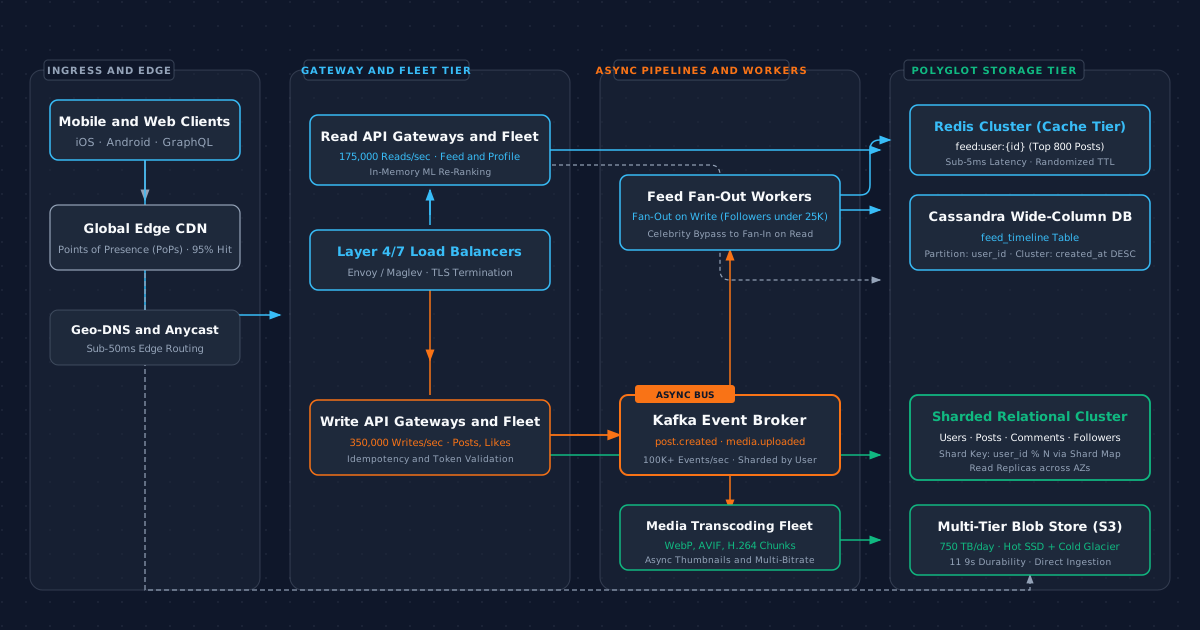
High-level social network architecture decouples client ingress, stateless application processing, distributed message brokering, and polyglot persistence tiers into dedicated horizontal layers. This structural isolation guarantees that sudden write spikes on viral posts cannot exhaust thread pools or starve latency-sensitive read operations.
To deliver extreme availability and low latency, Instagram separates incoming traffic by responsibility from the very first network hop.
The Ingress and Edge Routing Tier
When a user launches Instagram, the client application issues requests through global Geo-DNS (Domain Name System) and Anycast IP routing. The DNS resolver automatically directs the mobile client to the physically closest Point of Presence (PoP) or Edge data center.
- Global Content Delivery Network (CDN): The CDN serves static website bundles, cached user avatar images, and transcoded media files directly from local edge memory. Over 95 percent of binary media requests terminate at this layer, never touching core data center origin servers.
- Layer 4 and Layer 7 Load Balancers: Incoming API requests pass through high-performance Layer 4 load balancers (such as Maglev or IPVS) for initial TCP distribution, followed by Layer 7 proxies (such as Envoy). The Layer 7 proxies terminate Transport Layer Security (TLS), validate authentication headers, and enforce global rate limits.
Dedicated Read and Write API Gateways
Rather than directing all traffic into a single monolithic API cluster, the architecture bifurcates requests into distinct paths:
- Read API Gateways: Dedicated exclusively to latency-critical fetch operations, such as loading user profiles, querying comment threads, and delivering the main timeline. Because reads dominate traffic volume (175,000 peak QPS), these gateways are tuned for high concurrent network I/O, aggressive response caching, and fast in-memory lookups.
- Write API Gateways: Configured specifically for state modifications, such as publishing new posts, toggling likes, submitting comments, and following accounts. These gateways validate JSON payloads, ensure client idempotency, verify JWT authentication tokens, and immediately offload resource-intensive downstream side effects to asynchronous message queues.
By maintaining strict physical isolation between the read cluster and the write cluster, a massive influx of comments during a live global sporting event will never degrade the response time of regular users scrolling through their feeds.
If you want to understand how horizontal scaling principles evolve as an application grows from its first server to global scale, explore our detailed architectural walkthrough on scaling a system from zero to 10 million users.
3. Database Sharding and Consistent Partitioning
Database sharding is a horizontal partitioning technique that splits massive database tables across multiple independent database servers or clusters. Each shard holds a distinct subset of rows determined by a deterministic shard key, eliminating single-node storage and connection limits.
At hundreds of millions of users, holding all user profiles, follow relationships, and post records in a single database instance is mathematically impossible. A single PostgreSQL or MySQL instance cannot store hundreds of terabytes of relational data in RAM, nor can it handle 350,000 writes per second. Instagram addresses this reality using horizontal database sharding.
The Shard Key Dilemma: Why Sharding by Post ID Fails
When choosing a shard key for a social graph, you have two primary options:
- Partitioning by Post ID: If you partition tables by
post_id, posts are evenly scattered across all database shards. However, when a user navigates to a creator's profile page to view their latest twelve photos, the backend application server must issue a scatter-gather query across every single database shard in the cluster. As the number of shards increases to hundreds of machines, scatter-gather queries incur severe network overhead and tail-latency degradation. - Partitioning by User ID: If you partition by
user_id, all data belonging to a particular user (their profile record, their uploaded posts, and their comments) resides on the same logical shard. Fetching a user's entire profile requires querying exactly one database instance.
Instagram chose to shard primary relational data by user_id. Every table that represents user-generated content includes the author's user_id as part of its primary or composite index.
Instagram 64-Bit Custom ID Architecture
To make sharding work seamlessly without a centralized auto-increment bottleneck, engineers at Instagram created a custom 64-bit ID generation scheme inspired by Twitter's Snowflake algorithm. Every ID generated for a post, comment, or like encodes its own logical shard mapping and creation timestamp directly into its bits.
The 64-bit ID is structured into three distinct segments:
- 41 bits for Timestamp: Represents milliseconds elapsed since a custom Instagram epoch (such as January 1, 2020). With 41 bits, the system can generate unique IDs for approximately 69 years without rollover.
- 13 bits for Logical Shard ID: Represents the logical database shard where the entity lives. 13 bits allow for up to 8,192 unique logical shards ().
- 10 bits for Auto-Increment Sequence: A per-shard sequential counter that resets every millisecond. 10 bits allow each logical shard to generate up to 1,024 unique entity IDs per millisecond ().
Because the logical shard ID is physically baked into the first 54 bits of the entity ID, any application server that receives an entity ID (such as post_id = 458920194857219) can extract the logical shard ID using simple bitwise arithmetic, without querying a centralized routing index.
Here is a compilable C# implementation of the 64-bit ID generator and shard resolution logic:
using System;

namespace CodeToClarity.InstagramArchitecture.Sharding
{
    /// <summary>
    /// Generates and decodes 64-bit time-ordered entity identifiers
    /// containing an embedded logical shard identifier and sequence counter.
    /// </summary>
    public sealed class CodeToClarityIdGenerator
    {
        // Custom project epoch: January 1, 2024, 00:00:00 UTC in Unix milliseconds
        private const long CustomEpochMs = 1704067200000L;

        private const int ShardIdBits = 13;
        private const int SequenceBits = 10;

        private const long MaxShardId = (1L << ShardIdBits) - 1L;     // 8,191
        private const long MaxSequence = (1L << SequenceBits) - 1L;    // 1,023

        private readonly long _logicalShardId;
        private readonly object _syncLock = new object();

        private long _lastTimestampMs = -1L;
        private long _sequence = 0L;

        public CodeToClarityIdGenerator(long logicalShardId)
        {
            if (logicalShardId < 0 || logicalShardId > MaxShardId)
            {
                throw new ArgumentOutOfRangeException(
                    nameof(logicalShardId),
                    $"Shard ID must be between 0 and {MaxShardId}.");
            }

            _logicalShardId = logicalShardId;
        }

        public long GenerateId()
        {
            lock (_syncLock)
            {
                long currentTimestampMs = DateTimeOffset.UtcNow.ToUnixTimeMilliseconds();

                if (currentTimestampMs < _lastTimestampMs)
                {
                    // Clock moved backwards, handle clock skew
                    currentTimestampMs = _lastTimestampMs;
                }

                if (currentTimestampMs == _lastTimestampMs)
                {
                    _sequence = (_sequence + 1) & MaxSequence;
                    if (_sequence == 0)
                    {
                        // Sequence exhausted for this millisecond; spin-wait for next ms
                        while (currentTimestampMs <= _lastTimestampMs)
                        {
                            currentTimestampMs = DateTimeOffset.UtcNow.ToUnixTimeMilliseconds();
                        }
                    }
                }
                else
                {
                    _sequence = 0;
                }

                _lastTimestampMs = currentTimestampMs;

                long timeDelta = currentTimestampMs - CustomEpochMs;

                // Bit layout: [41 bits timeDelta] [13 bits shardId] [10 bits sequence]
                long id = (timeDelta << (ShardIdBits + SequenceBits))
                        | (_logicalShardId << SequenceBits)
                        | _sequence;

                return id;
            }
        }

        public static long ExtractLogicalShardId(long generatedId)
        {
            // Shift right past the 10-bit sequence and mask the 13-bit shard ID
            return (generatedId >> SequenceBits) & MaxShardId;
        }

        public static DateTimeOffset ExtractCreationTimestamp(long generatedId)
        {
            long timeDelta = generatedId >> (ShardIdBits + SequenceBits);
            long unixMs = timeDelta + CustomEpochMs;
            return DateTimeOffset.FromUnixTimeMilliseconds(unixMs);
        }
    }
}
Logical Shards vs Physical Databases
A critical architectural lesson from Instagram is the separation of logical shards from physical database servers.
Instead of provisioning 8,192 physical database servers on day one, Instagram created 8,192 logical database schemas distributed across a smaller cluster of physical machines (such as 32 or 64 high-memory database servers). A routing lookup table or consistent hashing algorithm maps each logical shard to a specific physical database connection string.
When database load increases or storage fills up, administrators simply provision 32 additional physical database servers and migrate half of the logical schemas to the new hardware. The application code remains completely unchanged because the 64-bit ID generation algorithm only references the logical shard ID.
To understand how distributed database choices handle data consistency versus network availability under partitioning, consult our developer guide on the PACELC theorem in distributed databases.
4. Feed Generation: Fan-Out on Write vs Fan-In on Read
Feed generation is the algorithmic process of collecting, ranking, and assembling a personalized stream of content published by an account's social graph. The engineering challenge lies in balancing precomputed timeline updates against dynamic query overhead when assembling millions of unique user feeds.
The feed is the core feature of the entire platform. Delivering personalized feeds to 500 million active accounts with sub-200ms response times is notoriously difficult due to the tension between write amplification and read latency.
Strategy A: Fan-Out on Write (The Push Model)
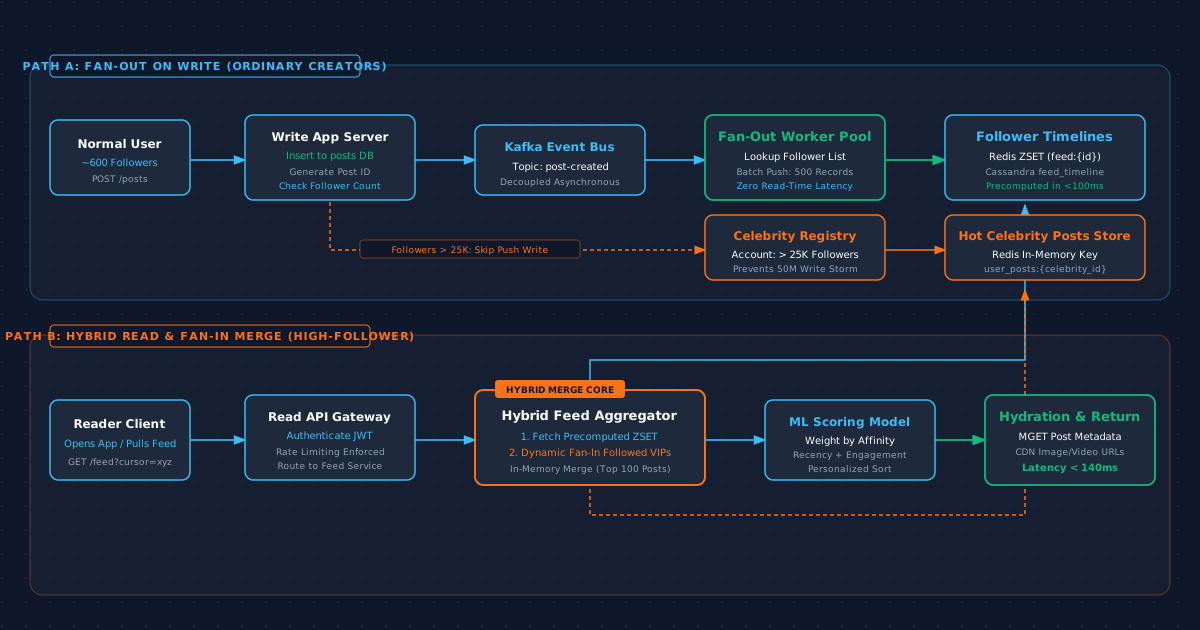
In a pure Fan-Out on Write architecture, when user Alice publishes a new photo, the backend system immediately pushes a reference to that post into the dedicated timeline storage of every single person who follows Alice.
- How It Works: When Alice posts, a background worker retrieves her follower list. If Alice has 600 followers, the worker writes 600 small records into the
feed_timelinetable for each follower. - The Major Benefit: Feed reads are blisteringly fast ( lookup). When follower Bob opens Instagram, the application server simply queries Bob's precomputed timeline from Redis or Cassandra:
SELECT post_id FROM feed_timeline WHERE user_id = Bob LIMIT 20;. No complex joins or cross-shard queries are required. - The Catastrophic Problem (Celebrity Write Amplification): If a celebrity with 100 million followers publishes a photo, a pure push model must execute 100,000,000 database writes for that single post. This causes a massive write storm, saturating message queues, choking database disks, and causing severe delays for downstream notification and feed updates.
Strategy B: Fan-In on Read (The Pull Model)
In a pure Fan-In on Read architecture, no precomputation occurs when an author publishes a post. The post is written once to the author's post table.
- How It Works: When Bob opens Instagram, the application server looks up all 500 accounts that Bob follows, queries the latest posts published by each of those 500 accounts across multiple database shards, merges the results in memory, and sorts them by timestamp.
- The Benefit: Zero write amplification. A celebrity post requires exactly one database write.
- The Major Problem: Extremely high read latency and CPU overhead. Bob's feed read requires querying dozens of distinct database shards, merging thousands of candidate records in memory, and executing machine-learning scoring on every single app refresh. Serving 175,000 reads per second this way would melt the backend infrastructure.
Strategy C: The Hybrid Approach (The Production Solution)
To resolve this trade-off, Instagram implemented a hybrid push-pull architecture:
- Standard Users (Followers < 25,000): Handled via Fan-Out on Write. When an everyday user publishes a photo, background workers push post references directly to all follower timelines in Redis and Cassandra. Because 99 percent of users have fewer than 1,000 followers, this push operation completes within tens of milliseconds.
- High-Follower Accounts and Celebrities (Followers >= 25,000): Handled via Fan-In on Read. When a verified creator or celebrity with millions of followers publishes content, the system completely skips the massive fan-out push. The post reference is written to the author's own hot-post list.
- Dynamic Merge on Read: When a follower opens their feed, the Read App Server fetches the user's precomputed timeline (containing posts from their standard friends) from Redis and dynamically pulls the latest posts from any celebrity accounts the user follows. The system blends the two lists in memory and hands the candidates to the ranking engine.
| Architectural Dimension | Fan-Out on Write (Push) | Fan-In on Read (Pull) | Hybrid Architecture (Instagram Model) |
|---|---|---|---|
| Write Amplification | Extreme ( writes per post where = followers) | Zero ( write per post) | Balanced ( for normal users, for celebrities) |
| Feed Read Latency | Ultra-low (Single key lookup, < 15ms) | High (Scatter-gather across shards, > 300ms) | Low (< 50ms Redis pull + in-memory merge) |
| Celebrity Problem | Severe system bottleneck and queue lag | Naturally handled without special logic | Solved via threshold-based branch routing |
| Storage Consumption | High (Duplicate post references stored per follower) | Low (Each post stored exactly once) | Moderate (Only active standard follower timelines retained) |
| Cold User Handling | Wasted writes for inactive accounts | Only active users consume read compute | Timelines for dormant accounts are pruned via TTL |
Feed Aggregation and Real-Time ML Re-Ranking
Once candidate post IDs are collected from the precomputed cache and the dynamic celebrity pull, they pass through a lightweight Machine Learning (ML) re-ranking pipeline. Instagram does not show a purely chronological feed. The ranking model evaluates:
- Affinity Score: Past interactions between the viewer and the author (direct messages, profile visits, previous likes).
- Content Freshness: Time elapsed since post creation, decaying exponentially.
- Media Type Engagement: Whether the viewer tends to spend more watch time on short Reels versus carousel photos.
After calculating candidate weights in memory, the server slices the top 20 post IDs and performs a batched lookup (MGET) against the post cache to retrieve captions, author profile pictures, and CDN media URLs.
Here is a production-grade C# implementation of the Hybrid Feed Aggregator service:
using System;
using System.Collections.Generic;
using System.Linq;
using System.Threading.Tasks;

namespace CodeToClarity.InstagramArchitecture.Feed
{
    public record FeedItem(long PostId, long AuthorId, DateTimeOffset CreatedAt, double RelevanceScore);

    public interface IRedisTimelineStore
    {
        Task<List<long>> GetPrecomputedPostIdsAsync(long userId, int limit);
        Task<List<long>> GetCelebrityRecentPostIdsAsync(long celebrityId, int limit);
    }

    public interface IFollowerGraphService
    {
        Task<List<long>> GetFollowedCelebrityIdsAsync(long userId);
    }

    public interface IPostMetadataHydrationService
    {
        Task<List<FeedItem>> HydrateAndScoreAsync(long viewerId, IEnumerable<long> postIds);
    }

    /// <summary>
    /// Implements hybrid feed aggregation combining precomputed follower timelines
    /// with dynamic fan-in queries for followed high-follower celebrity accounts.
    /// </summary>
    public sealed class HybridFeedAggregatorService
    {
        private readonly IRedisTimelineStore _timelineStore;
        private readonly IFollowerGraphService _followerGraph;
        private readonly IPostMetadataHydrationService _hydrationService;

        public HybridFeedAggregatorService(
            IRedisTimelineStore timelineStore,
            IFollowerGraphService followerGraph,
            IPostMetadataHydrationService hydrationService)
        {
            _timelineStore = timelineStore ?? throw new ArgumentNullException(nameof(timelineStore));
            _followerGraph = followerGraph ?? throw new ArgumentNullException(nameof(followerGraph));
            _hydrationService = hydrationService ?? throw new ArgumentNullException(nameof(hydrationService));
        }

        public async Task<List<FeedItem>> AssembleUserFeedAsync(long userId, int pageLimit = 20)
        {
            // Step 1: Concurrently fetch the precomputed timeline and followed celebrity IDs
            Task<List<long>> precomputedTimelineTask = _timelineStore.GetPrecomputedPostIdsAsync(userId, limit: 100);
            Task<List<long>> followedCelebritiesTask = _followerGraph.GetFollowedCelebrityIdsAsync(userId);

            await Task.WhenAll(precomputedTimelineTask, followedCelebritiesTask).ConfigureAwait(false);

            List<long> candidatePostIds = precomputedTimelineTask.Result;
            List<long> celebrityIds = followedCelebritiesTask.Result;

            // Step 2: Dynamic Fan-In: Query recent posts from followed celebrity accounts
            if (celebrityIds.Count > 0)
            {
                var celebrityTasks = celebrityIds.Select(celebId =>
                    _timelineStore.GetCelebrityRecentPostIdsAsync(celebId, limit: 5));

                long[][] celebrityPostArrays = await Task.WhenAll(celebrityTasks).ConfigureAwait(false);

                foreach (var postArray in celebrityPostArrays)
                {
                    candidatePostIds.AddRange(postArray);
                }
            }

            // Remove potential duplicate post IDs
            var uniqueCandidateIds = candidatePostIds.Distinct().Take(150).ToList();

            // Step 3: Hydrate metadata and apply personalized machine-learning ranking
            List<FeedItem> scoredItems = await _hydrationService
                .HydrateAndScoreAsync(userId, uniqueCandidateIds)
                .ConfigureAwait(false);

            // Step 4: Sort by final machine-learning score and take the requested page limit
            return scoredItems
                .OrderByDescending(item => item.RelevanceScore)
                .Take(pageLimit)
                .ToList();
        }
    }
}
To learn how to implement distributed caching layers, prevent cache stampedes, and configure high-performance Redis setups in your own services, check out our complete guide to caching in ASP.NET Core with Redis and HybridCache.
5. Media Ingestion Pipeline and Global CDN Strategy
Media ingestion in high-throughput social networks is an asynchronous pipeline that offloads multi-megabyte binary payloads directly from mobile clients to distributed blob storage before background workers execute video compression and thumbnail generation. This keeps web application servers responsive by isolating heavy input-output operations.
Instagram is a visual platform. Handling 925 Terabytes of new images and video clips each day requires an ingestion pipeline that protects API gateways from bandwidth exhaustion.
The Direct-to-Blob Upload Pattern
If mobile clients uploaded 15-Megabyte raw videos directly through the API application servers, the servers' incoming network interfaces and HTTP worker threads would be completely consumed handling slow cellular upload streams.
Instagram eliminates this bottleneck through pre-signed direct-to-blob uploads:
- Step 1: Upload Intent Ticket: The mobile client issues a lightweight
POST /posts/upload-ticketrequest containing post metadata (media format, byte size, author authentication). - Step 2: Pre-Signed URL Generation: The API server authenticates the user, generates a secure, time-limited cryptographic pre-signed URL pointing directly to the distributed blob storage bucket (such as Amazon S3 or internal blob storage), and returns it to the client.
- Step 3: Direct Binary Upload: The mobile client uploads the binary payload directly to the storage bucket over HTTPS. The API servers consume zero bandwidth during this transfer.
- Step 4: Completion Webhook: Once the blob storage validates receipt of the full payload, it publishes an event to an Apache Kafka message topic.
Asynchronous Transcoding and Variant Generation
Once the raw file is safely stored, background transcoding workers consume the Kafka event and generate multiple optimized variants:
- Image Processing: Generates WebP and AVIF formats in multiple resolutions (thumbnail, medium feed, high-density retina).
- Video Chunking: Transcodes videos into multiple bitrates (1080p, 720p, 480p) and chunks them into 2-to-4-second segments for Adaptive Bitrate Streaming (HLS and MPEG-DASH).
- Machine Learning Analysis: Scans images for content moderation, copyright verification, and automated accessibility alt-text generation.
Once processing concludes, workers write the finalized URLs to the relational database and trigger the feed fan-out pipeline.
To compare how Instagram's chunk-based media pipeline compares to the massive planet-scale video architecture of YouTube, read our in-depth analysis of how YouTube streams to 2 billion users without crashing.
Global CDN Caching and Cache Tiering
Serving billions of media views directly from primary storage buckets would cost millions of dollars in network egress fees and introduce unacceptable latency. Instagram routes all media traffic through a multi-tiered CDN strategy:
- Edge Points of Presence (PoPs): Geographically distributed edge nodes cache hot media files within milliseconds of end users.
- Regional Origin Shields: An intermediate caching layer positioned between edge PoPs and core storage data centers. If an edge node misses a cache query, it queries the regional shield rather than hitting the primary storage cluster.
- Differentiated Time-to-Live (TTL): Ephemeral stories have short TTLs (15 to 30 minutes), main feed posts receive medium TTLs (12 to 24 hours), and profile avatars receive long TTLs (7 days).
6. Rate Limiting, API Protection, and Anti-Abuse
API rate limiting is an infrastructure defense mechanism that tracks and throttles incoming HTTP request frequencies across client IP addresses, authentication tokens, and user identifiers. It prevents distributed denial of service floods, automated scraping, and write-queue exhaustion.
With 350,000 writes per second hitting interaction endpoints during peak hours, protecting the system against abusive bots, script scrapers, and malicious denial-of-service attacks is essential.
Rate Limiting Topologies
Instagram applies rate limits across multiple levels of the request path:
- IP and Subnet Throttling: Enforced at the Edge proxy layer to mitigate brute-force credential stuffing and scraping attempts.
- User-Level Token Buckets: Enforced in Redis for authenticated user accounts. Write endpoints have strict ceilings (for example, a user cannot submit more than 10 likes per second or 30 comments per minute).
- Action-Specific Cooling Windows: High-impact actions such as password resets and following accounts enforce exponential backoff upon repeated triggers.
If you are designing API backends and want to implement distributed token bucket or sliding window algorithms, review our comprehensive guide on rate limiting in ASP.NET Core.
7. Trade-offs and Production Realities: When NOT to Use This Architecture
While Instagram's architecture is a triumph of planetary-scale engineering, adopting these patterns blindly for standard applications is an anti-pattern. Every architectural decision involves trade-offs that introduce operational complexity, maintenance overhead, and engineering friction.
1. Operational Complexity and Infrastructure Cost
Sharding relational databases across thousands of logical schemas requires specialized tooling, custom database routers, complex backup orchestration, and dedicated Site Reliability Engineering (SRE) teams.
If your application has fewer than 10 million registered users and less than 5,000 queries per second, do not shard your database. A well-indexed, vertically scaled PostgreSQL or MySQL instance equipped with read replicas and connection pooling (such as PgBouncer) can comfortably handle thousands of queries per second at a fraction of the operational cost.
2. Eventual Consistency and Ghost Artifacts
The hybrid fan-out model and decoupled asynchronous pipelines rely on eventual consistency:
- Follower Update Latency: When a user publishes a post, their followers might not see the new content simultaneously. The fan-out worker pipeline can take between 2 and 5 seconds to propagate the post across all follower timelines.
- Counter Discrepancies: The like count displayed on a user's feed is often cached and decoupled from the exact row count in the relational likes table. Under heavy concurrent writes, a viewer might see a post with 1,520 likes, tap the like button, and see the count jump to 1,535 due to batched reconciliation.
If your domain requires strict immediate consistency (such as financial transactions, ledger accounting, or inventory reservation systems), you cannot use asynchronous fan-out caching architectures.
3. Cache Stampede and Cold-Start Risks
Because feeds depend heavily on in-memory Redis sorted sets, an outage in the caching tier can trigger a catastrophic cache stampede. If millions of users request feeds while the cache is cold, those queries fall back directly to primary databases, overwhelming database connection pools in seconds.
To prevent this, production systems must implement:
- Randomized Cache TTLs: Preventing simultaneous key expirations across popular accounts.
- Distributed Mutexes (Single-Flight Pattern): Ensuring that only one background thread rebuilds a missing cache key while other concurrent requests wait for the result.
- Proactive Cache Warming: Background jobs that pre-warm timelines for active daily users before their typical morning and evening app opening windows.
Conclusion: Architectural Lessons for Every Developer
You do not need to operate at the scale of 500 million daily users to benefit from Instagram's system design principles. The core architectural lessons that power this platform apply directly to scalable web applications and enterprise systems:
- Bifurcate Workloads by Access Patterns: Never force read-heavy queries and write-intensive transactions into the same shared pipelines. Separate your API gateways and backend worker fleets so high-volume background tasks cannot degrade user-facing latency.
- Decouple Heavy Workloads via Asynchronous Queues: Keep public API endpoints fast and lightweight. Validate inputs, write the initial state record, and push time-consuming side effects (such as transcoding, notifications, and fan-out updates) to background message brokers like Apache Kafka.
- Partition Data Early and Intelligently: Choose partition keys based on your most critical query patterns. Encoding logical shard routing and creation timestamps directly into 64-bit entity IDs eliminates centralized coordinator bottlenecks.
- Combine Push and Pull Strategies to Defeat Hot Keys: Pure push architectures fail under celebrity write amplification, while pure pull architectures collapse under high read concurrency. Blending push precomputation for everyday entities with dynamic pull merging for hot entities is the ultimate pattern for high-scale social systems.
- Offload the Edge with CDNs and Caching: Shield your persistent databases by serving static assets, binary media, and hot metadata from geographically distributed CDN edge nodes and in-memory caches.
When you approach software architecture through the lens of capacity planning, decoupled asynchronous processing, and balanced data partitioning, you elevate your engineering designs from simple CRUD applications to resilient, production-grade distributed systems.
Software engineer passionate about building scalable, production-grade applications with C#, .NET, and modern cloud technologies. Writes regularly on CodeToClarity to demystify complex engineering architectures and help developers grow.
Related Technical Guides
Production API Design Guide: The 5 Fundamental Principles Every Developer Must Master
Master the 5 pillars of production API design: resource interfaces, paradigm selection (REST vs GraphQL vs gRPC), relational modeling, evolution, and rate limiting.
Load Balancer vs Reverse Proxy vs Forward Proxy vs API Gateway: Complete Architecture Guide
Demystify the four core network routing components. Learn the architectural differences, Layer 4 vs Layer 7 traffic flow, and when to use each in production.
How YouTube Streams to 2 Billion Users Without Crashing: System Design Guide
Learn how YouTube scales to 2 billion users. A complete beginner's guide to video transcoding pipelines, global CDNs, polyglot persistence, and adaptive streaming.