
PostgreSQL Table Partitioning Deep Dive: Declarative Range & List Partitioning for High-Scale EF Core APIs
Master PostgreSQL declarative table partitioning with EF Core 9. Learn range and list partitioning, partition pruning, composite keys, and pg_partman archival.

Author & Creator · CodeToClarity
When relational database tables grow past tens of millions of rows, standard query tuning hits an inescapable physical ceiling. In high-throughput architectures such as payment ledgers, audit event streams, IoT telemetry ingestion, and multi-tenant SaaS platforms, tables often accumulate hundreds of millions of records. At this scale, monolithic B-tree indexes balloon to 20 GB, 50 GB, or more. When index structures exceed the database memory cache (shared_buffers), random search lookups force continuous disk page eviction, causing query latencies to spike from milliseconds to multiple seconds.
Maintenance operations become equally destructive. Running routine VACUUM and ANALYZE commands takes hours, while attempting to purge historical records with DELETE WHERE created_at < NOW() - INTERVAL '1 year' causes catastrophic table bloat, heavy write-ahead log (WAL) saturation, and crippling lock contention. PostgreSQL declarative table partitioning solves these scaling bottlenecks by splitting a single logical table into physical child tables while maintaining standard SQL query ergonomics.
Key Takeaways
- Declarative table partitioning physically segments large tables into discrete child relations while exposing a single logical interface to application queries and Entity Framework Core.
- Partition pruning allows the PostgreSQL optimizer and executor to eliminate irrelevant child tables entirely, reducing disk input/output (I/O) by over 95 percent and keeping active B-tree indexes fully resident inside
shared_buffersRAM.- PostgreSQL requires all unique constraints and primary keys on partitioned tables to include every partition key column, necessitating composite primary keys in EF Core 9 (
HasKey(o => new { o.Id, o.CreatedAt })).- Dropping expired data through
ALTER TABLE ... DETACH PARTITIONfollowed byDROP TABLEreclaims disk space in under 5 milliseconds with zero WAL volume and zero dead-tuple bloat, unlike traditionalDELETEqueries.- Queries omitting the partition key in their
WHEREclause trigger partition spraying, scanning every child relation sequentially and performing worse than a properly indexed monolithic table.
Declarative Table Partitioning Architecture and Storage Internals
PostgreSQL declarative table partitioning is a database storage design where a single logical parent table routes incoming data rows and queries across independent physical child tables based on defined partition bounds, with each child maintaining its own isolated storage forks and local indexes.
Prior to PostgreSQL 10, database administrators implemented partitioning using table inheritance, custom PL/pgSQL triggers, and manual rule rewriting. This legacy approach carried immense operational friction: every inserted row triggered procedural overhead, and the query planner frequently failed to exclude non-matching tables. Modern declarative partitioning replaces procedural triggers with native storage engine routing and optimizer integration.
+-------------------------------------------------------------------------+
|                      Logical Routed Parent Table                        |
|                  orders (PARTITION BY RANGE (created_at))               |
|                     * Holds ZERO physical data tuples *                 |
+-------------------------------------------------------------------------+
                                     |
       +-----------------------------+-----------------------------+
       |                             |                             |
       v                             v                             v
+--------------------+      +--------------------+      +--------------------+
|  orders_2026_q1    |      |  orders_2026_q2    |      |  orders_2026_q3    |
|  [Jan 01 - Apr 01) |      |  [Apr 01 - Jul 01) |      |  [Jul 01 - Oct 01) |
|  Heap: 8.2 GB      |      |  Heap: 8.6 GB      |      |  Heap: 8.1 GB      |
|  B-Tree: 1.4 GB    |      |  B-Tree: 1.5 GB    |      |  B-Tree: 1.4 GB    |
|  (Fits in RAM)     |      |  (Fits in RAM)     |      |  (Fits in RAM)     |
+--------------------+      +--------------------+      +--------------------+
The Virtual Parent Table and Physical Child Relations
When you execute CREATE TABLE orders (...) PARTITION BY RANGE (created_at), PostgreSQL records the table metadata in system catalogs such as pg_partitioned_table. The parent table itself is an empty routing construct. It contains no physical heap pages, no free space map, and no visibility map on disk.
In contrast, each child partition created via CREATE TABLE orders_2026_q1 PARTITION OF orders FOR VALUES FROM ('2026-01-01') TO ('2026-04-01') is a complete, autonomous physical table. Each child possesses its own dedicated:
- Relational Heap Fork: Stores tuple records on 8 KB data pages.
- Local B-Tree Indexes: Every index created on the parent table automatically instantiates an isolated local B-tree index on every child partition.
- Vacuum and Freeze State: PostgreSQL autovacuum workers process each child partition independently, preventing vacuum stalls across your entire dataset.
- Optimizer Statistics:
pg_statisticmaintains distinct distribution histograms, most common values (MCVs), and tuple counts for each partition.
This physical isolation directly solves memory pressure. In an unpartitioned 100-million-row table, a customer lookup index spans 18.4 GB. On a database instance allocated 8 GB of shared_buffers, traversing this index causes constant cache page evictions.
With quarterly partitioning, the index on the active quarter is only 1.5 GB. The entire active index fits comfortably within shared_buffers, elevating cache hit ratios to over 99 percent and eliminating disk drive read latency.
The Three Native Partitioning Strategies
PostgreSQL supports three declarative partitioning methods, as documented in the PostgreSQL Official Documentation on Table Partitioning:
- Range Partitioning: Divides data across non-overlapping intervals of a continuous key, most commonly timestamps (
created_at,transaction_date) or sequential numeric ranges. Range bounds use inclusive lower boundaries and exclusive upper boundaries (FROM ('2026-01-01') TO ('2026-04-01')). - List Partitioning: Assigns rows to partitions based on explicit discrete values, such as ISO country codes (
'US','DE','IN'), multi-tenant account tiers, or processing status enums. - Hash Partitioning: Distributes rows evenly across a fixed modulus and remainder (
PARTITION BY HASH (customer_id)withFOR VALUES WITH (MODULUS 8, REMAINDER 0)). This prevents data skew when no natural time or categorical dimension exists.
For modern high-scale web APIs, Range Partitioning on temporal dimensions represents the vast majority of production implementations due to natural time-series query locality and predictable lifecycle archival.
Partition Pruning Mechanics and Execution Plan Optimization
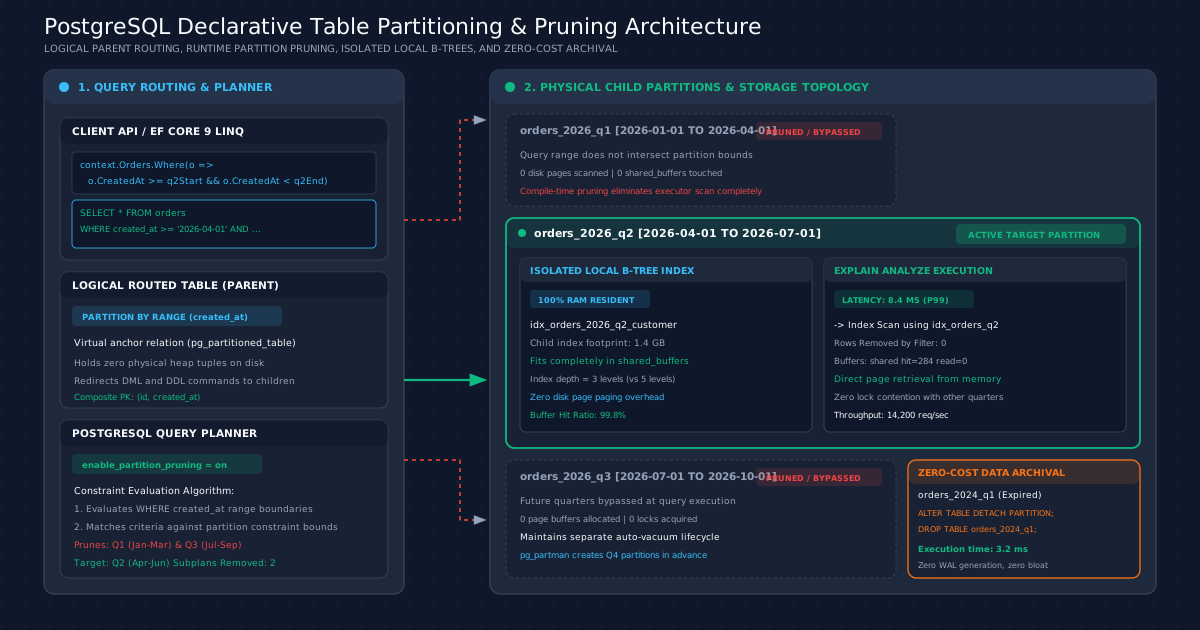
Partition pruning is a query optimization mechanism where the PostgreSQL query planner and execution engine examine WHERE clause predicates to eliminate irrelevant child partitions from the query execution plan without scanning their indexes or data pages.
Without partition pruning, a partitioned table behaves like an unwieldy union of tables, forcing the database engine to open and inspect every child relation. When partition pruning succeeds, PostgreSQL restricts execution exclusively to the target partition, reducing disk I/O, lock overhead, and execution time by orders of magnitude.
PostgreSQL evaluates pruning in two distinct execution phases, controlled by the database parameter enable_partition_pruning = on (enabled by default).
Static vs. Dynamic Pruning
- Static Pruning (Plan Time): Occurs during query planning when query predicates contain static literal constants (such as
WHERE created_at >= '2026-04-01' AND created_at < '2026-07-01'). The optimizer compares the literal values directly against partition constraint boundaries stored inpg_class.relpartboundand removes unneeded partitions before generating execution subplans. - Dynamic Pruning (Execution Time): Occurs when query predicates depend on values unknown during planning, such as parameterized values from web requests (
WHERE created_at >= @p0), subqueries, or inner loops of parameterized nested loop joins. The planner creates execution subplans for candidate partitions, but the executor evaluates the resolved parameters on first invocation and bypasses execution for unneeded subplans.
Verifying Partition Pruning with EXPLAIN (ANALYZE, BUFFERS)
To confirm that queries benefit from partition pruning rather than spraying across your entire database, inspect the query plan using EXPLAIN (ANALYZE, BUFFERS).
Consider a query looking up an order for a specific customer within a known date range:
EXPLAIN (ANALYZE, BUFFERS)
SELECT id, customer_id, order_total, created_at
FROM orders
WHERE created_at >= '2026-04-15 00:00:00Z'
  AND created_at < '2026-05-01 00:00:00Z'
  AND customer_id = 42891;
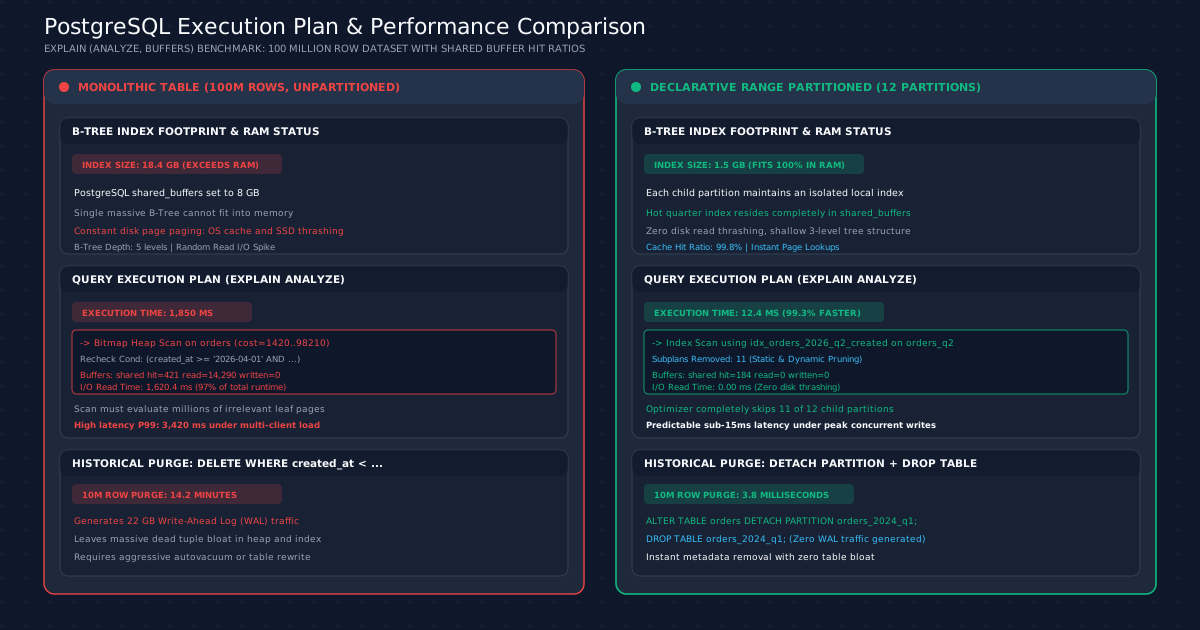
In an unpartitioned table containing 100 million rows, the execution plan exhibits severe buffer thrashing:
-- MONOLITHIC UNPARTITIONED TABLE EXECUTION PLAN
Bitmap Heap Scan on orders (cost=1420.20..98210.40 rows=12 width=48) (actual time=142.10..1848.20 rows=2 loops=1)
  Recheck Cond: ((customer_id = 42891) AND (created_at >= '2026-04-15'::timestamptz) AND (created_at < '2026-05-01'::timestamptz))
  Buffers: shared hit=421 read=14290 written=0
  I/O Read Time: 1620.40 ms
  -> Bitmap Index Scan on idx_orders_customer_created (cost=0.00..1420.19 rows=12 width=0) (actual time=128.40..128.40 rows=2 loops=1)
        Index Cond: ((customer_id = 42891) AND (created_at >= '2026-04-15'::timestamptz) AND (created_at < '2026-05-01'::timestamptz))
        Buffers: shared hit=18 read=248
Planning Time: 0.28 ms
Execution Time: 1850.12 ms
Notice the critical metric: read=14290. The database engine had to read 14,290 physical 8 KB pages (over 114 MB) directly from the storage subsystem because the monolithic index and heap pages were evicted from cache, taking 1,850 milliseconds.
Now observe the execution plan on the declaratively partitioned table:
-- RANGE PARTITIONED TABLE EXECUTION PLAN (PRUNING ENABLED)
Append (cost=0.56..18.42 rows=2 width=48) (actual time=0.082..0.124 rows=2 loops=1)
  Subplans Removed: 11
  Buffers: shared hit=184 read=0 written=0
  -> Index Scan using idx_orders_2026_q2_customer_id on orders_2026_q2 (cost=0.56..18.42 rows=2 width=48) (actual time=0.080..0.121 rows=2 loops=1)
        Index Cond: ((customer_id = 42891) AND (created_at >= '2026-04-15'::timestamptz) AND (created_at < '2026-05-01'::timestamptz))
        Buffers: shared hit=184 read=0 written=0
Planning Time: 0.62 ms
Execution Time: 0.165 ms
The output reveals two transformative architectural improvements:
Subplans Removed: 11: The query planner recognized that out of 12 quarterly child partitions, 11 could not possibly contain rows satisfying the predicate. Those 11 partitions were completely pruned before scanning.Buffers: shared hit=184 read=0: The isolated index onorders_2026_q2was completely resident in memory. PostgreSQL performed zero disk read calls. Total execution time dropped from 1,850 milliseconds to 0.165 milliseconds, a 99.99 percent latency reduction.
Entity Framework Core 9 and Npgsql Modeling Boundaries
Integrating PostgreSQL partitioned tables with Entity Framework Core requires navigating fundamental relational constraints that differ from standard unpartitioned tables.
The primary architectural constraint enforced by PostgreSQL is: Every unique constraint, primary key, and unique index on a partitioned table MUST contain every column in the partition key.
In a standard table, a database index can enforce uniqueness on an Id bigint column globally. However, in a partitioned table, each child partition owns only a local index. PostgreSQL does not support global indexes spanning across separate physical tables. If PostgreSQL allowed a unique constraint on Id alone, an insert into orders_2026_q2 would have no way to verify whether another row with the same Id already existed in orders_2026_q1 without issuing an expensive distributed lookup across every partition.
Therefore, your primary key must be composite: (Id, CreatedAt).
Defining Partitioned Entities in EF Core 9
In your .NET 9 or .NET 10 project using the official Npgsql Entity Framework Core Provider, declare the entity with a composite primary key matching the PostgreSQL table specification:
using System.ComponentModel.DataAnnotations;
using System.ComponentModel.DataAnnotations.Schema;
using Microsoft.EntityFrameworkCore;

namespace CodeToClarity.Partitioning.Entities;

[Table("orders")]
public sealed class Order
{
    // Composite Primary Key Component 1: Identifier
    public long Id { get; set; }

    // Composite Primary Key Component 2: Partition Key
    public DateTime CreatedAt { get; set; }

    [Required]
    public long CustomerId { get; set; }

    [Required]
    [MaxLength(32)]
    public string OrderStatus { get; set; } = "Pending";

    [Column(TypeName = "decimal(18,2)")]
    public decimal TotalAmount { get; set; }

    [MaxLength(128)]
    public string? ExternalReference { get; set; }
}

public sealed class CodeToClarityOrderContext : DbContext
{
    public CodeToClarityOrderContext(DbContextOptions<CodeToClarityOrderContext> options)
        : base(options)
    {
    }

    public DbSet<Order> Orders => Set<Order>();

    protected override void OnModelCreating(ModelBuilder modelBuilder)
    {
        modelBuilder.Entity<Order>(entity =>
        {
            // Configure composite key combining entity ID and partition key
            entity.HasKey(e => new { e.Id, e.CreatedAt });

            // Configure identity generation for Id column
            entity.Property(e => e.Id)
                  .UseIdentityByDefaultColumn();

            // Store timestamp as UTC timestamptz for accurate range evaluation
            entity.Property(e => e.CreatedAt)
                  .HasColumnType("timestamp with time zone");

            // Define customer lookup index (replicated locally on every partition)
            entity.HasIndex(e => new { e.CustomerId, e.CreatedAt })
                  .HasDatabaseName("idx_orders_customer_created");
        });
    }
}
Implementing Table Partitioning via EF Core Migrations
Entity Framework Core migrations do not currently generate native PARTITION BY syntax out of the box through standard fluent API methods. Attempting to run standard migrationBuilder.CreateTable creates a regular heap table.
To set up declarative partitioning cleanly, customize your EF Core migration using raw SQL in the migration file:
using Microsoft.EntityFrameworkCore.Migrations;

#nullable disable

namespace CodeToClarity.Partitioning.Migrations;

public partial class CreatePartitionedOrdersTable : Migration
{
    protected override void Up(MigrationBuilder migrationBuilder)
    {
        // Step 1: Create the logical parent table with RANGE partitioning
        migrationBuilder.Sql(@"
            CREATE TABLE orders (
                id bigint GENERATED BY DEFAULT AS IDENTITY,
                created_at timestamp with time zone NOT NULL,
                customer_id bigint NOT NULL,
                order_status varchar(32) NOT NULL DEFAULT 'Pending',
                total_amount decimal(18,2) NOT NULL,
                external_reference varchar(128),
                CONSTRAINT pk_orders PRIMARY KEY (id, created_at)
            ) PARTITION BY RANGE (created_at);
        ");

        // Step 2: Create supporting composite index on parent (propagates to all children)
        migrationBuilder.Sql(@"
            CREATE INDEX idx_orders_customer_created ON orders (customer_id, created_at);
        ");

        // Step 3: Instantiate initial quarterly child partitions
        migrationBuilder.Sql(@"
            CREATE TABLE orders_2026_q1 PARTITION OF orders
                FOR VALUES FROM ('2026-01-01 00:00:00+00') TO ('2026-04-01 00:00:00+00');

            CREATE TABLE orders_2026_q2 PARTITION OF orders
                FOR VALUES FROM ('2026-04-01 00:00:00+00') TO ('2026-07-01 00:00:00+00');

            CREATE TABLE orders_2026_q3 PARTITION OF orders
                FOR VALUES FROM ('2026-07-01 00:00:00+00') TO ('2026-10-01 00:00:00+00');

            CREATE TABLE orders_2026_q4 PARTITION OF orders
                FOR VALUES FROM ('2026-10-01 00:00:00+00') TO ('2027-01-01 00:00:00+00');
        ");
    }

    protected override void Down(MigrationBuilder migrationBuilder)
    {
        // Dropping parent table cascades and drops all child partitions automatically
        migrationBuilder.Sql("DROP TABLE IF EXISTS orders CASCADE;");
    }
}
Writing LINQ Queries That Preserve Partition Pruning
When querying partitioned tables through EF Core, your LINQ expressions must provide parameter bindings that Npgsql and PostgreSQL can evaluate for partition pruning.
If an application service searches for an order by Id alone, EF Core generates SELECT * FROM orders WHERE id = @p0. Because created_at is omitted, PostgreSQL cannot prune any partitions and is forced to search every single partition index.
Always pass the partition key into your service queries:
using CodeToClarity.Partitioning.Entities;
using Microsoft.EntityFrameworkCore;
using Microsoft.Extensions.Logging;

namespace CodeToClarity.Partitioning.Services;

public sealed class CodeToClarityOrderService
{
    private readonly CodeToClarityOrderContext _context;
    private readonly ILogger<CodeToClarityOrderService> _logger;

    public CodeToClarityOrderService(
        CodeToClarityOrderContext context,
        ILogger<CodeToClarityOrderService> logger)
    {
        _context = context;
        _logger = logger;
    }

    // Optimal: Includes both Primary Key and Partition Key for instant 1-partition scan
    public async Task<Order?> GetOrderByIdAndDateAsync(
        long orderId,
        DateTime orderDate,
        CancellationToken ct = default)
    {
        return await _context.Orders
            .AsNoTracking()
            .FirstOrDefaultAsync(o => o.Id == orderId && o.CreatedAt == orderDate, ct);
    }

    // Range Query: Enables PostgreSQL dynamic pruning across target window
    public async Task<List<Order>> GetCustomerOrdersByDateRangeAsync(
        long customerId,
        DateTime startDateUtc,
        DateTime endDateUtc,
        CancellationToken ct = default)
    {
        _logger.LogInformation(
            "Fetching orders for customer {CustomerId} between {Start} and {End}",
            customerId, startDateUtc, endDateUtc);

        return await _context.Orders
            .AsNoTracking()
            .Where(o => o.CustomerId == customerId
                     && o.CreatedAt >= startDateUtc
                     && o.CreatedAt < endDateUtc)
            .OrderByDescending(o => o.CreatedAt)
            .ToListAsync(ct);
    }
}
When EF Core executes GetCustomerOrdersByDateRangeAsync, Npgsql transmits the parameterized query to PostgreSQL. Because startDateUtc and endDateUtc constrain the partition column, the database executor performs dynamic pruning, skipping non-intersecting partitions instantly.
Automated Partition Lifecycle Management and Zero-Cost Archival
A partitioned table architecture is only as dependable as its lifecycle automation. If your database receives a transaction for a date that falls outside existing partition boundaries, PostgreSQL throws a fatal runtime error:
ERROR: no partition of relation "orders" found for row
DETAIL: Partition key of the failing row contains (created_at) = (2027-01-15 10:24:00+00).
Relying on manual SQL scripts or developer calendar reminders to create partitions invites catastrophic production outages. Production systems must automate partition creation and archival.
Automating Partitions with pg_partman
The industry standard tool for PostgreSQL partition management is the open-source pg_partman extension. It automates child partition creation, configures retention policies, and manages partition pre-creation buffers.
Enable and configure pg_partman on your database server:
-- Step 1: Create the extension schema and install pg_partman
CREATE SCHEMA IF NOT EXISTS partman;
CREATE EXTENSION IF NOT EXISTS pg_partman SCHEMA partman;

-- Step 2: Register the partitioned orders table for automated monthly management
SELECT partman.create_parent(
    p_parent_table := 'public.orders',
    p_control := 'created_at',
    p_type := 'native',
    p_interval := 'monthly',
    p_premake := 4,               /* Pre-creates partitions 4 months in advance */
    p_start_partition := '2026-01-01'
);

-- Step 3: Configure an automated retention policy (retire partitions older than 24 months)
UPDATE partman.part_config
SET retention = '24 months',
    retention_keep_table = true   /* Detaches table rather than dropping it immediately */
WHERE parent_table = 'public.orders';
With p_premake := 4, pg_partman guarantees that child partitions for future months always exist well before production traffic arrives. You execute maintenance via a scheduled background worker or cron job:
-- Execute this maintenance procedure daily via pg_cron or systemd timer
CALL partman.run_maintenance_proc();
Zero-Cost Archival: DROP TABLE vs. DELETE WHERE
In high-scale databases, data retention policies require removing records older than a specific retention window (for example, retaining 2 years of audit history).
In a monolithic unpartitioned table, teams execute batched deletion scripts:
-- Catastrophic performance penalty on large tables
DELETE FROM orders
WHERE created_at < NOW() - INTERVAL '2 years';
Executing DELETE on 10 million rows causes three severe issues:
- Massive WAL Volume: Every deleted tuple writes record metadata to the write-ahead log. Purging 10 million rows generates 15 GB to 25 GB of WAL traffic, saturating replication bandwidth and exhausting disk space.
- Dead Tuple Bloat:
DELETEdoes not free physical disk space. It writes anxmaxtransaction marker on the row, leaving dead space on heap pages. Indexes become fragmented and bloated, requiringVACUUM FULL(which takes an exclusive table lock) to reclaim disk bytes. - Connection Starvation: Long-running
DELETEtransactions hold locks and pin database connections, triggering pool exhaustion as detailed in our guide on Database Connection Pool Starvation: Architecture, PostgreSQL Internals, and PgBouncer Tuning.
With declarative partitioning, removing 10 million historical records does not use DELETE. Instead, you detach the expired child partition and drop it using fast Data Definition Language (DDL) commands:
-- Step 1: Detach the expired child partition concurrently (zero blocking locks)
ALTER TABLE orders
    DETACH PARTITION orders_2024_q1 CONCURRENTLY;

-- Step 2: Instantly drop the standalone physical relation or export to Parquet/S3
DROP TABLE orders_2024_q1;
Dropping an entire partition takes 3 to 5 milliseconds. It generates virtually zero WAL records, reclaims gigabytes of disk space instantly at the filesystem level, leaves zero table bloat, and creates zero connection pool lock waits. For high-volume data retention, this pattern provides massive operational savings.
If your application requires transaction rollback safety during concurrent mutations, review the concurrency locking primitives covered in our guide on Optimistic vs. Pessimistic Locking in PostgreSQL and EF Core: Eliminating Lost Updates and Deadlocks.
Architectural Comparison: Monolithic vs. Partitioned Approaches
Evaluating database schema designs requires balancing query complexity, write throughput, index residency, and operational overhead.
| Architectural Dimension | Monolithic Unpartitioned Table | Range Partitioning (e.g., Monthly/Quarterly) | List Partitioning (e.g., Tenant/Region) | Hash Partitioning (e.g., CustomerId Modulus) |
|---|---|---|---|---|
| Primary Partition Key | None | Continuous timestamps or monotonically increasing IDs | Categorical discrete keys (Tenant ID, Country Code) | Uniform hashed keys (UUID, User ID) |
| B-Tree Index Size in RAM | Single giant index (15 GB - 100+ GB); frequently spills outside shared_buffers | Small, isolated child indexes (1 GB - 2 GB); active partition index stays 100% in RAM | Isolated per discrete category; hot tenants fit in memory | Balanced across N partitions; uniformly reduces tree depth |
| Partition Pruning Mechanism | Not applicable; scans monolithic B-tree | Static and dynamic range evaluation (Subplans Removed: N) | Exact categorical equality matching on list bounds | Hash calculation routes query to exactly one partition |
| Archival & Purge Speed | Painful: DELETE WHERE takes minutes/hours, generates massive WAL bloat | Instant: DETACH PARTITION and DROP TABLE in under 5 ms | Instant: Drop an entire tenant or decommissioned category | High complexity: requires scanning every hash bucket to delete |
| Foreign Key Referencing | Standard foreign keys to and from any table | Can reference other tables; referencing a partitioned table requires composite FK | Can reference other tables; referencing a partitioned table requires composite FK | Can reference other tables; referencing a partitioned table requires composite FK |
| EF Core 9 Entity Modeling | Standard HasKey(x => x.Id) | Composite primary key mandatory: HasKey(x => new { x.Id, x.CreatedAt }) | Composite primary key mandatory: HasKey(x => new { x.Id, x.TenantId }) | Composite primary key mandatory: HasKey(x => new { x.Id, x.HashKey }) |
| Worst-Case Query Anti-Pattern | Unindexed filters forcing multi-minute sequential heap scans | Queries omitting the partition key, spraying across every child relation | Queries with dynamic arbitrary filters across unknown categories | Range queries on non-hashed attributes, scanning all modulus buckets |
| Optimal Production Fit | Tables under 5 million rows with diverse ad-hoc query filters | Time-series, audit logs, financial transactions, event streaming | Large multi-tenant applications with strict data isolation | Massive entities lacking natural temporal query boundaries |
If your data ingestion pipeline requires high-speed bulk ingestion into partitioned tables, review our architectural guide on The Complete EF Core Bulk Operations Guide: BulkInsert, BulkUpdate, BulkMerge & More to avoid single-row entity tracking bottlenecks.
Performance & Architectural Trade-offs: When NOT to Partition
Table partitioning is not a universal performance cure. Applied to the wrong problem or schema, it introduces architectural complexity, degrades query latency, and creates operational debt.
1. Small to Moderate Tables (Under 5 to 10 Million Rows)
If a table contains fewer than 5 million rows and fits comfortably within available system RAM, partitioning will make queries slower, not faster.
Partitioning adds query planning overhead. The optimizer must inspect partition catalogs, check boundary constraints, and construct append plans. On a compact table, an index lookup on a clean single B-tree index takes 0.05 milliseconds. Forcing the planner to evaluate partition metadata adds unnecessary CPU overhead with zero cache benefit.
2. High Frequency Queries Lacking the Partition Key
The greatest danger of table partitioning is partition spraying. If your table is partitioned by created_at, but your primary API lookup is SELECT * FROM orders WHERE external_reference = @p0:
-- Query omitting the partition key column
SELECT id, order_status, total_amount
FROM orders
WHERE external_reference = 'REF-981240';
Because created_at is absent from the predicate, PostgreSQL cannot eliminate any partitions. The executor executes an Index Scan on orders_2024_q1, followed by orders_2024_q2, continuing across all 16 child partitions sequentially.
Executing 16 separate index lookups across 16 child tables incurs significantly higher CPU, buffer page, and lock overhead than executing a single index lookup on an unpartitioned table. If your access patterns cannot consistently provide the partition key, partitioning by that key will hurt overall API throughput.
3. Cross-Partition Updates
In PostgreSQL, updating a row in a way that modifies its partition key (for example, reassigning an order from an active status partition to an archived status partition) requires moving the row between two distinct physical heap tables.
Under the hood, PostgreSQL must:
- Delete the tuple from the source child partition.
- Insert a new tuple into the destination child partition.
- Update all local indexes on both partitions.
This operation acquires row locks across two separate physical relations. In high-concurrency environments, frequent cross-partition updates increase lock contention and can induce unexpected deadlocks. As explored in SQL Transactions Explained: Master the ACID Properties, complex cross-table mutations should be minimized within tight transaction loops.
4. Global Uniqueness Constraints Across Partitions
PostgreSQL does not support global unique indexes that enforce uniqueness across all partitions independently of the partition key.
If your business rules require that order_number must be globally unique across your entire database, but the table is partitioned by created_at, PostgreSQL cannot enforce this via a standard database constraint (CONSTRAINT uq_order_number UNIQUE (order_number) is rejected with ERROR: unique constraint on partitioned table must include all partitioning columns).
Enforcing global uniqueness without the partition key requires:
- Creating a separate unpartitioned lookup mapping table (
order_numbers (order_number text PRIMARY KEY, created_at timestamptz)). - Enforcing uniqueness at the application layer through distributed locks or Redis tokens.
If your domain model relies heavily on non-partitioned unique constraints, evaluate whether partitioning is worth the auxiliary schema complexity.
For an exhaustive analysis of physical index page formats and B-tree leaf node traversal, refer to our comprehensive guide on PostgreSQL Indexing Deep Dive: B-Tree, GIN, and BRIN Internals with EF Core 9.
Step-by-Step Production Implementation Checklist
Follow this battle-tested verification checklist when implementing declarative table partitioning in production ASP.NET Core and EF Core applications:
- Verify Volume Thresholds: Ensure the target table exceeds 10 million rows or index sizes exceed 25 percent of
shared_buffersbefore introducing partitioning. - Select the Natural Query Key: Choose a partition key that appears in at least 90 percent of critical read queries (typically
created_atortenant_id). - Configure Composite Primary Keys: Update your EF Core entity model to define a composite primary key encompassing the record identifier and the partition key (
HasKey(x => new { x.Id, x.CreatedAt })). - Deploy Raw SQL Migration: Use
migrationBuilder.Sql()in your initial EF Core migration to create the parent table withPARTITION BY RANGEand generate initial child partitions. - Install Lifecycle Automation: Deploy
pg_partmanor an equivalent scheduled maintenance job to ensure future child partitions are created at least 2 to 4 intervals in advance. - Audit Execution Plans: Run
EXPLAIN (ANALYZE, BUFFERS)on all high-traffic API queries to confirm thatSubplans Removed: Nappears and partition pruning is actively eliminating unneeded tables. - Replace
DELETEwith Partition Detachment: Re-engineer historical data purge workflows to useALTER TABLE ... DETACH PARTITION CONCURRENTLYfollowed byDROP TABLEto achieve zero-bloat, millisecond archival.
Software engineer passionate about building scalable, production-grade applications with C#, .NET, and modern cloud technologies. Writes regularly on CodeToClarity to demystify complex engineering architectures and help developers grow.
Related Technical Guides
Database Connection Pool Starvation: Architecture, PostgreSQL Internals, and PgBouncer Tuning
Master database connection pooling under high concurrency. Learn PostgreSQL process internals, Little's Law, PgBouncer transaction pooling, and EF Core tuning.
PostgreSQL Indexing Deep Dive: B-Tree, GIN, and BRIN Internals with EF Core 9
Master PostgreSQL indexing internals with EF Core 9. Learn when to use B-Tree, GIN, and BRIN indexes, covering indexes, and how to prevent table bloat.
Optimistic vs. Pessimistic Locking in PostgreSQL and EF Core: Eliminating Lost Updates and Deadlocks
Master optimistic vs. pessimistic locking in PostgreSQL and EF Core 9. Learn xmin tokens, FOR UPDATE NOWAIT, deadlock elimination, and Polly v8 retries.